


 Claim Ownership
CSAIL Alliances Podcasts
Subscribed: 34,362Played: 81,953
Subscribe

© All rights reserved
Description
MIT's Computer Science and Artificial Intelligence Laboratory (CSAIL) Alliances serves as a gateway into the lab for industry and governmental institutions seeking a closer connection to the work, researchers, and students of CSAIL. Our podcast aims to provide inside access to topics covered by CSAIL and other leaders advancing computer science and AI research.
72 Episodes
Reverse
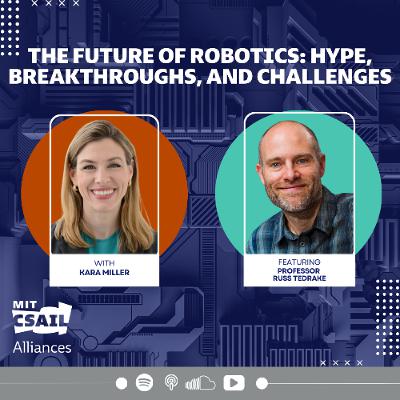
Host Kara Miller sits down with MIT Professor Russ Tedrake, a leading researcher in robotics and AI at CSAIL to explore the rapidly accelerating world of humanoid and intelligent robots.
Tedrake takes us behind the scenes of the robotics revolution—from the cultural resistance and skepticism, to the moment everything shifted. Today, major tech leaders are declaring humanoid robots “the biggest product in human history.” But is that true? Is it hype, or are we on the edge of a real technological turning point?
Topics Include:
01:00 - The Ramp Up of Robots
03:00 - Where Will We See Robots?
07:44 - Will Robots Replace Humans Soon?
13:02 - Robots Entering the Workforce
15:32 - Robots and Low Birth Rates
20:06 - Robots and Humans Working in the Same Space
24:57 - AI Changed the Trajectory of Robots
26:42 - The Barriers of a Personal Robot
31:37 - The Relationship between Academia and Companies
35:37 - Will You Have a Robot in the Home in Five Years?
They explore why COVID fundamentally changed how the world views automation and robotics, and dive into the hardest technical challenges in robotics, revealing why the real world is nothing like chess or chatbots. We talk about how AI, control theory, and physical dynamics must work together to create true intelligence, and discuss why humanoid robots may soon become as common and transformative as smartphones. Finally, we examine the growing gap between digital intelligence and embodied intelligence in the physical world, and what it will take to bridge it.
Episodes, listener discounts, meet the host, and more can be found here: https://csail.mit.edu/podcast
Connect with CSAIL Alliances:
On our site: cap.csail.mit.edu/about-us/meet-our-team
On LinkedIn: linkedin.com/company/mit-csail
#Robotics #ArtificialIntelligence #HumanoidRobots #FutureOfWork #AIInnovation #TechPodcast #MachineLearning #Automatio

In this episode of MIT CSAIL Alliances, host Kara Miller sits down with Professor Manya Ghobadi, a researcher and entrepreneur bridging the gap between academia and industry. Ghobadi, who has worked at Microsoft Research, Google, and now leads her own startup Systalyze, explores why so many companies struggle to efficiently deploy AI — and how her team is creating the “AI doctor” enterprises didn’t know they needed.
From hospitals sitting on mountains of private data to banks seeking smarter fraud detection, Ghobadi explains how better infrastructure and smarter tools can finally unlock AI’s full potential. Tune in for an inside look at how innovation moves from lab to launchpad — and what it takes to make AI work in the real world.
Topics Include:
00:07 - Origins of Systalze
01:40 - AI systems are difficult to build
02:53 - Systalyze is like an AI doctor
03:38 - How AI can transform the health care industry
04:41 - When companies unlock their AI potential
05:13 - Academia as an enterprenuer
Episodes, listener discounts, meet the host, and more can be found here: csail.mit.edu/podcast
Connect with CSAIL Alliances:
On our site: cap.csail.mit.edu/about-us/meet-our-team
On LinkedIn: linkedin.com/company/mit-csail
#MITCSAIL #AI #Education #MIT #GenerativeAI #Leadership #Technology #csailpodcast
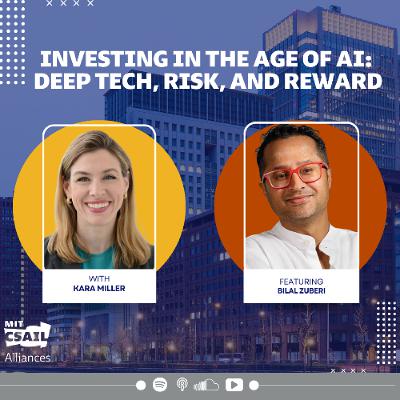
How will AI reshape the future of deep tech, industry, and investment?
In this episode of the MIT CSAIL Alliances Podcast, host Kara Miller speaks with Bilal Zuberi, founder and managing partner of Red Glass Capital. A longtime venture capitalist, Zuberi explains why AI isn’t just changing apps and SaaS tools—it’s unlocking massive sectors like manufacturing, healthcare, energy, and defense. He shares why he sees AI as the new “cost of intelligence,” what deep tech really means, and how breakthrough innovations could create trillions of dollars in value while tackling humanity’s toughest challenges, from climate change to healthcare.
Tune in for a conversation on the future of innovation, the shifting role of academia, and why Zuberi believes we’re moving from being AI consumers to becoming AI creators.
Topics Include:
02:39 - Introduction to Bilal Zuberi
04:43 - What is Deep Tech?
06:16 - Using technology to solve important problems
10:45 - AI granting access to old dreams and new jobs
12:56 - How helpful is AI as a tool?
14:52 - How AI is changing the world
19:04 - Academia’s role in AI
26:09 - The value of venture capital
30:12 - How AI will influences jobs
33:46 - What will be mainstream in five years?
36:13 - Outro
Episodes, listener discounts, meet the host, and more can be found here: https://csail.mit.edu/podcast
For Danny Weitzner’s episode:
https://soundcloud.com/csail-alliances/how-companies-can-rebuild-trust-around-data-with-danny-weitzner
Connect with CSAIL Alliances:
On our site: cap.csail.mit.edu/about-us/meet-our-team
On LinkedIn: linkedin.com/company/mit-csail
#MITCSAIL #AI #Education #MIT #GenerativeAI #Leadership #Technology #csailpodcast
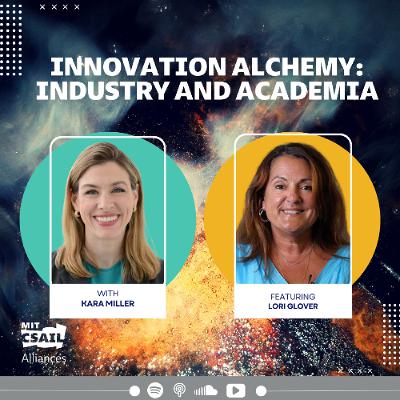
From sports drinks to self-driving cars, some of the most transformative innovations have emerged when universities and businesses join forces. In this episode, host Kara Miller talks with Lori Glover, author of Innovation Alchemy and Managing Director of Global Strategic Alliances at MIT CSAIL, about the surprising ways academic research and industry collaboration shape technology, talent, and the global economy.
Together, they explore stories from the invention of Gatorade to modern AI research, the challenges of aligning two very different cultures, and how partnerships can spark unexpected breakthroughs, sometimes changing entire industries.
Whether you’re curious about how new ideas move from the lab to the marketplace or want to learn why companies and universities need each other more than ever, this episode offers a deep look into the evolving innovation ecosystem at the juncture of academia and industry.
Episodes, listener discounts, meet the host, and more can be found here: https://csail.mit.edu/podcast
Connect with CSAIL Alliances:
On our site: cap.csail.mit.edu/about-us/meet-our-team
On LinkedIn: linkedin.com/company/mit-csail
#MITCSAIL #AI #Education #MIT #GenerativeAI #Leadership #Technology #csailpodcast
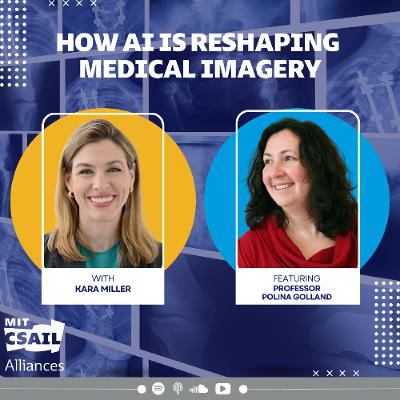
AI is transforming radiology, but not at the expense of skilled technicians. In the same way that personal computers and spreadsheets didn’t eliminate accountants, AI is not going to replace radiologists but will instead transform the way they work.
MIT CSAIL Professor Polina Golland’s research sits at the intersection of machine learning and healthcare, specifically medical imaging. In this episode, she discusses her team’s groundbreaking work on algorithms that analyze subtle patterns in x-rays, helping detect diseases earlier and understand them more deeply.
This conversation covers:
2:00 - How do doctors diagnose heart failure?
5:27 - Converting medical imagery to numbers
8:20 - Code generation for radiologists
9:25 - Weaknesses in the medical system that computing can strengthen
16:48 - The choreography of treating a patient
20:31 - Turning an algorithm into a product
24:26 - Will radiologists be replaced by AI?
30:21 - How will AI change medical imagery?
Connect with CSAIL Alliances:
On our site: cap.csail.mit.edu/about-us/meet-our-team
On LinkedIn: linkedin.com/company/mit-csail #MITCSAIL #AI #GenerativeAI #Leadership #Technology #CSAILPodcast
In this special crossover episode, we're bringing you a conversation from our friends at Me, Myself, and AI, a podcast by MIT Sloan Management Review and Boston Consulting Group.
Walter Sun, Senior VP and Global Head of AI at SAP, joins hosts Shervin Khodabandeh and Sam Ransbotham for a deep dive into how SAP is deploying AI at scale across its platforms, from building a generative AI hub with access to over 30 large language models to developing specialized AI agents that reduce hallucinations.
You’ll hear insights into:
The real-world use of small vs. large language models
How SAP is empowering employees through “AI Days”
What AI agents can teach us about specialization and collaboration
How to avoid hallucinations with fine-tuned, task-specific agents
Building trust and transparency into enterprise AI systems
Whether you're an AI enthusiast, enterprise leader, or just curious about how cutting-edge AI is transforming business, hear how AI is shaping industry strategy and transforming the market.
For more episodes from Me, Myself, and AI: https://sloanreview.mit.edu/audio-series/me-myself-and-ai/
Connect with CSAIL Alliances:
On our site: https://cap.csail.mit.edu/
On LinkedIn: https://www.linkedin.com/company/mit-csail/
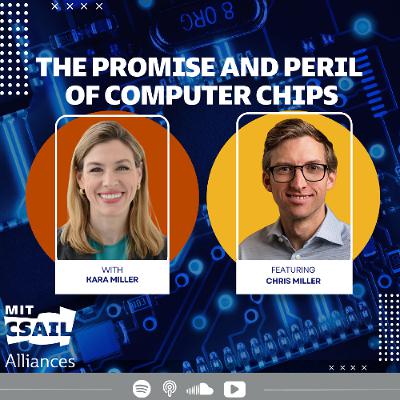
Chris Miller, Tufts Professor and author, explains how semiconductors—those tiny chips inside your phone, car, and coffee maker—have become the most critical technology in the world. Today’s global economy, military power, and AI breakthroughs all hinge on who makes the chips and where.
In this episode, Dr. Miller explores how the chip industry evolved from independent manufacturing giants to specialized global supply chains and why that’s both a strength and a vulnerability. He breaks down the growing competition between the U.S. and China, the geopolitical risk of relying on Taiwan, and why the future of AI depends not just on better software but on smarter, faster hardware.
💡 Topics Covered:
Why semiconductors are the backbone of modern technology
The shift from integrated chip companies to design vs. manufacturing specialization
How legacy companies like Intel lost ground and what it means for the U.S.
The U.S./China tech rivalry and supply chain vulnerabilities
AI’s explosive growth and the chip race driving it
The surprising role of immigration in America’s tech dominance
Why even automakers and retailers are becoming chip-aware
Learn more in Dr. Miller’s book, Chip War: The Fight for the World's Most Critical Technology: https://www.christophermiller.net/books
Connect with CSAIL Alliances:
On our site: https://cap.csail.mit.edu/about-us/meet-our-team
On LinkedIn: https://linkedin.com/company/mit-csail #MITCSAIL #AI #GenerativeAI #Leadership #Technology #CSAILPodcast
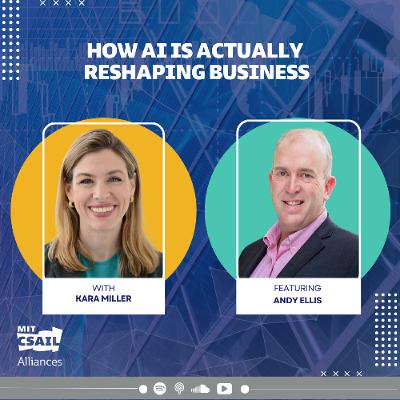
Cybersecurity expert and venture capitalist Andy Ellis breaks down why the smartest organizations are using AI to augment their workers, not replace them. Today’s AI systems are best used when they serve as “semi-pro” tools—fast, scalable, surprisingly effective, but still guided by some human oversight. In this conversation, he shares cautionary tales about hallucinations, prompt injections, unintended consequences, and outlines the common pitfalls he already sees companies falling into.
You’ll hear:
- How to minimize resistance and bring the workforce onboard when deploying AI tools.
- Why AI agents should be limited in scope and the advantage of stacking specialized agents which, acting together, enhance productivity and capacity.
- Why AI is good for generating content for specific purposes but not good at creating writing, art, or materials which will have lasting impact.
- How productivity “nag bots” can help workers get more done.
Ellis sees this moment as the next SaaS-level transformation, arguing that the winners of today’s AI arms race will become the trillionaires of tomorrow. Fundamentally, he believes the best way to implement this transformative new technology is to let humans decide and the AIs act.
Connect with CSAIL Alliances:
On our site: cap.csail.mit.edu/about-us/meet-our-team
On X: x.com/csail_alliances
On LinkedIn: linkedin.com/company/mit-csail
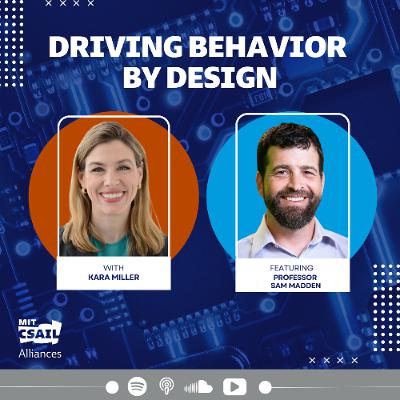
Can your phone make you a safer driver? Or is it part of the problem?
MIT CSAIL Professor Sam Madden shares the origin story of Cambridge Mobile Telematics, a CSAIL spinout using smartphones and AI to prevent car crashes and save lives. In this episode, Professor Madden joins host Kara Miller to explore how accelerometers, algorithms, and well-timed incentives are transforming how we understand and improve driver behavior.
Professor Madden reflects on surprising data trends, like why crash rates haven’t fallen despite better car tech, and how the ubiquitous smartphone became a key tool for reducing risk on the road. He also dives into how generative AI is reshaping software development, what it means for education and programming skills, and why trust and privacy remain top concerns when deploying AI across sensitive industries.
Covering distracted driving, autonomous vehicles, behavioral nudges, and business infrastructure, Professor Madden reveals what’s working and where the road ahead leads.
Topics include:
The history of Cambridge Mobile Telematics
The realities of traffic accidents
How your phone can track your driving safety
Turning your data into a narrative
The corrosive effects of phones
Learn more about Professor Madden on his website: https://db.csail.mit.edu/madden/
Or his CSAIL page: https://www.csail.mit.edu/person/sam-madden
Read our case study on Cambridge Mobile Telematics: https://cap.csail.mit.edu/sites/default/files/2023-05/CMT_Case%20Study%20Template_2022.pdf
Connect with CSAIL Alliances:
On our site: https://cap.csail.mit.edu/about-us/meet-our-team
On X: https://x.com/csail_alliances
On LinkedIn: https://linkedin.com/company/mit-csail
Finches, zebras, Darwin... and AI? 🧠🌍
Two centuries after Darwin explored the Galápagos, artificial intelligence is transforming how we study and protect the natural world, rapidly expanding what’s possible in biodiversity and ecology research. In this episode, MIT CSAIL Assistant Professor Sara Beery explains how AI is unlocking new possibilities in conservation, from identifying endangered species to analyzing ecosystem health at scale. AI can help biologists collect, process, and interpret enormous volumes of data, unlocking patterns and offering insights that were simply not possible without modern technology.
Beery shares her journey, from tagging snow leopards in college to leading global research at the intersection of computer vision and ecology. But she sounds a note of caution: AI has no values of its own and must be paired with human values to tackle the complex tradeoffs behind biodiversity decisions. As these tools become more powerful, it’s up to us to decide how they’re used, and what (or who) we prioritize.
🎧 Topics include:
Using AI to analyze millions of wildlife images
Why computer vision is revolutionizing species identification
The ethical dilemmas behind conservation decisions
How researchers are using AI to inform policy and protect ecosystems
🔗Learn more about Professor Beery:
🌐 Website: https://beerys.github.io/ or her CSAIL page https://www.csail.mit.edu/person/sara-beery
Connect with CSAIL Alliances:
On our site: https://cap.csail.mit.edu/about-us/meet-our-team
On X: https://x.com/csail_alliances
On LinkedIn: https://linkedin.com/company/mit-csail
#MITCSAIL #AI #Conservation #Biology #Technology #CSAILPodcast
What happens when every company becomes a tech company—and the geeks take the wheel?
Renowned economist, bestselling author, and MIT Principal Research Scientist Andrew McAfee unpacks how AI is transforming corporate strategy—from cement makers to software engineers. Drawing on insights from his book The Geek Way and his startup Workhelix, McAfee shares what he’s hearing from executives around the world, where AI is delivering real ROI, and why understanding how we measure impact is just as important as what we measure.
From call centers to material science labs, from spreadsheet power users to the future of education, McAfee examines how generative AI is changing who wins—and how people can avoid getting left behind. He also weighs in on the biggest AI misconceptions, the risks that actually matter, and why Silicon Valley still holds the crown in the age of innovation.
Topics include:
The management playbook of the future
Real-world studies on AI’s impact in the workplace
Why AI helps some workers more than others
The “credibility revolution” in measuring ROI
What companies get wrong about scaling AI
Whether writing—and even coding—will still matter in 10 years
Andrew McAfee is the Co-Director of the IDE and a Principal Research Scientist at the MIT Sloan School of Management. His research investigates how information technology changes the way companies perform, organize themselves, and compete. He is a NYT bestselling author and writes a widely read blog, which is at times one of the 10,000 most popular in the world. Prior to joining MIT Sloan, McAfee was a professor at Harvard Business School.
Connect with CSAIL Alliances:
On our site: https://cap.csail.mit.edu/about-us/meet-our-team
On X: https://x.com/csail_alliances
On LinkedIn: https://linkedin.com/company/mit-csail
#MITCSAIL #AI #GenerativeAI #Leadership #Technology #CSAILPodcast

For a full, uncut video version of this show (shot in Professor Andreas' MIT CSAIL office!), watch here: https://www.youtube.com/watch?v=QBV5Bj_NnbA
MIT CSAIL Associate Professor Jacob Andreas walks listeners through how LLMs like ChatGPT evolved from academic curiosities to industry-disrupting technologies.
Reflecting on the transformations he has observed in AI research, Professor Andreas discusses how some ideas—like linking NLP research to cognitive science—have taken a backseat, while others—like the importance of large-scale training data—remain central.
He offers insights on AI use cases, the emergence of models like DeepSeek, and the critical role of human oversight in AI deployment. Acknowledging both the excitement and concerns surrounding AI, Professor Andreas believes that educators and industry alike face a challenge in keeping pace with the ‘moving target’ of AI progress.
Plus: learn how AI can be used to decode the language of sperm whales!
About the guest: Professor Andreas is an MIT EECS Associate Professor and CSAIL PI. Before joining MIT, he earned his PhD at Berkeley. His group's research focuses on three themes: building machine learning models that learn language in human-like ways, enabling the use of language as a general-purpose tool for building intelligent systems, and developing techniques for understanding machine learning models using language. His group envisions a future built around training, explaining, and interacting with intelligent systems for users of all the world's languages.
Learn more about Professor Jacob Andreas and his research here: https://www.mit.edu/~jda/
Want to know more about Professor Andreas' work on the language of sperm whales? Read here: https://news.mit.edu/2024/csail-ceti-explores-sperm-whale-alphabet-0507
MIT's CSAIL Alliances Podcast is your guide to how AI & computer science research impact how we live, work, play, and learn. Listener discounts, meet the host, and more: csail.mit.edu/podcast
The MIT CSAIL Alliances Podcast is collaborating with MIT Sloan’s Me, Myself, and AI podcast to share a special bonus episode this month.
Paul Romer once considered himself the most optimistic economist. He rightfully predicted that technology would blow up as an economic driver coming out of the inflation of the 1970s, but acknowledges he did not foresee the inequality that technology advances would lead to.
On this episode of the Me, Myself, and AI podcast, Paul shares his views on AI advances and their implications for society. Rather than pave the way for full automation, he is a proponent of keeping humans in the loop and believes that technology can be pointed in a direction for more meaningful and beneficial use, citing education as an area ripe to benefit from AI.
More about CSAIL Alliances and our podcasts: csail.mit.edu/podcast
For more episodes from Me, Myself, and AI: https://sloanreview.mit.edu/audio-series/me-myself-and-ai/

 2
2How AI will Change Your Job with MIT Economics Professor David Autor & The Potential of Self-Supervised Learning with CSAIL PhD Student Sharut Gupta
Host: Kara Miller
Part One: MIT Economics Professor David Autor says that AI is “not like a calculator where you just punch in the numbers and get the right answer. It's much harder to figure out how to be effective with it.” Offering unique insights into the future of work in an AI-powered world, Professor Autor explains his biggest worries, the greatest upside scenarios, and how he believes we should be approaching AI as a tool, and addresses how AI will impact jobs like nursing and skilled trades.
Studies and papers referenced in conversation:
AI and Product Innovation: https://aidantr.github.io/files/AI_innovation.p
AI and the Gender Gap: https://papers.ssrn.com/sol3/papers.cfm?abstract_id=4759218
Robotics and Nursing Homes:
https://www.nber.org/papers/w33116
Part Two: CSAIL PhD student Sharut Gutpa describes how self-supervised learning might bring about truly adaptable models which can respond to fast-changing environments, like consumer preferences.
CSAIL Alliances connects business and industry to the people and research of MIT's Computer Science and Artificial Intelligence Labs. Learn more about CSAIL Alliances here.
Each month, the CSAIL podcast features cutting-edge MIT and CSAIL experts discussing their current research, challenges and successes, as well as the potential impact of emerging tech. Learn more and listen to past episodes.
Connect with CSAIL Alliances:
On our site: https://cap.csail.mit.edu/about-us/meet-our-team
On X: x.com/csail_alliances
On LinkedIn: linkedIn.com/mit-CSAIL

Have we achieved Artificial General Intelligence? MIT CSAIL Professor Manolis Kellis argues yes. Computers can do nearly every intellectual task that humans are capable of and are rapidly tackling the physical tasks. What does this mean for the future of AI integration, regulation, and development? Hear Professor Kellis’ ideas about how businesses can incorporate LLMs (large language models) to minimize silos, why we shouldn’t put up too many guardrails on AI technology, and how human-AI collaboration can lead to broader societal benefit, including healthcare. Professor Kellis is working toward a future where AI transforms healthcare through a deeper understanding of our individual genetics and targeted treatment development.
Visit Professor Kellis’s website to learn more about his work on AI and computational biology: https://www.csail.mit.edu/person/manolis-kellis

Associate Professor Marzyeh Ghassemi discusses why, despite its tremendous potential for good, AI must be approached with caution, especially in high risk areas like healthcare. Biases in training data can perpetuate real-world inequalities, providers might rely too much on potentially faulty AI, and tools created for one demographic might not necessarily translate to a different population. However, considering the incredible potential of AI to tackle challenges in transformative ways, it’s worth approaching these considerations with rigorous academic insight. Learn more about her work here: https://www.csail.mit.edu/person/marzyeh-ghassemi

This month’s podcast is a double feature. First up, Associate Professor and Chief Health AI Officer at the University of California San Diego Karandeep Singh explains the reality of using artificial intelligence for medicine. Professor Singh extrapolates on what works, what doesn’t, and how some challenges are social rather than technical.
Plus, MIT CSAIL’s Assistant Professor Andreea Bobu explains how large language models are advancing the field of robotics. Thanks to LLMs, giving directions to robots might soon look more like a conversation, without the need for step-by-step commands.
You can learn more about CSAIL research and access a full transcript of this podcast at https://cap.csail.mit.edu/.
To learn about CSAIL's Professional Development Courses, including the upcoming Cybersecurity for Technical Leaders and Deploying AI courses, visit here: cap.csail.mit.edu/events-professional-programs. Podcast listeners save 10% on courses with code MITXPOD10.

Founding Director of the MIT Internet Policy Research Initiative CSAIL Senior Research Scientist Daniel Weitzner says a lack of visibility about how personal data is being used is leading to an erosion of customer trust. However, companies increasingly need to leverage data for analytic advantage, generative AI applications, and more. His research focuses on solutions which would empower consumers with visibility and control of their data, facilitating a future of accountability and trust. Hear more about his work here: https://www.csail.mit.edu/person/daniel-weitzner
Find out more about CSAIL Alliances, as well as a full transcript of this podcast, at: https://cap.csail.mit.edu/podcasts/how-companies-can-rebuild-trust-around-data-danny-weitzner?utm_source=alliancesmembers&utm_medium=pardot&utm_campaign=dannypod24
If you would like to learn more about CSAIL's Professional Development Courses, including the upcoming Driving Innovation with Generative AI, visit here: cap.csail.mit.edu/events-professional-programs. Podcast listeners save 10% on courses with code MITXPOD10.

Professor of Finance at the MIT Sloan School of Management and CSAIL Andrew Lo believes AI can help everyday consumers make important financial decisions by democratizing access to quality finance advice. His research aims to address the challenges of deploying AI in finance by, for example, answering questions around responsibility and engaging with financial advisors to make sure such tools are useful in the field. Professor Lo is the faculty director for the FintechAI@CSAIL research initiative.
Find out more about CSAIL Alliances, as well as a full transcript of this podcast, at https://cap.csail.mit.edu/podcasts/how-ai-can-help-financial-decision-making-andrew-lo
If you would like to learn more about CSAIL's Professional Development Courses, including the upcoming Driving Innovation with Generative AI, visit here: cap.csail.mit.edu/events-professional-programs. Podcast listeners save 10% on courses with code MITXPOD10.
Looking for another great podcast? MIT Sloan Management Review’s "Me, Myself, and AI," expert hosts and researchers talk with AI leaders from organizations like NASA, Upwork, Github, and Meta to explore how organizations achieve success with generative AI — and what challenges and ethical considerations they face along the way. Listen to Me, Myself, and AI wherever you stream podcasts. https://link.chtbl.com/pxsEZ4pf?sid=CSAIL

Princeton Professor Arvind Narayanan, author of "AI Snake Oil," sheds light on the stark contrast between the public perception and actual capabilities of AI. In this podcast, he explores the significant gap between the excitement surrounding AI and its current limitations. Find out more about CSAIL Alliances, as well as a full transcript of this podcast, at https://cap.csail.mit.edu/podcasts/current-state-ai-arvind-narayanan.
If you would like to learn more about CSAIL's Professional Development Courses, visit here: https://cap.csail.mit.edu/events-professional-programs. Podcast listeners save 10% on courses with code MITXPOD10.


Download from Google Play

Download from App Store
 United States
[url=https://iterasacucarti.com/]Terasa Cu Carti[/url]
Great article. Information about the adventure is very great. I really like this article.Terasa Cu Carti Destin la Rascruce.