


 Claim Ownership
Freakonomics Radio
Subscribed: 1,149,114Played: 16,851,949
Subscribe


© 2024 Dubner Productions and Stitcher
Description
Freakonomics co-author Stephen J. Dubner uncovers the hidden side of everything. Why is it safer to fly in an airplane than drive a car? How do we decide whom to marry? Why is the media so full of bad news? Also: things you never knew you wanted to know about wolves, bananas, pollution, search engines, and the quirks of human behavior.
To get every show in the Freakonomics Radio Network without ads and a monthly bonus episode of Freakonomics Radio, start a free trial for SiriusXM Podcasts+ on Apple Podcasts or by visiting siriusxm.com/podcastsplus.
To get every show in the Freakonomics Radio Network without ads and a monthly bonus episode of Freakonomics Radio, start a free trial for SiriusXM Podcasts+ on Apple Podcasts or by visiting siriusxm.com/podcastsplus.
879 Episodes
Reverse
 4
4Behavioral scientists have been exploring whether a psychological reset can lead to lasting change. In this update of a 2021 episode, we survey evidence from the London Underground, Major League Baseball, and New Year’s resolutions to look at accidental fresh starts, forced fresh starts, fresh starts that backfire — and the ones that succeed. SOURCES:Katy Milkman, professor at the Wharton School.Andy Byford, former commissioner of Transport for London.Ferdinand Rauch, economist at the University of St. Gallen.Hengchen Dai, professor at U.C.L.A.’s Anderson School of Management.Bob Tewksbury, former big-league pitcher. RESOURCES:“A Large-Scale Experiment on New Year’s Resolutions: Approach-Oriented Goals are More Successful than Avoidance-Oriented Goals,” by Martin Oscarsson, Per Carlbring, Gerhard Andersson, and Alexander Rozental (PLOS ONE, 2020).“A Double-Edged Sword: How and Why Resetting Performance Metrics Affects Motivation and Performance,” by Hengchen Dai (Organizational Behavior and Human Decision Processes, 2018).“The Benefits of Forced Experimentation: Striking Evidence from the London Underground Network,” by Shaun Larcom, Ferdinand Rauch, and Tim Willems (2017).“Framing the Future: The Risks of Pre-Commitment Nudges and Potential of Fresh Start Messaging,” by John Beshears, Hengchen Dai, Katherine L. Milkman, and Shlomo Benartzi (NBER, 2016).“The Fresh Start Effect: Temporal Landmarks Motivate Aspirational Behavior,” by Hengchen Dai, Katherine L. Milkman, and Jason Riis (Management Science, 2014).“Holding the Hunger Games Hostage at the Gym: An Evaluation of Temptation Bundling,” by Katherine L. Milkman, Julia A. Minson, and Kevin G. M. Volpp (Management Science, 2013).“The Resolution Solution: Longitudinal Examination of New Year’s Change Attempts,” by John C. Norcross and Dominic J.Vangarelli (Journal of Substance Abuse, 1989). EXTRAS:How to Change: The Science of Getting from Where You Are to Where You Want to Be, by Katy Milkman (2021). Hosted by Simplecast, an AdsWizz company. See pcm.adswizz.com for information about our collection and use of personal data for advertising.
A series of academic studies suggest that the wealthy are, to put it bluntly, selfish jerks. It’s an easy narrative to embrace — but is it true? As part of GiveDirectly’s “Pods Fight Poverty” campaign, we revisit a 2017 episode. SOURCES:Jim Andreoni, professor of economics at the University of California, San Diego.Nikos Nikiforakis, professor of economics at New York University in Abu Dhabi.Paul Piff, associate professor of psychology at the University of California, Irvine.Jan Stoop, associate professor of applied economics at the Erasmus School of Economics. RESOURCES:"Are the Rich More Selfish Than the Poor, or do They Just Have More Money? A Natural Field Experiment," by James Andreoni, Nikos Nikiforakis, and Jan Stoop (National Bureau of Economic Research, 2017)."Exploring the Psychology of Wealth, 'Pernicious' Effects of Economic Inequality," (PBS NewsHour, 2013)."Poverty Impedes Cognitive Function," by Anandi Mani, Sendhil Mullainathan, Eldar Shafir, and Jiaying Zhao (Science, 2013)."Higher Social Class Predicts Increased Unethical Behavior," by Paul Piff, Daniel Stancato, Stéphane Côté, Rodolfo Mendoza-Denton, and Dacher Keltner (PNAS, 2011)."Relative Earnings and Giving in a Real-Effort Experiment," by Nisvan Erkal, Lata Gangadharan, and Nikos Nikiforakis (American Economic Review, 2011)."Experimenter Demand Effects in Economic Experiments," by Daniel John Zizzo (Experimental Economics, 2009)."Impure Altruism and Donations to Public Goods: A Theory of Warm-Glow Giving," by James Andreoni (The Economic Journal, 1990)."Privately Provided Public Goods in a Large Economy: The Limits of Altruism," by James Andreoni (Journal of Public Economics, 1987)."A Positive Model of Private Charity and Public Transfers," by Russell Roberts (Journal of Political Economy, 1984).Pods Fight Poverty Campaign on Give Directly. EXTRAS:“How to Raise Money Without Killing a Kitten,” by Freakonomics Radio (2013). Hosted by Simplecast, an AdsWizz company. See pcm.adswizz.com for information about our collection and use of personal data for advertising.

All sorts of people have put their mark on Messiah, and it has been a hit for nearly 300 years. How can a single piece of music thrive in so many settings? You could say it’s because Handel really knew how to write a banger. (Part three of “Making Messiah.”) SOURCES:Charles King, political scientist at Georgetown University.Jane Glover, classical music scholar, conductor.Katharine Hogg, musicologist, head librarian at the Foundling Museum.Susannah Heschel, religion professor, chair of Jewish Studies at Dartmouth College.Mark Risinger, teacher at St. Bernard’s School.Michael Marissen, professor emeritus of music at Swarthmore College, author of Tainted Glory in Handel’s Messiah: The Unsettling History of the World’s Most Beloved Choral Work. RESOURCES:Every Valley: The Desperate Lives and Troubled Times That Made Handel’s Messiah, by Charles King (2024)."Why These Christmas Songs Could Only Be Written in America," by Eli Lake (The Free Press, 2024)."Reflections on Bernstein’s 1956 “Messiah,”" by Mark Risinger (Leonard Bernstein Office, 2022).Handel in London: The Making of a Genius, by Jane Glover (2018).Tainted Glory in Handel's Messiah: The Unsettling History of the World's Most Beloved Choral Work, by Michael Marissen (2014).“Handel’s Messiah,” performed by The London Symphony Orchestra (2007). EXTRAS:"Making Messiah," series by Freakonomics Radio (2025). Hosted by Simplecast, an AdsWizz company. See pcm.adswizz.com for information about our collection and use of personal data for advertising.
In the 18th century, Handel relied on royal patronage. Today, it’s donors like Gary Parr who keep the music playing. In this bonus episode of our “Making Messiah” series, Parr breaks down the economics of the New York Philharmonic. SOURCES:Gary Parr, senior managing director and on the management committee at Apollo, philanthropist. RESOURCES:"A Notoriously Jinxed Concert Hall Is Reborn, Again," by Michael Kimmelman (New York Times, 2022)."Apollo’s New Guy Is a Legend in Banking, a Novice in Buyouts," by Sonali Basak (Bloomberg, 2017).“Handel’s Messiah,” performed by The London Symphony Orchestra (2007)."Racial/Ethnic and Gender Diversity in the Orchestra Field," by James Doeser (League of American Orchestras).Parr Prize for Excellence in Teaching Shakespeare. EXTRAS:"Making Messiah," series by Freakonomics Radio (2025). Hosted by Simplecast, an AdsWizz company. See pcm.adswizz.com for information about our collection and use of personal data for advertising.
When he wrote Messiah (in 24 days), Handel was past his prime and nearly broke. One night in Dublin changed all that. (Part two of “Making Messiah.”) SOURCES:Charles King, political scientist at Georgetown University.Chris Scobie, curator of music, manuscripts, and archives at the British Library.Ellen Harris, musicologist and professor emeritus at MIT.Mark Risinger, teacher at St. Bernard's School.Philip Rushforth, organist and master of the choristers at the Chester Cathedral.Proinnsías Ó Duinn, conductor and music director of Our Lady's Choral Society. RESOURCES:Every Valley: The Desperate Lives and Troubled Times That Made Handel's Messiah, by Charles King (2024)."Arnaud du Sarrat and the international music trade in Halle and Leipzig c.1700," by Tomasz Górny (Early Music, 2023).George Frideric Handel: A Life with Friends, by Ellen Harris (2014).Handel (Composers Across Cultures), by Donald Burrows (2012)."Georg Händel (1622–97): The Barber-Surgeon Father of George Frideric Handel (1685–1759)," by Aileen Adams and B. Hofestädt (Journal Of Medical Biography, 2005).Handel's Messiah: A Celebration: A Richly Illustrated History of the Music and Its Eighteenth-Century Background, by Richard Luckett (1995).Handel's Messiah The Advent Calendar, podcast series. Hosted by Simplecast, an AdsWizz company. See pcm.adswizz.com for information about our collection and use of personal data for advertising.
Why does an 18th-century Christian oratorio lend such comfort to our own turbulent times? Stephen Dubner sets out for Dublin to tell the story of George Frideric Handel’s Messiah. (Part one of “Making Messiah.”) SOURCES:Charles King, political scientist at Georgetown University.Katrine Nyland Sørensen, Danish broadcaster, host of Handel's Messiah - The Advent Calendar.Mark Risinger, teacher at St. Bernard's School.Michael and Aileen Casey, Dublin conservationists.Proinnsías Ó Duinn, conductor and music director of Our Lady's Choral Society.Stuart Kinsella, tenor soloist and consort singer. RESOURCES:Every Valley: The Desperate Lives and Troubled Times That Made Handel's Messiah, by Charles King (2024)."Two Men Wrote ‘Messiah.’ You Know One of Them." by Charles King (New York Times, 2024)."On Fishamble Street, family lives among four centuries of relatives’ keepsakes," by Zuzia Whelan (Dublin Inquirer, 2018).Hallelujah: The Story of a Musical Genius & the City That Brought His Masterpiece, by Jonathan Bardon (2016).George Frideric Handel: A Life with Friends, by Ellen Harris (2014).Handel: The Man & His Music, by Jonathan Keates (2010)."Handel's Messiah," performed by The London Symphony Orchestra (2007).Handel's Messiah The Advent Calendar, podcast series. Hosted by Simplecast, an AdsWizz company. See pcm.adswizz.com for information about our collection and use of personal data for advertising.

Macy’s wants to recapture its glorious past. The author of the Wimpy Kid books wants to rebuild his dilapidated hometown. We just want to listen in. (Part two of a two-part series, first published in 2024) SOURCES:Mark Cohen, former professor and director of retail studies at Columbia Business School.Will Coss, vice president and executive producer of Macy’s Studios.Jeff Kinney, author, cartoonist, and owner of An Unlikely Story Bookstore and Café.Tony Spring, chairman and C.E.O. of Macy’s Inc. RESOURCES:"How Macy’s CEO Tony Spring Is Turning the Retailer Around," by Suzanne Kapner (The Wall Street Journal, 2025).“NBC Ready to Pay Triple to Gobble Up Thanksgiving Parade Broadcast Rights,” by Joe Flint (The Wall Street Journal, 2024).“How Macy’s Set Out to Conquer the Department Store Business — and Lost,” by Daphne Howland (Retail Dive, 2022).An Unlikely Story Bookstore and Café. EXTRAS:“Can the Macy’s Parade Save Macy’s?” series by Freakonomics Radio (2024). Hosted by Simplecast, an AdsWizz company. See pcm.adswizz.com for information about our collection and use of personal data for advertising.
The iconic department store calls the parade its “gift to the nation.” With 30 million TV viewers, it’s also a big moneymaker — at least we think it is: when it comes to parade economics, Macy’s is famously tight-lipped. In this 2024 episode, we try to loosen them up. (Part one of a two-part series.) SOURCES:John Cheney, carpenter at Macy’s Studios.Will Coss, vice president and executive producer of Macy’s Studios.Jeff Kinney, author, cartoonist, and owner of An Unlikely Story Bookstore and Café.Kevin Lynch, vice president of global helium at Messer.Jen Neal, executive vice president of live events and specials for NBCUniversal Entertainment.Tony Spring, chairman and C.E.O. of Macy’s Inc.Jessica Tisch, New York City police commissioner, former commissioner of the New York City Department of Sanitation.Dawn Tolson, executive director of Citywide Event Coordination and Management and the Street Activity Permit Office for the City of New York. RESOURCES:Macy’s: The Store. The Star. The Story., by Robert M. Grippo (2009).History of Macy’s of New York, 1853-1919: Chapters in the Evolution of the Department Store, by Ralph M. Hower (1943).Macy’s Thanksgiving Day Parade. EXTRAS:"Helium," by The Economics of Everyday Things (2024). Hosted by Simplecast, an AdsWizz company. See pcm.adswizz.com for information about our collection and use of personal data for advertising.
A Trump executive order is giving retail investors more access to private markets. Is that a golden opportunity — or fool’s gold? SOURCES:Elisabeth de Fontenay, professor of law at Duke University.Steven Kaplan, professor of entrepreneurship and finance at the University of Chicago. RESOURCES:"Democratizing Access to Alternative Assets for 401(k) Investors," (The White House, 2025)."The (Heterogeneous) Economic Effects of Private Equity Buyouts," by Steven J. Davis, John Haltiwanger, Kyle Handley, Ben Lipsius, Josh Lerner, and Javier Miranda (Management Science, 2025)."Risk-Adjusted Returns of Private Equity Funds: A New Approach," by Arthur G. Korteweg and Stefan Nagel (The Review of Financial Studies, 2025)."The Effects of Management Buyouts on Operating Performance and Value," by Steven Kaplan (Journal of Financial Economics, 1989). EXTRAS:"The Biden Policy That Trump Hasn't Touched," by Freakonomics Radio (2025)."Should Companies Be Owned by Their Workers?" by Freakonomics Radio (2024)."Do You Know Who Owns Your Vet?" by Freakonomics Radio (2023)."Are Private Equity Firms Plundering the U.S. Economy?" by Freakonomics Radio (2023). Hosted by Simplecast, an AdsWizz company. See pcm.adswizz.com for information about our collection and use of personal data for advertising.
Thoroughbred auction prices keep setting records. But tracks are closing, gambling revenues are falling, and the sport is increasingly reliant on subsidies. Is that the kind of long shot anybody wants? (Part three of a series, “The Horse Is Us.”) SOURCES:Anne Archer Hinkle, owner and director of Hinkle Farms.Cormac Breathnach, senior director of sales operations at Keeneland.Emily Plant, thoroughbred researcher and statistician, associate professor of marketing at the University of Montana.Mark Taylor, president of Taylor Made Farm.Marshall Gramm, horse player, professor of economics at Rhodes College in Memphis, Tennessee.Richard Migliore, head racing analyst for Fox Sports and New York Racing Association, retired jockey.Sean Feld, bloodstock agent.Scott Heider, managing principal of Chartwell Capital, thoroughbred investor.Thomas Lambert, economist at the University of Louisville. RESOURCES:Death of a Racehorse: An American Story, by Katie Bo Lillis (2025)."State of the States 2025: The AGA Analysis of the Commercial Casino Industry," (American Gaming Association, 2025)."An Empirical Analysis of Reputation Effects and Network Centrality in a Multi-Agency Context," by Emily Plant (University of Kentucky, 2010).Calculated Bets: Computers, Gambling, and Mathematical Modeling to Win (Outlooks), by Steven Skiena (2001).Bill Oppenheim and Emily Plant's Thoroughbred Market Reports.Horseracing Integrity and Safety Authority. Hosted by Simplecast, an AdsWizz company. See pcm.adswizz.com for information about our collection and use of personal data for advertising.
The world has changed a good bit since Freakonomics was first published. In this live anniversary episode, Stephen Dubner tells Geoff Bennett of PBS NewsHour everything he has learned since then. Happy birthday, Freakonomics. SOURCES:Geoff Bennett, co-anchor and co-managing editor of PBS News Hour. RESOURCES:Freakonomics Twentieth Anniversary Edition: A Rogue Economist Explores the Hidden Side of Everything, by Stephen Dubner and Steve Levitt (2025). Hosted by Simplecast, an AdsWizz company. See pcm.adswizz.com for information about our collection and use of personal data for advertising.
How does Kentucky keep itself atop the thoroughbred industry? Is a champion stallion really worth $200,000 per date? And how many hands can one jockey have? (Part two of a series, “The Horse Is Us.”) SOURCES:Emily Plant, thoroughbred researcher and statistician.Jill Stowe, professor of economics at the University of Kentucky.Mark Taylor, president of Taylor Made Farm.Oscar Gonzales, vice chair of the California Horse Racing Board.Richard Migliore, head racing analyst for Fox Sports and New York Racing Association, retired jockey. RESOURCES:"Horse racing industry braces for crackdown on illegal immigration," by Ximena Bustillo (NPR, 2025)."Conceptualizing the Kentucky Horse Industry as an Economic Cluster," by Lori Garkovich (Bluegrass Equine Digest, 2009). Hosted by Simplecast, an AdsWizz company. See pcm.adswizz.com for information about our collection and use of personal data for advertising.
For most of human history, horsepower made the world go. Then came the machines. So why are there still seven million horses in America? (Part one of a series, “The Horse Is Us.”) SOURCES:Ann N. Greene, historian of 19th century America, retired professor at the University of Pennsylvania.Constance Hunter, chief economist at the Economist Intelligence Unit.Elizabeth Bortuzzo, professional horse rider.Mark Paul, professor of economics at Rutgers University.Peter Frankopan, professor of global history at Oxford History. RESOURCES:"2023 Economic Impact Study of the U.S. Horse Industry," (American Horse Council Foundation, 2024).Riding to Arms, by Charles Caramello (2022).The Horse in the City, by Clay McShane and Joel Tarr (2011).Horses at Work, by Ann Norton Greene (2008). Hosted by Simplecast, an AdsWizz company. See pcm.adswizz.com for information about our collection and use of personal data for advertising.
Spotify, Oracle, and Comcast have each recently announced they’re going with co-C.E.O.s. In this 2023 episode, we dig into the research and hear firsthand stories of triumph and disaster. Also: lessons from computer programmers, Simon and Garfunkel, and bears versus alligators. SOURCES:Jim Balsillie, retired chairman and co-C.E.O. of Research In Motion.Mike Cannon-Brookes, co-founder and C.E.O. of Atlassian.Scott Farquhar, co-founder and former co-C.E.O. of Atlassian.Marc Feigen, C.E.O. advisor.Jeffrey Sonnenfeld, professor of management studies and senior associate dean at the Yale School of Management and founding president of the Chief Executive Leadership Institute.Laurie Williams, professor of computer science at North Carolina State University. RESOURCES:"Scott Farquhar to resign as joint CEO of Atlassian," by Jonathan Barrett (The Guardian, 2024)."Is It Time to Consider Co-C.E.O.s?" by Marc A. Feigen, Michael Jenkins, and Anton Warendh (Harvard Business Review, 2022)."The Costs and Benefits of Pair Programming," by Alistair Cockburn and Laurie Williams (2000)."Strengthening the Case for Pair Programming," by Laurie Williams, Robert R. Kessler, Ward Cunningham, and Ron Jeffries (IEEE Software, 2000). EXTRAS:"The Secret Life of a C.E.O.," series by Freakonomics Radio (2018). Hosted by Simplecast, an AdsWizz company. See pcm.adswizz.com for information about our collection and use of personal data for advertising.
The U.S. has a physician shortage, created in part by a century-old reform that shut down bad medical schools. But why haven’t we filled the gap? Why are some physicians so unhappy? And which is worse: a bad doctor or no doctor at all? SOURCES:Karen Clay, professor of economics and public policy at Carnegie Mellon University.Rochelle Walensky, physician-scientist and former director of the CDC. RESOURCES:"Medical School Closures, Market Adjustment, and Mortality in the Flexner Report Era," by Karen Clay, Grant Miller, Margarita Portnykh, and Ethan Schmick (National Bureau of Economic Research, 2025)."Application Overload — A Call to Reduce the Burden of Applying to Medical School," by Rochelle Walensky and Loren Walensky (New England Journal of Medicine, 2025)."Challenges to the Future of a Robust Physician Workforce in the United States," by Rochelle Walensky and Nicole McCann (New England Journal of Medicine, 2025)."The first step to addressing the physician shortage," by Rochelle Walensky and Nicole McCann (STAT, 2025)."Physician Workforce: Projections, 2022-2037," (National Center for Health Workforce Analysis, 2024).“Projected Estimates of African American Medical Graduates of Closed Historically Black Medical Schools,” by Kendall Campbell, Irma Corral, Jhojana Infante Linares, and Dmitry Tumin (JAMA Network, 2020)."Medical Education in the United States and Canada," by Abraham Flexner (The Carnegie Foundation for the Advancement of Teaching, 1910). EXTRAS:"Is the Air Traffic Control System Broken?" series by Freakonomics Radio (2025)."Are You Ready for the Elder Swell?" by Freakonomics Radio (2025)."Are Private Equity Firms Plundering the U.S. Economy?" by Freakonomics Radio (2023). Hosted by Simplecast, an AdsWizz company. See pcm.adswizz.com for information about our collection and use of personal data for advertising.
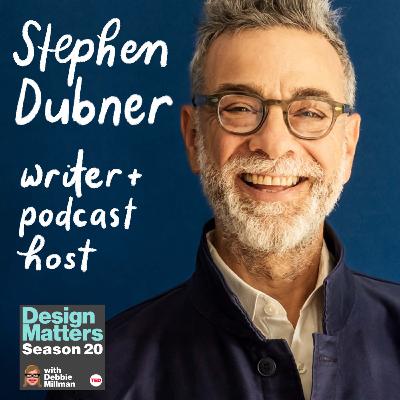
For the 20th anniversary of Freakonomics, Debbie Millman of Design Matters interviews Stephen Dubner about his upbringing, his writing career, and why it's important to “swing your swing.” Plus: a sneak peek at a new project. SOURCES:Debbie Millman, writer and host of Design Matters with Debbie Millman. RESOURCES:"Stephen J. Dubner," by Design Matters with Debbie Millman (2025).Turbulent Souls: A Catholic Son's Return To His Jewish Family, by Stephen Dubner (1999)."Choosing My Religion," by Stephen Dubner (New York Times, 1996). EXTRAS:"In Search of the Real Adam Smith," by Freakonomics Radio (2022). Hosted by Simplecast, an AdsWizz company. See pcm.adswizz.com for information about our collection and use of personal data for advertising.
Arthur Brooks, an economist and former head of the American Enterprise Institute, believes that there is only one remedy for our political polarization: love. In this 2021 episode, we ask if Brooks is a fool for thinking this — and if perhaps you are his kind of fool? SOURCES:Arthur Brooks, professor of public and nonprofit leadership at Harvard University. RESOURCES:“Vital Statistics on Congress,” by Molly Reynolds and Naomi Maehr (Brookings Institute, 2024).Dopamine Nation: Finding Balance in the Age of Indulgence, by Anna Lembke (2021).“Reading Too Much Political News Is Bad for Your Well-Being,” by Arthur Brooks (The Atlantic, 2020).Love Your Enemies: How Decent People Can Save America from the Culture of Contempt, by Arthur Brooks (2019).“This 75-Year Harvard Study Found the 1 Secret to Leading a Fulfilling Life,” by Melanie Curtin (Inc., 2017).The Conservative Heart: How to Build a Fairer, Happier, and More Prosperous America, by Arthur Brooks (2015).“Grin and Bear It: The Influence of Manipulated Facial Expression on the Stress Response,” by Tara Kraft and Sarah Pressman (Psychological Science, 2012). EXTRAS:“Why Is U.S. Media So Negative?” by Freakonomics Radio (2021). Hosted by Simplecast, an AdsWizz company. See pcm.adswizz.com for information about our collection and use of personal data for advertising.
Soccer leagues around the world use a promotion-and-relegation system to reward the best teams and punish the worst. We ask whether American sports fans would enjoy a similar system. (Part two of a two-part series.) SOURCES:Domonique Foxworth, sports analyst and former N.F.L. player.Stefan Szymanski, professor of sport management at the University of Michigan.Victor Matheson, professor of economics at the College of the Holy Cross. RESOURCES:"'Root, root, root for the home team" did TV kill minor league baseball in the 1950s?" by Stefan Szymanski (University of Michigan, 2025)."European and North American Sports Differences (?): A Quarter Century on," by Stefan Szymanski (Principles and Paradoxes of Sports Economics, 2024).National Pastime: How Americans Play Baseball and the Rest of the World Plays Soccer, by Stefan Szymanski and Andrew Zimbalist (2006). EXTRAS:"When Is a Superstar Just Another Employee? (Update)," by Freakonomics Radio (2025)."The Longest Long Shot," by Freakonomics Radio (2016). Hosted by Simplecast, an AdsWizz company. See pcm.adswizz.com for information about our collection and use of personal data for advertising.
The N.F.L. is a powerful cartel with imperial desires. College football is about to undergo a financial reckoning. So maybe they should team up? (Part one of a two-part series.) SOURCES:DeMaurice Smith, former executive director of the National Football League Players Association.Domonique Foxworth, sports analyst and former N.F.L. player.Jeffrey Kessler, partner at the law firm of Winston & Strawn.Oliver Luck, sports executive and consultant.Victor Matheson, professor of economics at the College of the Holy Cross. RESOURCES:Turf Wars: The Fight for the Soul of America's Game, by DeMaurice Smith (2025)."Is there a Case for Subsidizing Sports Stadiums?" by Victor Matheson (Journal of Policy Analysis and Management, 2018). EXTRAS:"America’s Hidden Duopoly," by Freakonomics Radio (2018)."Should the U.S. Merge With Mexico?" by Freakonomics Radio (2014). Hosted by Simplecast, an AdsWizz company. See pcm.adswizz.com for information about our collection and use of personal data for advertising.
In this episode we first published in 2021, the political scientist Yuen Yuen Ang argues that different forms of government create different styles of corruption — and that the U.S. and China have more in common than we’d like to admit. SOURCES:Yuen Yuen Ang, professor of political science at Johns Hopkins University. RESOURCES:"China’s Anti-Graft Show Is Educational, With Unintended Lessons," by Li Yuan (The New York Times, 2022).China’s Gilded Age: The Paradox of Economic Boom and Vast Corruption, by Yuen Yuen Ang (2020)."A Fair Assessment of China’s IP Protection," by Shang-Jin Wei and Xinding Yu (Project Syndicate, 2019).The Bankers' New Clothes: What's Wrong with Banking and What to Do about It, by Anat Admati (2013)."A Fistful of Dollars: Lobbying and the Financial Crisis," by Deniz Igan, Prachi Mishra, and Thierry Tressel (2011). EXTRAS:"China Is Run by Engineers. America Is Run by Lawyers." by Freakonomics Radio (2025).American Culture series by Freakonomics Radio (2021). Hosted by Simplecast, an AdsWizz company. See pcm.adswizz.com for information about our collection and use of personal data for advertising.


Download from Google Play

Download from App Store
 United States
🎶
AirBnB has been terrible in most neighborhoods in my city. The company seems to not respond to complaints about badly behaving tourists and even false pictures of the place you are supposedly staying at. AirBnb is just interested in money and don't give a damn about the customer or the impact and disruption they cause in neighborhoods and the housing market. They assist people in bypassing the law and avoid safety regulations and even avoid taxes. It's just a step away from Silk Road
45:31 continued
🛫🛬
Everyone agrees that community is important it does not have to be religious. It could be a community of people who like to dress up like animals. I feel his " common good" idea sounds great, but he is very out of touch with the struggles of the people of this country. The US is too vast and different. Each community and state needs to address their needs individually. As long as there is more money in the problem, i.e., gambling addiction and sports betting and porn/sex, no change will occur.
Why do incense exist?
It is foolish and immoral to equate Gazan suffering with Israeli suffering. Gazans suffer because they would prefer to keep Israelis in torture dungeons forever rather than live in peace. Israelis suffer because Gazans refuse to leave them alone.
Eerrr, propaganda much? very disappointed in this episode, the alignment behind the scenes enabling the Genocide and then allowing to main enabler to make up nonsense. disgusting really.
I've been a long time listener of this podcast and reader of the books. this was absolutely the worst episode I've ever heard. so many lies were told. Anthony blinken is a war criminal
Great article post, keep sharing... https://www.meerapatil.com/
"Elder Swell"? oh, do better ffs!
#MATH
it has problem for playing
Oh, thank Christ, that music stopped 🤦🏻♂️
In Iran, we have one agent for both sides, and the commotion fee is .5 percent that the buyers and sellers divide it by half
I appreciate the highlighting of the high school/Broadway cycle - such truth about how each feeds the other and why.
Great podcast. https://sugardeferder.com
great episode i learned a lot Jessica's voice is like Bill Gates's thanks ❤️❤️
Fascinating to hear about how a piece of live theater is born.
I was waiting for Barbara Corcoran to jump into the commentary & say that high commissions are justified because moving a $10M penthouse suite in Manhattan is different from moving a $250k raised ranch in Des Moines. Realtors, for better or for worse, are only marginally comparable to travel agents: yes, they both do a ton of digital & physical paper legwork, but, with Realtors, their legwork also involves being a professional house-sitter for weeks while people traipse through so you can work.