


Math! Science! History!
Subscribed: 131Played: 2,978
Subscribe

© 2025
Description
Math! Science! History! is about the history of people, theories, and discoveries that have moved our scientific progress forward and spurred us on to unimaginable discoveries. Join Gabrielle Birchak for a little math, a little science, and a little history. All in a little bit of time.
176 Episodes
Reverse
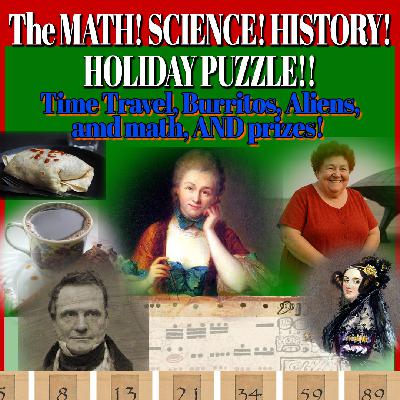
It's finally here. The annual math science history holiday puzzle. It's a long one but it is a fun one. When you solve it be sure to send all of your work, handwritten, and your answers too hello at math sciencehistory.com by midnight on December 16th. Be in the top three to get it in first and correct and you will have a chance to win some prizes. All of those in the top three can choose to be interviewed on the podcast to tell us all about their love for math, science and history! First place wins a $25 Amazon gift card and a choice of a Math! Science! History! baseball cap or our latest "Powered by Curiosity" t-shirt Second place wins a "Powered by Curiosity" t-shit Third place wins our newest computer sticker "Because Time Machines Don't Exist Yet!" You can find the transcripts at mathsciencehistory.com – just click on the link The Transcriptorium There, you will find the equations and explanations for each of the puzzles! 📚 To buy my book Hypatia: The Sum of Her Life on Amazon, visit https://a.co/d/g3OuP9h 🌍 Let's Connect!Bluesky: https://bsky.app/profile/mathsciencehistory.bsky.social Instagram: https://www.instagram.com/math.science.history Facebook: https://www.facebook.com/mathsciencehistory LinkedIn: https://www.linkedin.com/company/math-science-history/ Threads: https://www.threads.com/@math.science.history Mastodon: https://mathsciencehistory@mathstodon.xyz YouTube: Math! Science! History! - YouTube Pinterest: https://www.pinterest.com/mathsciencehistory 🎧 Enjoying the Podcast? ☕ Support the Show: Coffee!! PayPal Leave a review! It helps more people discover the show! Share this episode with friends & fellow history buffs! Subscribe on your favorite podcast platform Check out our merch: https://www.mathsciencehistory.com/the-store Music: All music is public domain and has no Copyright and no rights reserved. Selections from The Little Prince by Lloyd Rodgers Sci fi transition – Rescopic Sound – from Pixabay Futuristic atmo Hangar by Samuel F. Johanns from Pixabay Air transition Sound Effect by storegraphic from Pixabay The Stella Princess Can Dance Waltz Prince Edward the Twin by The-Vampires-Monster Soundtrack from Pixabay Whoosh Sound Effect by floraphonic from Pixabay Power Up Sparkle by floraphonic from Pixabay Ground Impact SFX by universefield from Pixabay Punch a rock SFX by LordSonny from Pixabay Bubble FX by Jurij from Pixabay Landing Spacecraft by Fronbondi_Skegs from Pixabay Until next time, carpe diem!
In this Flashcards Friday episode, we take the science of light bulbs out of the hardware aisle and into everyday life. Most people assume a bulb is just a bulb, but the truth is that the type you choose affects your energy bill, eye comfort, the way your rooms feel, and even the safety of your fixtures. From LEDs to incandescent filaments, from color temperature to socket fit, this episode breaks down the science behind the glow. You'll walk away with practical knowledge you can use immediately, all through the lens of curiosity and real-world physics. If you enjoy episodes that help you understand the science hidden in everyday objects, please leave a review, subscribe on your favorite platform, and share this episode with someone who's still trying to figure out why their lamp keeps flickering. Three Enlightening Takeaways The science behind the most common types of light bulbs - You'll explore how incandescent, halogen, CFL, and LED bulbs actually produce light, why some run hot while others stay cool, and what those differences mean for your home and energy use. Why color temperature matters more than most people realize - You'll learn how warm, neutral, and cool tones affect visibility, mood, and comfort, and how to choose the right color temperature for different rooms in your home. How to choose a bulb that safely fits your fixture - You'll understand why the right socket base, wattage rating, and fixture requirements matter, and how picking the correct bulb prevents overheating, flickering, or damaged lamps. Episode Resources Understanding LED vs. Incandescent Bulbs (Energy.gov) https://www.energy.gov/energysaver/lighting-choices-save-you-money Guide to Bulb Bases and Fixture Compatibility https://www.gelighting.com/inform/guide-light-bulb-sizes-types-shapes-and-codes Explore more on our website: mathsciencehistory.com To buy my book Hypatia: The Sum of Her Life on Amazon, visit https://a.co/d/g3OuP9h Let's Connect!Bluesky: https://bsky.app/profile/mathsciencehistory.bsky.social Instagram: https://www.instagram.com/math.science.history Facebook: https://www.facebook.com/mathsciencehistory LinkedIn: https://www.linkedin.com/company/math-science-history/ Threads: https://www.threads.com/@math.science.history Mastodon: https://mathsciencehistory@mathstodon.xyz YouTube: Math! Science! History! - YouTube Pinterest: https://www.pinterest.com/mathsciencehistory Do you want the ad-free podcast?! Visit us at Supercast at www.MathScienceHistory.Supercast.com - pick a tier, and immerse yourself without the ads! ☕ Support the Show: Coffee!! PayPal - https://www.paypal.com/ncp/payment/PR7F7ST49GDNA Leave a review! It helps more people discover the show! Share this episode with friends & fellow history buffs! Subscribe on your favorite podcast platform Check out our merch: https://www.mathsciencehistory.com/the-store Music: All music is public domain and has no Copyright and no rights reserved. Selections from The Little Prince by Lloyd Rodgers Until next time, carpe diem!
Step into a silent museum after closing hours, where moonlight washes over long corridors and the hum of unseen forces seems to guide your every step. In this immersive narrative puzzle episode, four historical artifacts awaken in the darkness to share their stories. Each object reveals a piece of a much larger scientific legacy, one that begins with ancient reverence for a thunderous waterfall and continues through centuries of experimentation, rivalry, and extraordinary imagination. By following the clues, listeners uncover the lineage of ideas that shaped the power system we depend on every day. The final answer emerges only after connecting the voices of the artifacts, the rhythm of innovation, and the history of electricity itself. Three Enlightening Moments: The scientific breakthroughs that paved the way for modern power systems - Listeners discover how early experiments in magnetism, induction, and natural energy set the foundation for the electricity that powers our lives today. The cultural and industrial significance of a legendary waterfall - The episode explores the Indigenous reverence for this natural wonder, its role in early milling and industry, and its eventual transformation into a symbol of scientific ambition. The story behind a historic rivalry that shaped the future of electricity - Listeners learn how competing visions for electrical power sparked debate, innovation, and ultimately the system we use today. Resources: History of the Legendary Waterfall https://www.nps.gov/nifa/index.htm Haudenosaunee Confederacy & Indigenous Histories https://www.haudenosauneeconfederacy.com General Overview of Early Electrical Inventions https://www.britannica.com/science/electricity 🔗 Explore more on our website: mathsciencehistory.com 📚 To buy my book Hypatia: The Sum of Her Life on Amazon, visit https://a.co/d/g3OuP9h 🌍 Let's Connect!Bluesky: https://bsky.app/profile/mathsciencehistory.bsky.social Instagram: https://www.instagram.com/math.science.history Facebook: https://www.facebook.com/mathsciencehistory LinkedIn: https://www.linkedin.com/company/math-science-history/ Threads: https://www.threads.com/@math.science.history Mastodon: https://mathsciencehistory@mathstodon.xyz YouTube: Math! Science! History! - YouTube Pinterest: https://www.pinterest.com/mathsciencehistory 🎧 Enjoying the Podcast? ☕ Support the Show: Coffee!! PayPal Leave a review! It helps more people discover the show! Share this episode with friends & fellow history buffs! Subscribe on your favorite podcast platform Check out our merch: https://www.mathsciencehistory.com/the-store Music: All music and SFX are public domain and have no Copyright and no rights reserved. Selections from The Little Prince by Lloyd RodgersHowling wind Effect by Darina Evstafeva from Pixabay Heartbeat by Dragon Studio from Pixabay Waterfall by John Tramp from Pixabay Until next time, carpe diem!

Your nose is more powerful than you think. In this episode of Math! Science! History!, we explore the hidden biology behind your sense of smell, how it connects directly to memory and emotion, and why scent has shaped human evolution for more than 500 million years. From safety and attraction to learning and emotional balance, your olfactory system is a biological superpower hiding in plain sight. THREE INSIGHTS THAT PASS THE SNIFF TEST Why Smell Is the Fastest Path to Emotion - Smell bypasses the thalamus and goes straight to the limbic system, which explains instant emotional memories triggered by scent. How Humans Detect Over a Trillion Odors - With about 400 types of receptors combining in complex patterns, your nose functions like a biological symphony conductor. How Scent Improves Memory, Focus & Emotional Well-Being - From cognitive scent-pairing to olfactory training, smell can sharpen memory, improve concentration, and reinforce emotional grounding 🔗 Explore more on our website: mathsciencehistory.com Do you want the ad-free podcast?! Visit us at Supercast at www.MathScienceHistory.Supercast.com - pick a tier, and immerse yourself without the ads! LINKS TO RESOURCES Scientific References (from episode): • Axel & Buck (1995): https://doi.org/10.1038/scientificamerican1095-154 • Buck (2000): https://doi.org/10.1016/S0092-8674(00)80698-4 • Bushdid et al. (2014): https://doi.org/10.1126/science.1249168 • Herz & Engen (1996): https://doi.org/10.3758/BF03210754 • Hummel et al. (2009): https://doi.org/10.1002/lary.20101 • Larson et al. (2007): https://doi.org/10.1016/j.brainres.2007.03.064 • Moss et al. (2003): https://doi.org/10.1080/00207450390161903 • Stevenson (2010): https://doi.org/10.1093/chemse/bjp083 • Wysocki & Beauchamp (1984): https://doi.org/10.1073/pnas.81.15.4899 Further Reading: • The Scent of Desire — Rachel Herz • What the Nose Knows — Avery Gilbert • Harvard Gazette — "Why Smell Triggers Powerful Memories" • American Academy of Otolaryngology — https://www.entnet.org 🌍 Let's Connect!Bluesky: https://bsky.app/profile/mathsciencehistory.bsky.social Instagram: https://www.instagram.com/math.science.history Facebook: https://www.facebook.com/mathsciencehistory LinkedIn: https://www.linkedin.com/company/math-science-history/ Threads: https://www.threads.com/@math.science.history Mastodon: https://mathsciencehistory@mathstodon.xyz YouTube: Math! Science! History! - YouTube Pinterest: https://www.pinterest.com/mathsciencehistory 🎧 Enjoying the Podcast? ☕ Support the Show: Coffee!! PayPal Leave a review! It helps more people discover the show! Share this episode with friends & fellow history buffs! Subscribe on your favorite podcast platform Check out our merch: https://www.mathsciencehistory.com/the-store Music: All music is public domain and has no Copyright and no rights reserved. Selections from The Little Prince by Lloyd Rodgers Until next time, carpe diem!

 1
1In this episode of Math! Science! History!, I explore the extraordinary life and legacy of Carl Friedrich Gauss, often called the Prince of Mathematics. From a childhood marked by brilliance to contributions that underpin GPS, machine learning, astronomy, electromagnetism, and modern geometry, Gauss reshaped the scientific world with humility and unwavering precision. You'll learn where the myths end, where the history begins, and why Gauss's work remains foundational in virtually every field touched by numbers today. A Trio of Gaussian Insights The Myth and the Mind Behind the Child Prodigy - Why the famous "1 to 100" story is partly folklore. But it still reveals Gauss's unbelievable early intuition. How Gauss Found a Lost Planet - A clear explanation of his orbit-reconstruction breakthrough that forever changed astronomy. The Mathematical Tools That Power Today's Technology - From least squares to the Gaussian curve, learn how his ideas fuel GPS, machine learning, physics, and more. 📚 Resources & References · Bell, Eric Temple. Men of Mathematics. New York: Simon & Schuster, 1937. · Dunnington, G. Waldo. Gauss: Titan of Science. New York: Mathematical Association of America, 2004. · Gauss, Carl Friedrich. Disquisitiones Arithmeticae. Trans. Arthur A. Clarke. Yale University Press, 1966. · Kline, Morris. Mathematical Thought from Ancient to Modern Times. Oxford University Press, 1972. · Kurtz, David C. "Gauss' Determination of the Orbit of Ceres." Archive for History of Exact Sciences 30, no. 3 (1984): 231–244. · Schär, Bernhard. "Carl Friedrich Gauss and the First Electromagnetic Telegraph." Isis 102, no. 3 (2011): 501–524. · Schneider, Carl. "Carl Friedrich Gauss." In Dictionary of Scientific Biography, vol. 5. New York: Scribner's, 1972. · Teets, Donald, and Karen Whitehead. "The Discovery of Ceres: How Gauss Became Famous." Mathematics Magazine 72, no. 2 (1999): 83–93. VISIT US!! mathsciencehistory.com 📚 To buy my book Hypatia: The Sum of Her Life on Amazon, visit https://a.co/d/g3OuP9h 🌍 Let's Connect!Bluesky: https://bsky.app/profile/mathsciencehistory.bsky.social Instagram: https://www.instagram.com/math.science.history Facebook: https://www.facebook.com/mathsciencehistory LinkedIn: https://www.linkedin.com/company/math-science-history/ Threads: https://www.threads.com/@math.science.history Mastodon: https://mathsciencehistory@mathstodon.xyz YouTube: Math! Science! History! - YouTube Pinterest: https://www.pinterest.com/mathsciencehistory ☕ Support the Show: Coffee!! PayPal Leave a review! It helps more people discover the show! Share this episode with friends & fellow history buffs! Subscribe on your favorite podcast platform Music: All music is public domain 0.0 or 1.0 and has no Copyright and no rights reserved. Selections from The Little Prince by Lloyd Rodgers, Mirecourt Trio composed by Lloyd Rodgers CC1.0 From Page to Practice by Bryan Teoh from Pixabay Smooth Piano by Universefield from Pixabay Serene Sonnet by Oleksii Holubiev from Pixabay Until next time, carpe diem!
If you enjoy learning how chemistry, math, and history shape everyday life, follow Math! Science! History! and share this episode with someone still blaming the turkey! Why does tryptophan always get accused of making everyone sleepy after Thanksgiving? Today's Flashcards Friday takes a closer look at the real science behind this famous amino acid , including how it works in the body, why carbohydrates change everything, and how tryptophan connects to your mood and even your sense of gratitude. Whether your plate had turkey or tofu, this tiny molecule has a much bigger story to tell. Three Things You'll Learn in This Episode: The Tryptophan Edition How tryptophan actually enters the brain and why the carb-insulin ratio determines whether it succeeds. Why vegetarian foods often contain more tryptophan than turkey, and how plant-based meals create the same post-meal calm. How serotonin and tryptophan connect to emotional resilience and gratitude, especially after warm, shared meals. 🔗 Explore more on our website: mathsciencehistory.com 📚 To buy my book Hypatia: The Sum of Her Life on Amazon, visit https://a.co/d/g3OuP9h 🌍 Let's Connect!Bluesky: https://bsky.app/profile/mathsciencehistory.bsky.social Instagram: https://www.instagram.com/math.science.history Facebook: https://www.facebook.com/mathsciencehistory LinkedIn: https://www.linkedin.com/company/math-science-history/ Threads: https://www.threads.com/@math.science.history Mastodon: https://mathsciencehistory@mathstodon.xyz YouTube: Math! Science! History! - YouTube Pinterest: https://www.pinterest.com/mathsciencehistory 🎧 Enjoying the Podcast? 🔗 Explore more on our website: mathsciencehistory.com Do you want the ad-free podcast?! Visit us at Supercast at www.MathScienceHistory.Supercast.com - pick a tier, and immerse yourself without the ads! ☕ Support the Show: Coffee!! PayPal Leave a review! It helps more people discover the show! Share this episode with friends & fellow history buffs! Subscribe on your favorite podcast platform Check out our merch: https://www.mathsciencehistory.com/the-store Music: All music is public domain and has no Copyright and no rights reserved. Selections from The Little Prince by Lloyd Rodgers Until next time, carpe diem!
I'm diving deep into the chemistry of flavor, the history of spices, and the math behind crafting the perfect pumpkin spice latte. So go grab your cup of pumpkin spice whatever, get cozy, and let's explore! To read the podcast's transcripts, visit me at www.MathScienceHistory.com. You can buy my book Hypatia: The Sum of Her Life on Amazon at https://a.co/d/g3OuP9h Until next time, carpe diem! Show music by Lloyd Rodgers has no Copyright and no rights reserved. Other music by Georgetown Cafe, George Popoi, Free Music Archive, CC 4.0 https://popoi.bandcamp.com/track/georgetown-cafe Solace Acoustic, Mark Wilson, Free Music Archive, CC 4.0 https://freemusicarchive.org/music/mark-wilson-x/ 🔗 Explore more on our website: mathsciencehistory.com 📚 To buy my book Hypatia: The Sum of Her Life on Amazon, visit https://a.co/d/g3OuP9h 🌍 Let's Connect!Bluesky: https://bsky.app/profile/mathsciencehistory.bsky.social Instagram: https://www.instagram.com/math.science.history Facebook: https://www.facebook.com/mathsciencehistory LinkedIn: https://www.linkedin.com/company/math-science-history/ Threads: https://www.threads.com/@math.science.history Mastodon: https://mathsciencehistory@mathstodon.xyz YouTube: Math! Science! History! - YouTube Pinterest: https://www.pinterest.com/mathsciencehistory 🎧 Enjoying the Podcast? ☕ Support the Show: Coffee!! PayPal Leave a review! It helps more people discover the show! Share this episode with friends & fellow history buffs! Subscribe on your favorite podcast platform Check out our merch: https://www.mathsciencehistory.com/the-store Music: All music is public domain and has no Copyright and no rights reserved. Selections from The Little Prince by Lloyd Rodgers Until next time, carpe diem!
In this Flashcard Friday follow-up to Tuesday's interview with theoretical physicist Dr. Ronald L. Mallett, Gabrielle explores Einstein's famous claim that imagination is more important than knowledge. From Marie Curie's invisible rays to Johannes Kepler's celestial harmonies, this episode traces how imagination transforms human emotion, grief, wonder, curiosity, into world-changing discovery. Listeners will hear how Dr. Mallett's childhood heartbreak became the seed for his groundbreaking work on time travel, and how imagination continues to link science and humanity. Three Takeaways How imagination transforms emotion into discovery—Dr. Mallett's story shows how grief became a lifelong scientific pursuit. Why creativity drives scientific progress—Curie, Kepler, Hypatia, and Einstein used imagination as their most vital research tool. How "What if?" questions ignite innovation—Every major discovery begins as an imaginative hypothesis. Resources Dr. Ronald L. Mallett, Time Traveler: A Scientist's Personal Mission to Make Time Travel a Reality (Basic Books, 2006) H. G. Wells, The Time Machine (1895) Albert Einstein, Relativity: The Special and the General Theory (1916) 🔗 Explore more on our website: mathsciencehistory.com 📚 To buy my book Hypatia: The Sum of Her Life on Amazon, visit https://a.co/d/g3OuP9h 🌍 Let's Connect!Bluesky: https://bsky.app/profile/mathsciencehistory.bsky.social Instagram: https://www.instagram.com/math.science.history Facebook: https://www.facebook.com/mathsciencehistory LinkedIn: https://www.linkedin.com/company/math-science-history/ Threads: https://www.threads.com/@math.science.history Mastodon: https://mathsciencehistory@mathstodon.xyz YouTube: Math! Science! History! - YouTube Pinterest: https://www.pinterest.com/mathsciencehistory 🎧 Enjoying the Podcast? ☕ Support the Show: Coffee!! PayPal Leave a review! It helps more people discover the show! Share this episode with friends & fellow history buffs! Subscribe on your favorite podcast platform Check out our merch: https://www.mathsciencehistory.com/the-store Music: All music is public domain and has no Copyright and no rights reserved. Selections from The Little Prince by Lloyd Rodgers Until next time, carpe diem!
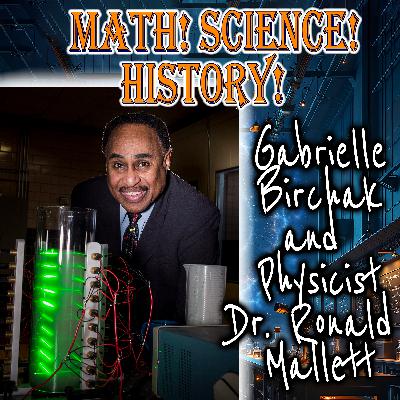
In this fascinating conversation, I interview theoretical physicist Dr. Ronald Mallett to explore one of humanity's most extraordinary scientific pursuits: time travel. From the influence of Einstein's general theory of relativity to quantum mechanics and parallel universes, Dr. Mallett shares the story of how his personal loss inspired a lifetime of discovery. Listeners will hear how his work connects the geometry of spacetime, wormholes, and cosmic strings to the real mathematics of time loops, and how time travel to the past is theoretically possible. The discussion also takes an emotional and philosophical turn, as Dr. Mallett reflects on his book Time Traveler: A Scientist's Personal Mission to Make Time Travel a Reality and the hopes of seeing his father's memory brought to life on the big screen. Three Things You'll Learn: Einstein's Relativity and the Mechanics of Time Loops: How frame dragging, rotation, and gravity could allow time to twist back on itself. Quantum Mechanics and the Multiverse Solution: Why physicists like Hugh Everett and David Deutsch believe time travel could avoid paradoxes through parallel universes. Real-World Implications of Time Travel: From predicting natural disasters to advancing communication and transportation, Dr. Mallett explains how this science could one day reshape our future. Resources and Further Reading: Dr. Ronald Mallett's Book: Time Traveler: A Scientist's Personal Mission to Make Time Travel a Reality University of Connecticut Physics Profile: Ronald L. Mallett, Ph.D. Einstein's General Theory of Relativity (Stanford Encyclopedia of Philosophy): SEP – General Relativity If you enjoyed this episode, please share it with your fellow science enthusiasts and leave a review wherever you listen. - Explore more on our website: mathsciencehistory.com 📚 To buy my book Hypatia: The Sum of Her Life on Amazon, visit https://a.co/d/g3OuP9h 🌍 Let's Connect!Bluesky: https://bsky.app/profile/mathsciencehistory.bsky.social Instagram: https://www.instagram.com/math.science.history Facebook: https://www.facebook.com/mathsciencehistory LinkedIn: https://www.linkedin.com/company/math-science-history/ Threads: https://www.threads.com/@math.science.history Mastodon: https://mathsciencehistory@mathstodon.xyz YouTube: Math! Science! History! - YouTube Pinterest: https://www.pinterest.com/mathsciencehistory 🎧 Enjoying the Podcast? ☕ Support the Show: Coffee!! PayPal Leave a review! It helps more people discover the show! Share this episode with friends & fellow history buffs! Subscribe on your favorite podcast platform Check out our merch: https://www.mathsciencehistory.com/the-store Music: All music is public domain and has no Copyright and no rights reserved. Selections from The Little Prince by Lloyd Rodgers Treasure – no drums by BreakzStudios Pixabay Documentary Soundscapes by Music by Valentina López – Pixabay Classic Documentary Piano by Mikhail Smusev from Pixabay Modular Ambient 03 by SScheidel from Pixabay A choir of fairies and Elves from Pixabay For Documentary by Alisia Beatz from Pixabay Nature Documentary by James Carter from Pixabay Until next time, carpe diem!
Subscribe to Math! Science! History! wherever you listen to podcasts, and if you love learning how math and science make everyday life better, leave a review and share this episode with a friend who's always running out of time! In this episode of Math! Science! History!, Gabrielle Birchak explores how mathematics and science can help us master the one resource we can't manufacture, time. From the Shortest Path Problem in geometry to the Pareto Principle in physics and productivity, Gabrielle uncovers how optimization, energy management, and practical habits can transform the way we work, think, and live. This five-minute Flashcard episode blends logic, science, and real-world wisdom for anyone who wants to save time, and maybe feel a little like a time traveler. Three Time Saving Techniques: How the math of optimization teaches us to find the smartest, most efficient route. How physics and the 80/20 rule show us to manage energy instead of just minutes. How real-world strategies like the Two-Minute Rule, Time Blocking, and Habit Stacking turn theory into daily success. Links & Resources: Atomic Habits by James Clear, https://jamesclear.com/atomic-habits Learn more about the Pareto Principle, https://en.wikipedia.org/wiki/Pareto_principle 🔗 Explore more on our website: mathsciencehistory.com 📚 To buy my book Hypatia: The Sum of Her Life on Amazon, visit https://a.co/d/g3OuP9h 🌍 Let's Connect!Bluesky: https://bsky.app/profile/mathsciencehistory.bsky.social Instagram: https://www.instagram.com/math.science.history Facebook: https://www.facebook.com/mathsciencehistory LinkedIn: https://www.linkedin.com/company/math-science-history/ Threads: https://www.threads.com/@math.science.history Mastodon: https://mathsciencehistory@mathstodon.xyz YouTube: Math! Science! History! - YouTube Pinterest: https://www.pinterest.com/mathsciencehistory 🎧 Enjoying the Podcast? ☕ Support the Show: Coffee!! PayPal Leave a review! It helps more people discover the show! Share this episode with friends & fellow history buffs! Subscribe on your favorite podcast platform Check out our merch: https://www.mathsciencehistory.com/the-store Music: All music is public domain and has no Copyright and no rights reserved. Selections from The Little Prince by Lloyd Rodgers Until next time, carpe diem!
What if you could bend time like taffy, stretching moments, collapsing centuries, and stepping through the folds of history itself? In this episode of Math! Science! History!, Gabrielle explores the myths, literature, and scientific breakthroughs that brought time travel from ancient dreams to modern equations. From the Mahabharata to H.G. Wells, from Einstein's relativity to Ronald Mallett's laser loop, we uncover how humanity's yearning to rewrite the past or glimpse the future evolved into one of science's most mind-bending pursuits. Join Gabrielle for a journey through paradoxes, wormholes, and the minds who dared to ask: Can we really travel through time? Three Key Points 1. How ancient myths from India and Japan foreshadowed the physics of time dilation centuries before Einstein. 2. Why Einstein's relativity transformed time from a constant into a flexible dimension, and what experiments proved it. 3. How real physicists like Ronald Mallett are working to turn theoretical equations into the first tangible steps toward time travel. Resources & References · Einstein, Albert. Relativity: The Special and General Theory. 1916. · Kip Thorne. Black Holes and Time Warps: Einstein's Outrageous Legacy. W.W. Norton, 1994. · Ronald L. Mallett. Time Traveler: A Scientist's Personal Mission to Make Time Travel a Reality. Basic Books, 2006. · Gödel, Kurt. "An Example of a New Type of Cosmological Solutions of Einstein's Field Equations." Reviews of Modern Physics, 1949. · Hafele, J. C., & Keating, R. E. "Around-the-World Atomic Clocks: Predicted Relativistic Time Gains." Science, 1972. · NASA: Time Dilation Explained (FYI: NASA hasn't been able to update this page due to lack of government funding 🔗 Explore more on our website: mathsciencehistory.com 📚 To buy my book Hypatia: The Sum of Her Life on Amazon, visit https://a.co/d/g3OuP9h 🌍 Let's Connect!Bluesky: https://bsky.app/profile/mathsciencehistory.bsky.social Instagram: https://www.instagram.com/math.science.history Facebook: https://www.facebook.com/mathsciencehistory LinkedIn: https://www.linkedin.com/company/math-science-history/ Threads: https://www.threads.com/@math.science.history Mastodon: https://mathsciencehistory@mathstodon.xyz YouTube: Math! Science! History! - YouTube Pinterest: https://www.pinterest.com/mathsciencehistory 🎧 Enjoying the Podcast? ☕ Support the Show: Coffee!! PayPal Leave a review! It helps more people discover the show! Share this episode with friends & fellow history buffs! Subscribe on your favorite podcast platform Check out our merch: https://www.mathsciencehistory.com/the-store Music: All music is public domain and has no Copyright and no rights reserved. Selections from The Little Prince by Lloyd Rodgers Remainder of music and sounds from Pixabay – CC0 Until next time, carpe diem!
Raise your glass, and your curiosity. In this Math! Science! History! Flashcard Friday, Gabrielle Birchak takes you into a haunted pub where chemistry and folklore share the same barstool. You'll uncover how distillation mirrors transformation, why vapor behaves like a ghost, and how the energy that fuels both whiskey and legend never truly disappears. This is science told by firelight, a story of matter, energy, and the invisible bonds that tie us to everything that changes form. Three Ponderable Things How spirits are born: The chemistry of distillation, evaporation, condensation, and the poetic process of capturing a "spirit." Why nothing truly disappears: The physics of latent heat and energy conservation that mirror our fascination with ghost stories. How aroma tells a story: The role of volatile compounds that give whiskey its scent, and make chemistry feel almost supernatural. Resources & References Hornsey, Ian S. A History of Beer and Brewing. Royal Society of Chemistry, 2003. Forbes, R. J. Short History of the Art of Distillation. Brill, 1970. Atkins, P. W., and Julio de Paula. Atkins' Physical Chemistry. Oxford University Press, 2018. Royal Society of Chemistry – The Chemistry of Distilling Spirits American Chemical Society – How Distillation Works If this episode left you thinking differently about what lingers after a toast, follow Math! Science! History! wherever you listen to podcasts, and share it with a friend who loves science, storytelling, or a good glass of whiskey. For transcripts, references, and more stories that mix curiosity with chemistry, visit MathScienceHistory.com. Explore more on our website: mathsciencehistory.com To buy my book Hypatia: The Sum of Her Life on Amazon, visit https://a.co/d/g3OuP9h Let's Connect!Bluesky: https://bsky.app/profile/mathsciencehistory.bsky.social Instagram: https://www.instagram.com/math.science.history Facebook: https://www.facebook.com/mathsciencehistory LinkedIn: https://www.linkedin.com/company/math-science-history/ Threads: https://www.threads.com/@math.science.history Mastodon: https://mathsciencehistory@mathstodon.xyz YouTube: Math! Science! History! - YouTube Pinterest: https://www.pinterest.com/mathsciencehistory Enjoying the Podcast? If you love Math, Science, History, here's how you can help:🌟 Leave a review! It helps more people discover the show!📢 Share this episode with friends & fellow history buffs!🔔 Subscribe on your favorite podcast platform ☕ Support the Show: Coffee!! https://www.paypal.com/ncp/payment/PR7F7ST49GDNA 🛍 Check out our merch: https://www.mathsciencehistory.com/the-store Music: All music is public domain and has no Copyright and no rights reserved. Selections from The Little Prince by Lloyd Rodgers Until next time, carpe diem!
In this Halloween-special episode of Math! Science! History!, your host Gabrielle Birchak explores the strange world where superstition meets science. We dive into why machines sometimes bow to the mere presence of an engineer (the "Engineer Proximity Effect") and how one of the greatest physicists of the 20th century, Wolfgang Pauli, became the subject of an odd legend: wherever he went, lab equipment failed (the "Pauli Effect"). Join us for a spooky, fun, and surprisingly rational journey into the magical aura of tech support and haunted machines. Three Take-aways Why machines seem to fix themselves when the engineer enters the room, and the psychological and procedural forces behind the so-called Engineer Proximity Effect. The story behind the Pauli Effect, the absurd, amusing, and true folklore of Wolfgang Pauli and failing lab apparatus when he was nearby. How you can use a "spellbook for engineers" to break the cycle of tech gremlins, practical, science-based "spells" you can actually use to feel like you're doing a bit of Halloween magic while being perfectly logical. Useful Links & Resources The Pauli Effect: Institute of Physics Spark overview iop.org ETH Library: Wolfgang Pauli & the Pauli Effect anecdotes library.ethz.ch WIRED article: "The Strange, Totally Not-True Story of a Cursed Physicist" wired.com Explore more on our website: mathsciencehistory.com To buy my book Hypatia: The Sum of Her Life on Amazon, visit https://a.co/d/g3OuP9h 🌍 Let's Connect!Bluesky: https://bsky.app/profile/mathsciencehistory.bsky.social Instagram: https://www.instagram.com/math.science.history Facebook: https://www.facebook.com/mathsciencehistory LinkedIn: https://www.linkedin.com/company/math-science-history/ Threads: https://www.threads.com/@math.science.history Mastodon: https://mathsciencehistory@mathstodon.xyz YouTube: Math! Science! History! - YouTube Pinterest: https://www.pinterest.com/mathsciencehistory Enjoying the Podcast? ☕ Support the Show: Coffee!! PayPal Leave a review! It helps more people discover the show! Share this episode with friends & fellow history buffs! Subscribe on your favorite podcast platform Check out our merch: https://www.mathsciencehistory.com/the-store Music: All music is public domain and has no Copyright and no rights reserved. Selections from The Little Prince by Lloyd Rodgers Modular Ambient by Zen Man Mystical Music Box by Vira Miller Cinematic Suspense Mystery by Luis Humanoide 🎵 Audio Editor: Podcast mixed by David Aviles and Gabrielle Birchak Until next time, carpe diem!
In this Flashcard Friday episode of Math! Science! History!, Gabrielle explores how everyday choices can make a real difference for our oceans. From reducing single-use plastics to supporting sustainable seafood and climate-friendly habits, this episode uncovers the math, science, and history behind ocean conservation, and the powerful impact of small changes. Plastic pollution isn't just a problem for sea turtles and coral reefs, it's a problem for us. Every year, about 11 million metric tons of plastic enter the ocean, leaching chemicals and breaking down into microplastics that end up in fish, sea salt, and even human blood. But with awareness, advocacy, and action, we can help turn the tide. Three Things You'll Learn: The science behind ocean resilience , how oceans regulate Earth's climate and what happens when that balance is disrupted. What plastic really does to marine life , and the startling evidence of microplastics in fish and even in human systems. Practical steps you can take today , from rethinking single-use plastics to supporting legislation and sustainable brands. Resources: Pew Charitable Trusts, Breaking the Plastic Wave: pewtrusts.org United Nations Environment Programme, Why Are Coral Reefs Dying?: unep.org WWF UK, Coral Reefs and Climate Change: wwf.org.uk Ocean Conservancy, Plastics in the Ocean: oceanconservancy.org NCBI / ScienceDirect, Microplastics in Seafood and Human Exposure Studies: ncbi.nlm.nih.gov | sciencedirect.com Call to Action: If today's episode inspired you, take a minute to make one change, carry a reusable bottle, skip the plastic bag, or share this episode with a friend who loves the ocean. Together, we can protect the blue heart of our planet. Subscribe to Math! Science! History! on Spotify, Apple Podcasts, or wherever you listen, and leave a review to help more curious minds find the show! Explore more on our website: mathsciencehistory.com To buy my book Hypatia: The Sum of Her Life on Amazon, visit https://a.co/d/g3OuP9h Let's Connect!Bluesky: https://bsky.app/profile/mathsciencehistory.bsky.social Instagram: https://www.instagram.com/math.science.history Facebook: https://www.facebook.com/mathsciencehistory LinkedIn: https://www.linkedin.com/company/math-science-history/ Threads: https://www.threads.com/@math.science.history Mastodon: https://mathsciencehistory@mathstodon.xyz YouTube: Math! Science! History! - YouTube Pinterest: https://www.pinterest.com/mathsciencehistory Enjoying the Podcast? If you love Math, Science, History, here's how you can help:🌟 Leave a review! It helps more people discover the show!📢 Share this episode with friends & fellow history buffs!🔔 Subscribe on your favorite podcast platform ☕ Support the Show: Coffee!! PayPal 🛍 Check out our merch: https://www.mathsciencehistory.com/the-store 🎵 Music: All music is public domain and has no Copyright and no rights reserved. Selections from The Little Prince by Lloyd Rodgers Until next time, carpe diem!
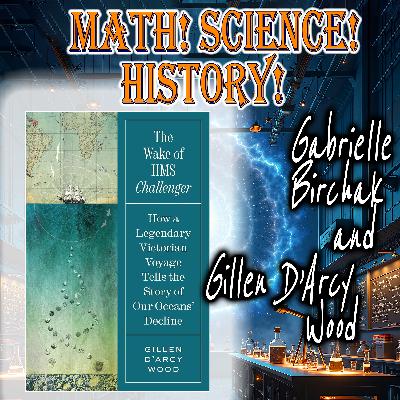
In this episode of Math! Science! History!, Gabrielle Birchak speaks with Professor Gillen D'Arcy Wood, author of The Wake of the HMS Challenger: How a Legendary Victorian Voyage Tells the Story of Our Ocean's Decline. Together, they uncover how a nineteenth-century Royal Navy warship transformed into a floating laboratory and gave humanity its first global snapshot of the oceans. From discovering thousands of new species to inspiring NASA's Challenger shuttle, the expedition shaped modern oceanography and continues to inform today's conservation science. Wood's biocentric storytelling reminds us that to save our planet, we must first fall in love with it again, to be, as he says, re-enchanted by the living ocean that sustains us all. Three Things Listeners Will Learn How the HMS Challenger (1872–1876) became the first global oceanographic expedition, collecting temperature, depth, and biological data still used today. Why Gillen D'Arcy Wood's "biocentric" approach reframes history through the perspective of marine life rather than human explorers. What the voyage teaches us about modern ocean crises: from overfishing and warming seas to microplastics—and how species like the green turtle show that recovery is possible. BUY THE BOOK! The Wake of the HMS Challenger by Gillen D'Arcy Wood - HarperCollins Publishers Explore more on our website: mathsciencehistory.com To buy my book Hypatia: The Sum of Her Life on Amazon, visit https://a.co/d/g3OuP9h Let's Connect!Bluesky: https://bsky.app/profile/mathsciencehistory.bsky.social Instagram: https://www.instagram.com/math.science.history Facebook: https://www.facebook.com/mathsciencehistory LinkedIn: https://www.linkedin.com/company/math-science-history/ Threads: https://www.threads.com/@math.science.history Mastodon: https://mathsciencehistory@mathstodon.xyz YouTube: Math! Science! History! - YouTube Pinterest: https://www.pinterest.com/mathsciencehistory Enjoying the Podcast? ☕ Support the Show: Coffee!! PayPal Leave a review! It helps more people discover the show! Share this episode with friends & fellow history buffs! Subscribe on your favorite podcast platform Check out our merch: https://www.mathsciencehistory.com/the-store Music: All music is public domain and has no Copyright and no rights reserved. Selections from The Little Prince by Lloyd Rodgers Smooth Piano by Universefield Musinova - Travelling And Discovering (Marimba World Percussion) Documentary-Nikita Kondrashev Audio Editor: Podcast mixed by David Aviles Until next time, carpe diem!
Publish or Purrish: The Cat Who Co-Authored Physics Episode Overview: In this episode of Math! Science! History!, we uncover the remarkable story of F.D.C. Willard, the Siamese cat who became a published co-author in a world-renowned physics journal. What began as a workaround for rigid authorship conventions turned into a beloved legend in science history. But Willard wasn't alone. We also take a closer look at other non-human co-authors, from a dog in immunology, to a hamster in physics, and even bonobos in language research, while exploring what these unusual stories reveal about the culture of scientific publishing and the pressures of the "publish or perish" system. Three Takeaways: The real physics behind Willard's paper and why the study of helium-3 was serious science, not just a playful prank. Other cases of animals as authors—including a dog, a hamster, and three bonobos—and what those choices meant. The bigger issue of authorship in science and how conventions and pressures shape who gets credit, and why. Resources and Further Reading: Wikipedia: F.D.C. Willard Hetherington, J.H. & Willard, F.D.C. (1975). Two-, Three-, and Four-Atom Exchange Effects in bcc ³He. Physical Review Letters, 35(21), 1442–1444. Matzinger, Polly & Galadriel Mirkwood. (1978). In a fully H-2 incompatible chimera, T cells of donor origin can respond to minor histocompatibility antigens in association with either donor or host H-2 type. Journal of Experimental Medicine, 148(1), 84–92. Geim, A.K. & H.A.M.S. ter Tisha. (2001). Detection of Earth rotation with a diamagnetically levitating gyroscope. Physica B: Condensed Matter, 294–295, 736–739. Savage-Rumbaugh, S., Kanzi, Panbanisha, & Nyota. (2007). Welfare of Apes in Captive Environments: Comments on, and by, a Specific Group of Apes. Journal of Applied Animal Welfare Science, 10(1), 7–19. Explore more on our website: mathsciencehistory.com To buy my book Hypatia: The Sum of Her Life on Amazon, visit https://a.co/d/g3OuP9h Let's Connect!Bluesky: https://bsky.app/profile/mathsciencehistory.bsky.social Instagram: https://www.instagram.com/math.science.history Facebook: https://www.facebook.com/mathsciencehistory LinkedIn: https://www.linkedin.com/company/math-science-history/ Threads: https://www.threads.com/@math.science.history Mastodon: https://mathsciencehistory@mathstodon.xyz YouTube: Math! Science! History! - YouTube Pinterest: https://www.pinterest.com/mathsciencehistory Enjoying the Podcast? If you love Math, Science, History, here's how you can help:🌟 Leave a review! It helps more people discover the show!📢 Share this episode with friends & fellow history buffs!🔔 Subscribe on your favorite podcast platform ☕ Support the Show: Coffee!! PayPal 🛍 Check out our merch: https://www.mathsciencehistory.com/the-store 🎵 Music: All music is public domain and has no Copyright and no rights reserved. Selections from The Little Prince by Lloyd Rodgers🎵 Sound Editor: David Aviles Until next time, carpe diem!
From tallying goats to launching rockets, this episode takes you on a fast-paced, lighthearted journey through the complete history of mathematics. Inspired by D.E. Smith's The History of Mathematics, this is the espresso version — goats, Greeks, calculus cage matches, infinity, and beyond. 3 Things Listeners Will Learn: How early humans counted goats, stars, and time with sticks, pebbles, and sky-watching. Why Newton and Leibniz's feud over calculus was the most brutal "cage match" in math history. How modern math evolved into the language of infinity, chaos, quantum physics, and AI. Resources Mentioned: The History of Mathematics by David Eugene Smith Euclid's Elements Explore more on our website: mathsciencehistory.com To buy my book Hypatia: The Sum of Her Life on Amazon, visit https://a.co/d/g3OuP9h 🌍 Let's Connect!Bluesky: https://bsky.app/profile/mathsciencehistory.bsky.social Instagram: https://www.instagram.com/math.science.history Facebook: https://www.facebook.com/mathsciencehistory LinkedIn: https://www.linkedin.com/company/math-science-history/ Threads: https://www.threads.com/@math.science.history Mastodon: https://mathsciencehistory@mathstodon.xyz YouTube: Math! Science! History! - YouTube Pinterest: https://www.pinterest.com/mathsciencehistory Enjoying the Podcast? ☕ Support the Show: Coffee!! PayPal Leave a review! It helps more people discover the show! Share this episode with friends & fellow history buffs! Subscribe on your favorite podcast platform Check out our merch: https://www.mathsciencehistory.com/the-store Music: All music is public domain and has no Copyright and no rights reserved. Selections from The Little Prince by Lloyd Rodgers Dionisio Aguado by Trygve Larsen from Pixabay Sneaky by Emmraan from Pixabay Flute, Oriental, Japan Shakuhachi Music by Lobsang Karma from Pixabay Audio Editor: Podcast mixed by David Aviles Until next time, carpe diem!
In this Flashcard Friday follow-up to Tuesday's interview with Dr. Kanisorn Wongsrichanalai of the Massachusetts Historical Society, we revisit the numbers that changed the course of history. During the Revolutionary War, smallpox was more dangerous to the Continental Army than the British. By comparing mortality rates, George Washington made a bold, science-driven choice: inoculate his troops. The math was simple but profound, 30% risk of death without inoculation versus just 2% with it. This decision helped save the Revolution. In this episode, we reiterate Dr. Wongsrichanalai's quote: "do the math, believe the science, and learn your history." From spotting misleading anecdotes to recognizing reliable sources, and from Washington's decision to Edward Jenner's breakthrough, today's lesson is that evidence and history are our best guides when confronting fear and misinformation. Three Things You'll Learn How arithmetic saved an army — Why the difference between 30% and 2% mortality mattered more than opinions. How to vet science today — Which sources are reliable and why consensus matters more than a single flashy headline. What history teaches us about vaccines — From smallpox inoculation to global eradication, the past shows us how trust in evidence safeguards survival. Resources Mentioned Massachusetts Historical Society World Health Organization (WHO) European Centre for Disease Prevention and Control (ECDC) Public Health Agency of Canada (PHAC) Explore more on our website: mathsciencehistory.com To buy my book Hypatia: The Sum of Her Life on Amazon, visit https://a.co/d/g3OuP9h Let's Connect!Bluesky: https://bsky.app/profile/mathsciencehistory.bsky.social Instagram: https://www.instagram.com/math.science.history Facebook: https://www.facebook.com/mathsciencehistory LinkedIn: https://www.linkedin.com/company/math-science-history/ Threads: https://www.threads.com/@math.science.history Mastodon: https://mathsciencehistory@mathstodon.xyz YouTube: Math! Science! History! - YouTube Pinterest: https://www.pinterest.com/mathsciencehistory Enjoying the Podcast? If you love Math, Science, History, here's how you can help:🌟 Leave a review! It helps more people discover the show!📢 Share this episode with friends & fellow history buffs!🔔 Subscribe on your favorite podcast platform ☕ Support the Show: Coffee!! PayPal 🛍 Check out our merch: https://www.mathsciencehistory.com/the-store 🎵 Music: All music is public domain and has no Copyright and no rights reserved. Selections from The Little Prince by Lloyd Rodgers Until next time, carpe diem!
In this episode of Math! Science! History!, Gabrielle Birchak speaks with Dr. Kanisorn Wongsrichanalai of the Massachusetts Historical Society about the hidden epidemic that shaped the American Revolution. While battles raged, smallpox quietly threatened to destroy the Continental Army and colonial communities. From George Washington's controversial order to inoculate his soldiers to Abigail Adams's letters describing her family's ordeal, this conversation reveals how trust in science, courage, and collective action helped secure America's future. Three Things Listeners Will Learn: How smallpox ravaged North America during the Revolutionary War and why it was considered more dangerous than the battlefield. Why George Washington's decision to inoculate the Continental Army may have saved the Revolution. How Abigail and John Adams's letters reveal the fears, risks, and resilience of ordinary families facing inoculation. Resources & Further Reading: Massachusetts Historical Society Massachusetts Historical Society – Adams Family Papers Mount Vernon – George Washington and Smallpox Inoculation Centers for Disease Control (CDC) – History of Smallpox WHO – Eradication of Smallpox 🔗 Explore more on our website: mathsciencehistory.com 📚 To buy my book Hypatia: The Sum of Her Life on Amazon, visit https://a.co/d/g3OuP9h 🌍 Let's Connect! Bluesky: https://bsky.app/profile/mathsciencehistory.bsky.social Instagram: https://www.instagram.com/math.science.history Facebook: https://www.facebook.com/mathsciencehistory LinkedIn: https://www.linkedin.com/company/math-science-history/ Threads: https://www.threads.com/@math.science.history Mastodon: https://mathsciencehistory@mathstodon.xyz YouTube: Math! Science! History! - YouTube Pinterest: https://www.pinterest.com/mathsciencehistory 🎧 Enjoying the Podcast? ☕ Support the Show: Coffee!! PayPal Leave a review! It helps more people discover the show! Share this episode with friends & fellow history buffs! Subscribe on your favorite podcast platform Check out our merch: https://www.mathsciencehistory.com/the-store Music: All music is public domain and has no Copyright and no rights reserved. Selections from The Little Prince by Lloyd Rodgers 🎵 Audio Editor: Podcast mixed by David Aviles Until next time, carpe diem!
What does it cost to carry a brilliant idea? Ludwig Boltzmann gave us the statistical foundations of entropy and the famous S = k log W, yet his life was marked by relentless skepticism, isolation, and personal struggle. In this episode, we weave Boltzmann's story with the modern mental health crisis in academia, where anxiety, depression, and burnout affect scientists at alarming rates. We'll explore how probability explains not only the arrow of time, but also why community, resilience, and care are essential for science to thrive. 3 Things Listeners Will Learn: How Ludwig Boltzmann's statistical mechanics shaped modern physics and why his ideas met fierce resistance. The scale of today's mental health crisis in academia — from graduate students to faculty. Practical tools like cognitive behavioral therapy (CBT) and community support that can help foster resilience in science. Resources & Further Reading: 988 Suicide & Crisis Lifeline (U.S.) International Association for Suicide Prevention Global Helpline Directory Evans, T. M., et al. "Evidence for a mental health crisis in graduate education." Nature Biotechnology (2018). Stanford Encyclopedia of Philosophy – Boltzmann's Work in Statistical Physics Nobel Prize: Jean Perrin's Nobel Lecture (1926) 🔗 Explore more on our website: mathsciencehistory.com 📚 To buy my book Hypatia: The Sum of Her Life on Amazon, visit https://a.co/d/g3OuP9h 🌍 Let's Connect! Bluesky: https://bsky.app/profile/mathsciencehistory.bsky.social Instagram: https://www.instagram.com/math.science.history Facebook: https://www.facebook.com/mathsciencehistory LinkedIn: https://www.linkedin.com/company/math-science-history/ Threads: https://www.threads.com/@math.science.history YouTube: Math! Science! History! - YouTube Pinterest: https://www.pinterest.com/mathsciencehistory 🎧 Enjoying the Podcast? ☕ Support the Show: Coffee!! PayPal Leave a review! It helps more people discover the show! Share this episode with friends & fellow history buffs! Subscribe on your favorite podcast platform Check out our merch: https://www.mathsciencehistory.com/the-store Music: All music is public domain and has no Copyright and no rights reserved. Selections from The Little Prince by Lloyd Rodgers 🎵 Audio Editor: Podcast mixed by David Aviles Until next time, carpe diem!

Comments

Download from Google Play

Download from App Store
 United States