


 Claim Ownership
SWIMMING GOLD
Subscribed: 1Played: 0
Subscribe

© Wayne Goldsmith
Description
Straight talk on swimming coaching from Wayne Goldsmith — 30+ years working with Olympic programs and national federations worldwide. Cutting through the noise on technique, training, race skills and building swimmers who love the sport.
swimminggold.substack.com
swimminggold.substack.com
41 Episodes
Reverse
By Wayne GoldsmithEvery swimming coach does some form of skills practice in their training sessions every day.For the most part, coaches focus on learning and practicing skills — but rarely test whether those skills are actually race-ready.The challenge is that there’s a big gap between doing a skill well in training and executing it under race conditions.Here are four steps to bridge that gap:1. Learn the skill — Understand the movement. Get the basics right.2. Practice the skill — Repeat it. Refine it. Build consistency.3. Test the skill — Add speed. Add fatigue. Add pressure. Can they still do it?4. Race the skill — Execute it in competition conditions - both simulated racing in training and actual races in Meets. That’s the real test.Most coaches live in steps 1 and 2. The best coaches make sure their swimmers get to steps 3 and 4.I’d be interested to know — how do you make sure your swimmers’ skills are race-ready?Wayne This is a public episode. If you'd like to discuss this with other subscribers or get access to bonus episodes, visit swimminggold.substack.com/subscribe
By Wayne GoldsmithOne of the hottest topics in swimming is always Dryland Training.When I speak at conferences, it’s inevitably a question from the audience. Swimming coaches have more opinions about dryland than just about anything else.Here are the three most commonly asked questions:* What are the best dryland exercises and programs?* When should we do dryland — before or after pool workouts?* At what age should young swimmers start strength training?My answers:1. Best exercises / best programsIt doesn’t matter as much as you think.Free weights, machines, body weight, pilates, yoga, a hybrid of everything — the method is less important than the outcome.The key is to vary your dryland program so that:* The swimmers enjoy it* They complete it with the same focus and commitment as pool trainingA program they hate is a program they won’t do properly.2. Timing — before or after pool?Simple answer: it depends on your focus.If you’re doing a precise, accurate, speed or technique-focused pool session — it makes no sense to fatigue swimmers with heavy dryland beforehand.Match the dryland timing to the pool session goals.3. Age to start drylandIt doesn’t matter what age. It matters what they do.Seven year olds can start a dryland program — IF it’s age and stage appropriate.Running. Jumping. Throwing a light medicine ball. Body weight exercises like lunges and step-ups. Seeing how high they can jump.Not heavy weights. Movement. Fun. Foundation.Watch the video and let me know — what are YOUR answers to dryland training’s three hottest topics?Wayne Goldsmith This is a public episode. If you'd like to discuss this with other subscribers or get access to bonus episodes, visit swimminggold.substack.com/subscribe
By Wayne GoldsmithLet’s get this right from the start:There are NO 7 year old backstrokers.There are NO 9 year old freestylers.There are NO 10 year old IMers.There are just kids who swim — who, at that point in their development, swim one specific stroke a little better than the other strokes.Now I know coaches and parents everywhere are reading this and thinking “He’s wrong. Johnny the 8 year old just broke the club record for 50 backstroke. He’s a backstroker.”WRONG x A MILLION.Little Johnny is just an eight year old kid who, for whatever reason, happens to swim backstroke faster than the other eight year old kids.Coaches — we need to stop referring to young kids as stroke specialists.Why?Because parents and swimmers develop the expectation that:a. My child / I am a “champion” backstroker or freestyler or breaststroker — and there are NO 8, 9, 10, 11, 12 year old champions.b. My child / I don’t need to do the other strokes or learn the other events because I’m a “backstroker” or “freestyler.”The truth is this.A young swimmer could be brilliant at freestyle this year. Then they grow, their limb lengths change, and POW — they can’t swim freestyle very well anymore.Happens over and over all around the world. We know this. As coaches we’ve seen it a million times. Yet it keeps happening.My friends — here are five practical tips:* Do not refer to any swimmer under about 14 as “the butterflyer” or any single stroke specialisation.* Take a balanced approach to development — all strokes, all events, speed training, aerobic work, great skills, underwater kicking, dives, starts, turns, finishes. Balanced.* Discourage parents from entering their kids only in specialist stroke events at meets. “My 8 year old is a breaststroker so we’re only entering 50 and 100 breaststroke” — no.* Build an overall stroke development philosophy in your team. Focus on events like:* 50 metres all strokes (develops real speed)* 200 IM (develops all strokes, turning skills, endurance)* 400 freestyle (develops endurance, sustained speed, discipline)* Relays (fun, team spirit, speed development)* Educate parents and swimmers. Prepare them for the reality that bodies and minds change year by year — and it’s perfectly normal to change stroke focus right up until mid-teens.The bottom line?Don’t build a 9 year old backstroker.Build a 9 year old who loves swimming, learns everything, and becomes whatever they’re meant to become — when they’re ready.That’s how you develop swimmers for the long game.Swimming coaches — if you want to develop swimmers this way but need help making it work in your program, that’s exactly what I do in CoachTED.One-on-one mentoring for swimming coaches who want to coach for the long game — not just the next meet.Contact me through Swimming Gold or email wayne@moregold.com.auWayne Goldsmith This is a public episode. If you'd like to discuss this with other subscribers or get access to bonus episodes, visit swimminggold.substack.com/subscribe
By popular demand — let’s talk about speed.There’s a lot written about it. A lot talked about it. And a lot of confusion about how to actually develop it.Here are my five fundamentals of going fast, fast, fast:1. Forget “throw your arms”I’m not a fan of that old drill where kids get on their back and just throw their arms as fast as possible. Some call it overspeed training.I don’t buy it — physiologically, biomechanically or from a skill learning perspective.It doesn’t teach anything except throwing your arms really fast.And our sport isn’t just about moving your arms quickly. It’s about moving your arms quickly with great technique and good skill — under fatigue, under pressure, in competition.All of those things together.Just thrashing your arms isn’t speed development. It’s just thrashing.2. Speed is relaxationHere’s a core principle I believe in deeply:The faster you want to go, the more relaxed you have to be.So how does a coach apply this day to day?When you’re at the end of the pool about to send them off for a fast 50 — watch your language.Don’t say: “50 metres hard.”Don’t say: “All out effort.”Why? Because we want speed to feel effortless. Easy. Smooth.Try this instead:“This one — as fast as you can go, but easy, smooth and relaxed.”“Maximum speed, no effort, totally relaxed.”You’re marrying two concepts: maximum speed and maximum relaxation.Look at anything that moves fast in the animal kingdom. Look at track and field sprinters. The ones who move really quickly are loose, relaxed, smooth.You can’t swim faster by trying harder.Swimming isn’t an effort sport. It’s a technique sport. A skill sport. A relaxation sport.3. Speed is speed is speedJust because you’re doing 25s or 50s doesn’t mean you’re doing a speed workout.It’s all about the rest. And the intensity.A real speed set might look like:* 8 x 25 on 3:00 - longer rest if needed.* 6 x 50 on 3:30 - longer rest if needed.Complete rest. Easy, relaxed recovery — static or dynamic, your choice.Short distances. Maximum speed. Lots of rest.Speed is speed is speed.Yes, there’s a case for doing speed work at the end of a session when they’re tired — technique under fatigue. That’s real. That’s what heats and finals feel like.But if you’re trying to develop genuine speed — short distances, long rest, not too many of them, great speed.4. Fast + Long = BestWhen kids are starting out, we think about moving arms quickly. Fine.But as they develop, we need them to move their arms quickly with maximum distance per stroke.It’s no good if they can thrash their arms really fast but they’re taking 30 strokes per 50.We’re looking for the combination: fast and long.Fast is good. Long is good. Fast and long is best.Long strokes at maximum speed. Pressure on the water throughout the stroke. Maintaining length while moving quickly.That’s what we’re chasing.5. Speed work all year roundThis might be the most important one.I see coaches around the world obsessed with what I call exclusion blocks. The first seven weeks of the season — endurance only. Then pre-competition — a bit of speed, lots of threshold. Then they throw speed in at the end and hope it comes back.I totally disagree.Speed is the most precious thing in our sport.Nobody lies in bed at night dreaming of doing 40 x 100. Kids are lying in bed thinking: how do I go faster?Olympic gold medals. World records. PBs. Qualifying for the next level.This whole sport is about going faster.It makes no sense to kill speed off for months with huge volumes of training and then hope it magically returns.Wishing, hoping and prayer do not represent a solid strategy.Do speed work at least two or three times a week. All year round. Even in the middle of your so-called endurance block.More and more coaches around the world are moving away from exclusion blocks toward holistic, balanced programs that include deliberate speed work throughout the year.The One-Second TestHere’s my rule of thumb:Swimmers should never be more than one second slower than their PB 50 time — at any point in the year.Middle of an endurance block? They should still be able to touch speed.If you kill it off and just hope it comes back — chances are, one day it won’t.Speed is the most precious thing in this sport. Protect it.Over to youWhat are your favourite speed sessions?How do you talk to your swimmers about going fast?How do you generate real speed in your workouts?I’d love to hear from you. Drop a comment below.Wayne Goldsmith This is a public episode. If you'd like to discuss this with other subscribers or get access to bonus episodes, visit swimminggold.substack.com/subscribe
By Wayne GoldsmithA lot of coaches, when they start out, focus on one thing: physiology. The body. The physical elements of swimming.They spend years looking for drills, workouts, training programs, session plans. They go to conferences. An elite coach stands up and talks about their sets and reps, their periodisation. Everyone writes it down or takes a photo of the PowerPoint. Everyone’s looking for the secret formula, the magic pill, the quick fix that’s going to turn their program into a high-performance machine.Colleagues, that’s not where your advantage is going to come from.Because of the internet and AI, you can get anything, anytime, anywhere — mostly for free. Type “top 10 freestyle drills for age group swimmers” into ChatGPT or Google and you’ll get solid answers in seconds. That stuff is everywhere now. There was a time when coaches guarded their best drills and workouts. Not anymore.You are no longer limited by your knowledge of the sport. You are no longer limited by what drills you know or how much you understand about heart rate or lactate. Those things are not limits anymore because everybody knows what everybody knows.There are no secrets.When I travel, people ask me: “What’s the secret to the Australian program? What are they doing differently?” The answer is nothing. Everybody is doing more or less what everybody else is doing.The one thing that will give you an advantage is YOU.Your coaching. The way you connect with your swimmers. The way you build relationships. The people factors are more important than ever.There is no app, no drill, no download that’s going to fix every problem you’ve got. There is no coach in the world — regardless of how many Olympic gold medals they’ve won — who holds secrets in their workouts. That is not the secret to success.Your edge is your ability to connect with kids. To put smiles on faces. To make them fall in love with the experience of swimming. To create friendship groups so they keep coming back.Some coaches hear this and say I’m getting soft. I’m not. If swimmers love what they do, they work harder at it. They come more often. They commit more fully to training and competition.Measuring VO2 or counting laps is nowhere near as important as you think it is. Coaching is far more important than you think it is.Believe in your coaching. Believe in yourself. Believe in your way of doing things.It’s your relationships, your personality, your energy, your character, your values. The things you already have.Not equipment. Not apps. Not downloads. Not AI.The difference is you.What do you do to connect and inspire the swimmers in your program?Wayne Goldsmith This is a public episode. If you'd like to discuss this with other subscribers or get access to bonus episodes, visit swimminggold.substack.com/subscribe
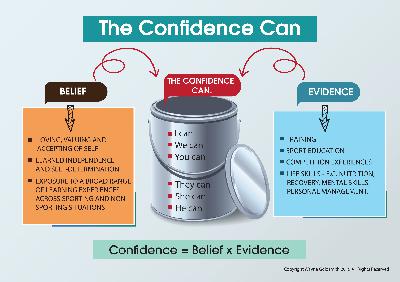
By Wayne GoldsmithCoaches and parents often ask me: “How do I help my swimmer develop confidence?”Here’s the equation I use:Confidence = Belief × EvidenceThink of confidence as a can — the Confidence Can.Our job as coaches — and as swimmers — is to fill that can with experiences. Evidence that proves “I CAN do this.”Every quality training session. Every race where they held their technique under pressure. Every time they got back on the blocks after a disappointing swim. Every early morning they showed up when they didn’t feel like it.That’s evidence. And evidence fills the ‘can.But here’s what most people miss: evidence alone isn’t enough.The other half of the equation — Belief — is what parents bring.Your unconditional love. Your complete acceptance of your child, win or lose, PB or DQ. Your child needs to know — with absolute certainty — that they are loved for who they are, not for what they achieve in the pool.Belief × Evidence.When coaches and swimmers fill the Confidence Can with great experiences, consistent training, quality recovery and healthy habits — AND parents provide that most powerful gift of all, unconditional love — something magical happens.Your swimmer stands behind the blocks, in any pool, at any meet, and thinks:I can. I can. I can.Know a swim coach or swimming parent who'd find this useful? Share this post or send them to swimminggold.substack.comWayne Goldsmith This is a public episode. If you'd like to discuss this with other subscribers or get access to bonus episodes, visit swimminggold.substack.com/subscribe
By Wayne GoldsmithI often get asked to do pool deck sessions with swim teams when I travel.Most of the time it’s drills and skills practices or “motivation” talks, attitude talks etc.But there’s one session I love to do because it’s so important: Straight Line Swimming.Swimming is a straight line sport.We start in a straight line: it’s called Streamlining.We swim in a straight line and avoid the lane ropes if we can.We turn straight! We come to the middle of the lane to then accelerate into the turn so we can turn and push off in a straight line.And we finish straight. We come to the middle of the lane and kick powefully to the wall to touch right in the centre of the lane.We start straight - we swim straight - we turn straight - we finish straight. When you think about it, we start and finish in streamline - as every great finish is Head forward, hips high, full kick and full stroke position on the wall.Coaches it is important you teach and continually reinforce straight line swimming.Why?Because under the pressure of competition, swimmers will do what they've practised.If we don’t teach them to start, swim, turn and finish in straight lines, then - when it really matters - they’ll be swimming in circles!Swimming. It’s a straight line sport.Know a swim coach who'd find this useful? Share this post or send them to swimminggold.substack.comWayne This is a public episode. If you'd like to discuss this with other subscribers or get access to bonus episodes, visit swimminggold.substack.com/subscribe
By Wayne GoldsmithNo matter what stroke.No matter the age of the squad swimmer.From “Minis to Masters” - there’s 7 Technique Tips that I guarantee will improve the swimming technique of every swimmer you coach.* Soft hands;* Loose feet;* Head and hips relationship;* Breathing;* Slow to fast;* Relax Relax Relax;* Feel - Connect - Pull.I promise you - these Magnificent 7 work every time!Wayne GoldsmithP.S. Paid subscribers will get a much longer and more detailed video on the “Magnificent 7” next week. This is a public episode. If you'd like to discuss this with other subscribers or get access to bonus episodes, visit swimminggold.substack.com/subscribe
Write a training session for yourself, coach!We all write workouts for our athletes. We know the repeats, the drills, the distances, the times. We prepare everything in advance for our swimmers.But what about YOUR plan?Add a column to your workout that says: “How I Will Coach.”So when the swimmers’ workout says “10 x ABC Drill” — yours says “Be energetic. Give individual feedback. Change the speed three times.”When their workout says “Cool-down and stretch” — yours says “Connect 1:1 with two swimmers. Ask how they’re feeling.”Plan their workout. Plan YOUR coaching. Then coach WITH them.What would be on YOUR coaching plan today?Wayne Goldsmith This is a public episode. If you'd like to discuss this with other subscribers or get access to bonus episodes, visit swimminggold.substack.com/subscribe
What would you do if you had ONE session with a team you don’t know, in a place you’ve never been, sometimes in a language you don’t speak, in a culture you don’t understand?I have the best job in the world. I get to travel around the globe spending time with swimming coaches, swimmers and swimming families everywhere.When I travel, coaches will often ask me to come and visit their pool and spend some time with their swim team. Sometimes they ask me to take a session. Other times it’s a talk on pool deck about attitude, motivation, team work or choosing to be exceptional. Or sometimes the coach will ask me to just walk up and down the pool with them talking about coaching, technique, skills and training.But no matter what they ask me to do, I challenge myself around this one question: What can I do in two hours that can make a real and lasting impact on their swimming careers? Here’s my answer: I make them feel good about themselves.I can’t improve their physiology in one session — so I don’t try.I can’t fix their technique in a single workout — so I don’t waste their time or mine.What I CAN do is inspire them to believe in themselves — just a little. Be a spark in their hearts that could change everything.I coach the Power of Choice.Coaches — our job, above all else, is to inspire people to believe in themselves and that anything is possible.Yes, we coach technique, tactics, speed, strength. But the effectiveness of our coaching comes down to one thing: our ability to inspire everyone we coach to believe in themselves — and in us.Wayne Goldsmith This is a public episode. If you'd like to discuss this with other subscribers or get access to bonus episodes, visit swimminggold.substack.com/subscribe
By Wayne GoldsmithThis is without doubt my favorite story to tell when I do Club visits, swimming parents workshops and coaching clinics: The 5 a.m. In A Swimming Household story.Please share this with every swimming parent you know.It is a funny story - but in my experience - having done hundreds of swimming club visits all over the world - it’s also very very true.The bottom line - the key message to all swimming parents is this: STOP HELPING YOUR KIDS.What I mean by that is continue to love them unconditionally, support them, accept them for who they are and value them the same regardless of their swimming performances BUT - stop:* Packing and unpacking their swim bags* Filling and cleaning their water bottles* Washing and drying their towels and swimming gear* Setting the morning alarm in your room and letting them sleep in* Carrying their swim bagBelieve me - please trust me - you are NOT helping them by doing these things. I know you think you’re helping them. I know you love them. But please stop doing it.We want your kids to be independent, self-responsible and accountable.Want more information - check out my book:The Talent Myth: Why Character Beats Genetics Every timeNow on Amazon!Kindle: https://www.amazon.com/dp/B0GKDC4NQ4Paperback: https://www.amazon.com/Talent-Myth-Character-Beats-Genetics/dp/0987155792/Wayne Goldsmith This is a public episode. If you'd like to discuss this with other subscribers or get access to bonus episodes, visit swimminggold.substack.com/subscribe
By Wayne GoldsmithI’ve been to over 1000 swimming pools.Australia, New Zealand, Canada, Fiji Islands, USA, South Korea, Zimbabwe, South Africa, England, The Isle of Man, Ireland, Northern Ireland, Scotland, Wales, Germany, France, Spain, Portugal, Switzerland, The Netherlands, The Philippines, Greece and Italy - and a few more places I’ve probably forgotten.And the “default” version of coaching swimming is the same in 90% of the places I visit: Coaches standing at the end of the pool yelling numbers and orders at kids!“1:20, 1:23, 1:21”….“Take your marks GO, Take your marks GO, Take your marks GO”…..“44 strokes, 39 strokes, 41 strokes”….“Finish on the wall, don’t breathe inside the flags, stop pulling on the lane ropes”….It’s like we’ve decided that there’s only one way to coach swimming and it’s replicated over and over and over all around the world.Coaches - here’s the great news: You don’t have to do it this way.You don’t have to be just another “telling and yelling” coach standing at the end of the pool screaming numbers at kids and calling it coaching.What is it the coaches do?WE COACH!And what is coaching?It’s connecting with, engaging with and inspiring the hearts and minds of everyone we coach.In this video I talk about how you can coach more effectively, more engagingly and have a lot more fun - and success in the process.Wayne Goldsmith This is a public episode. If you'd like to discuss this with other subscribers or get access to bonus episodes, visit swimminggold.substack.com/subscribe
Coaching is moments that matter.I was coaching a 14 year old.He looked sad and flat and tired and I asked him how he was going.He said, “I’m ok. I just wish I was more talented like Steve. He doesn’t train much and yet he keeps kicking my butt in races. It’s not fair.”.I replied, “From where I’m standing, when I see you I see a tough young man, who never gives up, who always tries his best, who encourages his team mates, who turns up even when he’s tired and who works harder than any athlete I’ve ever known”.He just smiled and walked away and started training.25 years later I received a letter.“Coach Wayne. You may not remember me but when I was 14 and was about to give up swimming, you told me how amazing you thought I was. I never really thanked you. You were the only person who believed in me. I have never forgotten you or your words.”. My friends - THIS IS COACHING. We change lives.We are all focused on helping kids to learn, to improve, to get better and to be successful in sport. That’s the nuts and bolts of coaching.But do you know what’s even better? Having the opportunity to say to a kid “I believe in you”.In my long experience, sometimes you might be the only person in their lives who is giving them that message. You might be the one person in their entire life who makes them feel that anything really is possible if they just believe it is so. Have you changed a life today?Wayne Goldsmith This is a public episode. If you'd like to discuss this with other subscribers or get access to bonus episodes, visit swimminggold.substack.com/subscribe
I was in Zimbabwe doing a swimming clinic in 1996 for WORLD AQUATICS - FINA as it was.The hosts took me to a local swimming program. Run down pool, no lane ropes, no backstroke flags, no starting blocks. Cold water. The sides of the pool had green scum on them. One of the kids told me they were toad eggs and they had to be careful not to swallow them. Coach - a very good guy - was a butcher - very limited high level swimming coaching knowledge but a very decent, hard working, dedicated coach.Overall pretty terrible environment.In one lane however was an 11 year old skinny little blonde kid. She just plowed up and down the pool relentlessly. She swam like she was angry at the water: she just worked and worked and worked. In between repeats she smiled, laughed, joked with her friends - then boom - back into it - lap after lap after lap to a standard that would have seen her fit in nicely to any age group program in Australia, USA, UK - anywhere.At the end of the session the coach introduced her to me and me to her. “Coach Wayne. I’d like you to meet Kirsty Coventry”.That’s Kirsty “First Woman IOC President, 7 medals (2 Gold, 4 Silver, 1 Bronze) across five Olympics (2000-2016)” Coventry.Environment doesn’t make champions. Character does.Toad eggs, green scum, no lane ropes. Seven Olympic medals. Tell me again that being great at sport is all about facilities.Wayne Goldsmith This is a public episode. If you'd like to discuss this with other subscribers or get access to bonus episodes, visit swimminggold.substack.com/subscribe
By Wayne Goldsmithir Alex Ferguson would stop training to talk one-on-one with players. In that moment, they were the only person who mattered.Laurie Lawrence told me: “Don’t put heart rate before heart.” If you see a moment to inspire an athlete — grab it. They can always do more reps later.Phil King, Olympic gold medal coach, put it this way: think about the impact of missing coaching opportunities.Three coaches. Same message.Physiology matters. Periodization matters. But none of it matters more than the moments when you can truly connect with an athlete and change the way they see themselves.Who cares if their heart rate drops for two minutes? That conversation - just swimming coach and swimmer - might change their career forever.Stop training. Start coaching.How do you balance the science with the human moments?Wayne Goldsmith This is a public episode. If you'd like to discuss this with other subscribers or get access to bonus episodes, visit swimminggold.substack.com/subscribe
There are two types of swimmers: Pacers and Racers.Alex Popov — multiple Olympic Gold medalist, world record holder — told me this years ago. It stuck.Pacers train to hit a time. They race to a plan, trying to control the controllables.Racers learn competitive skills that equip them to meet any challenge. They change pace, adjust technique, adapt to whatever the race demands.If you’re training athletes to WIN when it matters, train them to be Racers.Which are you coaching?Wayne Goldsmith This is a public episode. If you'd like to discuss this with other subscribers or get access to bonus episodes, visit swimminggold.substack.com/subscribe
One of the most common questions I get from coaches: “How do I motivate my swimmers to work harder?”My response: “You can’t. Don’t try.”You can’t motivate anyone to do something they don’t already want to do. It’s not your job to make them do it — it’s your job to create an environment where they can be all they choose to be.In this video, I’ll show you how to connect with, engage with and inspire the hearts and minds of every swimmer you coach.Wayne GoldsmithIf you found this useful, hit subscribe — it's free. This is a public episode. If you'd like to discuss this with other subscribers or get access to bonus episodes, visit swimminggold.substack.com/subscribe
By Wayne GoldsmithOne of the most confusing parts of learning about swimming coaching is training zones. When you attend your first ever swimming coaching course or when you open a swimming coaching textbook for the first time, you’ll see a table full of words like “alactic” and “aerobic” and “anaerobic” and percentages, sample heart rates and effort ratings.Often there will be six, seven or even more different training zones listed on those tables and the course presenter will tell you that it’s important you learn the training zones and apply them in your training programs precisely to help your swimmers develop specific physiological adaptations like speed, endurance, VO2 max etc.The current models of training zones are impractical, overly complex and most importantly not workable for the majority of age group coaching programs where one or two coaches are coaching 10, 20, 30 or more swimmers at any one time.Coaches - it is unrealistic - bordering on impossible - that you, me or any coach - can know for certain what training zone 30 kids are working in at any one time with any degree of accuracy or precision.When I teach training zones to swimming coaches, I start with big, simple, easy to coach zones e.g.* EASY, RELAXED, WARM UP PACE* AEROBIC PACE* RACE PACE* SPEED DEVELOPMENT / MAX SPEED PACEI then encourage coaches to “play” with the precision of the zones and add training zones if / where they need to make the training paces and workloads more accurate. In this video - a must watch for all swimming coaches - I suggest an alternate way of applying a common sense approach to training zones in your coaching programs.Wayne GoldsmithCOPYRIGHT WAYNE GOLDSMITH - ALL RIGHTS RESERVED.SWIMMING GOLD is a reader-supported publication. To receive new posts and support my work, consider becoming a free or paid subscriber. This is a public episode. If you'd like to discuss this with other subscribers or get access to bonus episodes, visit swimminggold.substack.com/subscribe
By Wayne GoldsmithEvery swimming coach will tell you that kicking is important and that they include kicking practice in all their practice sessions.Every swimming coach will also tell you that it’s difficult to inspire kids to complete kicking practice with a high level of engagement, intensity, accuracy and precision.I was talking with an elite coach over a coffee and he asked me an interesting question “How do you make kicking practice (in his words)“sexy”? TO BE VERY CLEAR - in this context using the word “sexy” - he meant how can swimming coaches make kicking practice interesting, engaging, enjoyable and fun so that they do it well: so that they do it with the same accuracy and precision as they complete their swim sets.Today’s video is all about making kick practice the highlight of every swimming workout.In short - use the C.I.C. (Kick) model:* Competition specific;* Intensity relative to a goal;* Competitive.If you’ve got other ideas about making kicking practice “sexy” that work in your program, please share them with our Swimming Gold Community in the comments.Wayne GoldsmithCOPYRIGHT WAYNE GOLDSMITH - ALL RIGHTS RESERVEDSWIMMING GOLD is a reader-supported publication. To receive new posts and support my work, consider becoming a free or paid subscriber. This is a public episode. If you'd like to discuss this with other subscribers or get access to bonus episodes, visit swimminggold.substack.com/subscribe
By Wayne GoldsmithOne of the most common questions I get asked by coaches is how to inspire swimmers to complete their workouts with the precision, accuracy and attention to detail that the coach feels is important - i.e. don’t count the laps, make the laps count.My answer is YOU DON’T AND YOU CAN’T.What I mean by that is, you are wasting your time if you believe you can stand at the end of the pool yelling at your team and make them / force them / motivate them to do the workout exceptionally well. A far better option is to coach the swimmers to look at THE workout and choose to make it THEIR workout. In this video, I share a story about the late and great coach John Carew and the lessons I learnt from him early one morning while he was coaching the brilliant Olympic Gold medalist, World champion and World record holder Kieren Perkins.The bottom line is this colleagues: Coach your swimmers to choose to swim their practice exceptionally well - make it all about them - and inspire them - believe in them - to take ownership of and responsibility for the standards of their own workouts and your world - and theirs - will change forever.Wayne GoldsmithCOPYRIGHT WAYNE GOLDSMITH - ALL RIGHTS RESERVED.SWIMMING GOLD is a reader-supported publication. To receive new posts and support my work, consider becoming a free or paid subscriber. This is a public episode. If you'd like to discuss this with other subscribers or get access to bonus episodes, visit swimminggold.substack.com/subscribe

Comments

Download from Google Play

Download from App Store
 United States