DiscoverThe Backyard Bouquet Podcast: Cut Flower Farming Podcast for Flower Farmers & Backyard Gardeners
The Backyard Bouquet Podcast: Cut Flower Farming Podcast for Flower Farmers & Backyard Gardeners
Claim Ownership

The Backyard Bouquet Podcast: Cut Flower Farming Podcast for Flower Farmers & Backyard Gardeners

Author: Jennifer Gulizia of The Flowering Farmhouse

Subscribed: 127Played: 3,579
Share

Description

A podcast for flower farmers, gardeners, and cut flower growers who are growing more than just flowers.

Hosted by Jennifer Gulizia of The Flowering Farmhouse, The Backyard Bouquet shares inspiring conversations and expert tips from the fields and gardens of cut flower farmers and home growers.

Whether you're planting your first backyard bed or running a thriving flower farm, each episode offers practical growing advice, heartfelt stories, and the encouragement to cultivate beauty, joy, and connection—both in your garden and in your life.

From backyard plots to blooming fields, this podcast celebrates the people behind the petals and the lessons we learn when we grow with intention. Discover how locally grown flowers can enrich your days, root you in the present, and remind you that every flower—and every season—has a purpose.

Join us on this flourishing journey—where growing flowers is just the beginning.

For Show Notes And More Podcast Details: https://thefloweringfarmhouse.com/the-backyard-bouquet-podcast/

Sign up for our newsletter: https://thefloweringfarmhouse.myflodesk.com/backyardbouquetpodcast
The Flowering Farmhouse: Instagram | Facebook  | Website

101 Episodes
Reverse
Today's guest is the woman I call when I have a real soil question. Jen Aron is a regenerative farmer and soil agronomist at Blue Raven Farm in Corbett, Oregon, and she has spent the last decade quietly proving that soil is its own ecosystem with its own voice. In this episode we walk through what is actually happening beneath our feet, why compost may not be the answer you have been told it is, and the mantra she has taught me to repeat when farming feels too slow: trust and stay the course. In this episode: * Why "no-till" is not the one-size-fits-all answer the internet wants it to be * The ball pit analogy that finally made soil structure click for me * Why too much compost can actually invite disease into your plants * The single tool Jen would buy on day one if she could start her farm over Guest Bio Jen Aron is the founder of Blue Raven Farm in Corbett, Oregon, where she has been farming regeneratively for ten years. She is an agroecologist, farmer, and educator. Before Blue Raven, Jen spent seven years with Oregon State University Extension, running a beginner urban farming program where she trained over a thousand new farmers. Today she consults with flower farmers, food farmers, and growers across the Pacific Northwest, helping them build soil that can actually hold a farm up. Connect with Jen * Website: https://www.blueravenfarm.org [https://www.blueravenfarm.org/] * Instagram: @blue_raven_farm [https://www.instagram.com/blue_raven_farm/] Related Episode With Marion Boswall: * Episode 52 with Marian Boswall [https://thefloweringfarmhouse.com/2025/03/26/ep-52-the-kindest-garden-and-regenerative-gardening/] Sign Up For Podcast Newsletter: https://thefloweringfarmhouse.myflodesk.com/backyardbouquetpodcast
What does it actually look like to leave one career behind and walk into the one that's been waiting for you? In this episode, Jennifer sits down with Graeme Corbett, the grower and storyteller behind Bloom & Burn, just weeks after the release of his brand new book Life in Bloom. Graeme spent years working in television in London, casting contestants for shows like The Voice and Celebrity Big Brother, before flowers found him. He talks about the long line of side projects that almost worked, the friend who told him to go to flower school, and the ten-year journey from a £7.50 posy at a London coffee shop to a cutting garden in Kent. What you'll hear: * Why he calls himself a florist first and a grower second * How a £99 online course turned into his most powerful funnel * The honest story of writing a book when you don't come from money * Why "people can only say no" is the line that changed everything If you have ever felt stuck in a career that doesn't quite fit, this one is for you. Life in Bloom by Graeme Corbett (available in the UK and US through your local bookstore or online) https://amzn.to/3QFDCPv Guest Bio Graeme Corbett is the founder of Bloom & Burn, a floral design studio based on a converted cow shed in Kent, England. After ten years in television casting, he pivoted to flowers in 2016 and has since built a workshop business that draws students from around the world. His first book, Life in Bloom, was released in April 2026. * Instagram: @bloomandburn [https://instagram.com/bloomandburn] * Website: bloomandburnflowers.com [https://www.bloomandburnflowers.com/] Sign Up For Podcast Newsletter: https://thefloweringfarmhouse.myflodesk.com/backyardbouquetpodcast
I've been using AI on my flower farm for over a year, and up until recently, I've only told a handful of people. Today I'm opening a conversation I haven't heard many in our industry having. It's a conversation every farmer deserves to be part of, whether you end up using AI or not. In this solo episode, I share what I actually use AI for in my business, what I refuse to touch, and the ethical questions I've been living with: the data centers threatening the Hood River watershed, the training data taken without consent, the job displacement that's already real. I'm not here to convince you of anything. I'm here to make sure you have enough understanding to make the choice that's actually yours. I talk about why the plow is the perfect metaphor for this moment. Why rare is going to matter in the age of AI-generated content. Why two things can be true at the same time. And why, on May 2nd, I'm hosting a workshop for flower farmers who want to learn how I use these tools to get back in the dirt. Key Takeaways: * AI isn't new. What's new is the speed and the agentic leap. AI used to answer questions. Now it takes action. * The farmers who care most about the earth should not be the last ones at the table. They should be the first. * You can't advocate for or against a tool you have never touched. Curiosity is how you earn your seat in the conversation. * Two things can be true at the same time. AI can give small farmers their time back, and the data centers that power it can be threatening our watersheds. Both are real. * Boycotting is also a form of advocacy. The farmer who chooses not to use AI is doing something meaningful, and that choice deserves respect. * When everything online sounds the same, the voice that sounds like a real human is going to matter more than ever. Like a unicorn dahlia. Rare. Real. One of a kind. You're Invited to Join Us For A 2 Hour AI Workshop on May 30th: On May 30th I'm hosting a workshop called AI That Gets You Back in the Dirt. Two hours. Five tools. Live demos on a real flower farm business. No tech jargon. No rocket ships. It's $47 to attend live, or $97 for VIP access which includes the lifetime replay, my Flower Farmer's AI Prompt Vault with over 50 prompts written for our industry, and my Voice Profile Builder so when AI helps you with your work, it keeps you sounding like you and not like every other AI-generated post on the internet. Whether you decide to use AI or not is your decision alone. I respect whichever option you choose. What I do believe is that this is a conversation our industry needs to have. We need a voice at this table. And to have one, we have to understand what we are talking about. Save your seat for May 30: https://thefloweringfarmhouse.mykajabi.com/AI-That-Gets-You-Back-in-the-Dirt [https://thefloweringfarmhouse.mykajabi.com/AI-That-Gets-You-Back-in-the-Dirt] Connect With Jennifer * Website: https://thefloweringfarmhouse.com [https://thefloweringfarmhouse.com/] * Instagram: https://instagram.com/thefloweringfarmhouse * Newsletter: https://thefloweringfarmhouse.myflodesk.com/backyardbouquetpodcast * Substack: https://substack.com/@thefloweringfarmhouse Show Notes: https://thefloweringfarmhouse.com/2026/04/25/ep-93-should-flower-farmers-be-using-ai/
There are some places on earth that flower people put on a bucket list and never quite cross off. Holland's flower bulb region is one of them. The fields outside Keukenhof, where tulips bloom in waves of color every spring and tourists from around the world stop their cars on the side of the road just to take a picture. For Linda and Marlies of FAM Flower Farm, that landscape is daily life. Linda and Marlies grew up as friends in middle school, both surrounded by flowers. Linda married Henk, a tulip grower whose family has farmed the same land for 240 years. Marlies married Hubert, whose grandfather was a dahlia man and whose fields now produce millions of dahlia tubers a year. For most of their adult lives, the two friends watched their husbands grow flowers that traveled the world without ever knowing where they ended up. Then, around a dinner table about seven years ago, an idea was born. Why not show people the beauty of the farm? Why not build a direct relationship with the gardeners who plant these bulbs? FAM Flower Farm became that bridge. A consumer brand built on top of two separate family farms, run by two women who can finish each other's sentences. In this conversation, we talk about everything from harvesting tulips with machines that mow entire fields in a few hours, to selling complete dahlia clumps instead of dividing them, to what it means to be authentic in a world flooded with AI. We also talk about their new slogan, "Grow Your Own Happiness," and what they want every gardener to feel when they open one of their boxes. What you'll hear in this episode: * How two lifelong friends built a global brand on top of two separate family farms * The magic of Holland's sandy soil and sea climate (and why most dahlia tubers in the world come from a few small kilometers) * Why FAM ships full dahlia clumps instead of cutting them apart the U.S. way * How AI, robots, and authenticity are reshaping flower farming in Europe If this episode stirs something in you, share it with a friend who dreams of growing flowers, or visiting Holland someday. And don't forget to subscribe so you never miss a conversation. Show notes: https://thefloweringfarmhouse.com/2026/04/23/ep-92-fam-flower-farm-growing-tulips-and-dahlias-in-holland/ Resources & Links Mentioned * FAM Flower Farm Website: famflowerfarm.eu [https://www.famflowerfarm.eu/] (ships within Europe only) * Instagram: @famflowerfarm [https://www.instagram.com/famflowerfarm/] Guest Bio Linda and Marlies are the lifelong best friends behind FAM Flower Farm, a consumer flower brand rooted in two Dutch family farms in Holland's famous flower bulb region. Linda married into the Vanderslot family, where her husband Henk grows tulip bulbs and cut flowers on land the family has farmed for 240 years. Marlies married Hubert, whose family farm produces over 200 varieties of dahlias for export across Europe. Together, the two women have built a global flower community by sharing the beauty, the seasons, and the real life behind the fields most people only ever see in photos. Sign up for our podcast newsletter: https://bit.ly/thefloweringfarmhousenewsletter
There are people who grow dahlias, and then there are people who spend two decades quietly shaping what dahlias can become. Kristine Albrecht is one of those people. From a weed-choked quarter acre in Santa Cruz, California, Kristine has built an extraordinary breeding program, growing 1,500 seedlings a year and selecting only about 50 to carry forward. Her cultivars (all marked with the K.A. prefix) have won some of the highest honors in the dahlia world, including multiple Daryl Hart Awards and the Stanley Johnson Medal. She was the first California breeder to receive that honor. In this conversation, Kristine walks us through how she got started (giant pumpkins played a role), what hand pollination actually looks like in the field, why she keeps organza bags on everything in August, and what traits she's breeding for right now. We also get into soil health, virus testing, the Juicy Fruit gopher trick, and why your soil test matters more than any recipe you'll find online. Key Takeaways * Hybridizing is a numbers game and a patience game. Kristine starts with 1,500 seedlings and keeps about 50 by season's end. * Hand pollination gives you more control over traits. Open pollination from bees adds genetic diversity. Both are valuable. * First-year seedlings are incredibly vigorous, and most are virus-free when grown from seed. * About 87% of older dahlia varieties carry virus, which is why new, clean varieties matter so much. * There is no universal soil recipe for dahlias. Get a soil test and feed based on what YOUR soil actually needs. * Kristine practices no-till farming with cover crops, building soil biology over time rather than tilling each year. * She carries a bleach solution in a wearable pack to sanitize cutting tools between every plant. * Patience is everything. Some breeding goals take 4 years. Some take 15. Resources & Links Mentioned * Santa Cruz Dahlias website: santacruzdahlias.com [https://santacruzdahlias.com/] * Kristine's Instagram: https://www.instagram.com/santacruzdahlias/ * Kristine's YouTube: https://www.youtube.com/@kristinealbrecht3560 * Book: Dahlia Breeding for the Farmer, Florist, and the Home Gardener https://amzn.to/4sEjn1Q * Book: Dahlias: Seed to Bloom https://amzn.to/4myYF25 * Stonehouse Dahlias (licensed seller of K.A. varieties. Sales are every other Saturday from March 21 through May 16.) https://stonehousedahlias.com/ Show Notes: https://thefloweringfarmhouse.com/2026/04/16/ep-91-dahlia-hybridizing-with-kristine-albrecht/ Guest Bio Kristine Albrecht is a dahlia hybridizer and grower at Santa Cruz Dahlias in Santa Cruz, California. She's been growing dahlias since 2006 on a quarter-acre suburban plot that's home to over 2,600 dahlias. Kristine is vice president of the Monterey Bay Dahlia Society, author of two dahlia books, and a tireless advocate for excellence in dahlia cultivation. Her K.A. cultivars have earned national recognition including multiple Daryl Hart Awards, the Stanley Johnson Medal (she was the first California breeder to receive it), and the Les Connell Medal. Sign up for our podcast newsletter: https://bit.ly/thefloweringfarmhousenewsletter
She left medicine to grow flowers at her kitchen table. Thirty years later, Sarah Raven has written fourteen books, built a garden empire at Perch Hill, and changed how a generation thinks about cut flowers. In this episode, Jennifer sits down with Sarah to talk about her journey from wildflower-obsessed child to one of the most respected voices in the gardening world. They dig into the science of cutting (and why your garden actually gets better when you harvest from it), the magic of dahlia hybridizing, lessons learned from contaminated compost, and the heart behind Sarah's newest book, A Year of Cut Flowers. What you'll hear in this episode: * Why "liveheading" is Sarah's secret to a more productive garden * The pinching rule that changed everything: "If in doubt, pinch out" * How the local flower movement is reshaping the industry on both sides of the Atlantic * What Sarah's new book offers gardeners at every level (and why her own daughter finally picked it up) If this episode inspires you, share it with a friend who loves flowers. And don't forget to subscribe so you never miss a conversation. Resources & Links Mentioned * Sarah Raven's Website: sarahraven.com [https://www.sarahraven.com/] * Sarah's Book: A Year of Cut Flowers https://amzn.to/4vhXc41  [https://amzn.to/4vhXc41] * Sarah's Podcast: Grow Cook Eat Arrange [https://podcasts.apple.com/us/podcast/grow-cook-eat-arrange-with-sarah-raven-friends/id1550764907] * Sarah's Instagram: @sarahravenperchhill [https://www.instagram.com/sarahravenperchhill/] | @sarahravensgarden [https://www.instagram.com/sarahravensgarden/] Guest Bio Sarah Raven is a gardener, teacher, author of fourteen books, and the founder of a gardening brand rooted at Perch Hill in East Sussex, England. Trained as a doctor, she transitioned to full-time growing after the birth of her second child. For more than thirty years, she has championed seasonal, locally grown cut flowers through her writing, teaching, and her weekly podcast, Grow Cook Eat Arrange. Her latest book, A Year of Cut Flowers, is a month-by-month guide drawing on three decades of growing, trialing, and arranging at Perch Hill. Sign up for our podcast newsletter: https://bit.ly/thefloweringfarmhousenewsletter Show Notes: https://thefloweringfarmhouse.com/2026/04/08/ep-90-sarah-raven-a-year-of-cut-flowers/ https://thefloweringfarmhouse.com/the-backyard-bouquet-podcast/
She started with zero qualifications, a personal trainer husband, and six dahlia tubers from the hardware store. Now Katie and her husband Rob run Little Lyndoch Flower Farm in Australia's Barossa Valley, growing just three crops on under an acre, and building a business that actually brings them joy. In this episode, Katie shares how they sold everything during COVID to fund the farm, why growing fewer crops made them more profitable, and what it really looks like to build something from the ground up with your partner. What you'll hear in today's episode: * Why Katie and Rob narrowed their entire farm down to just three crops, and how that one decision changed everything * The story of Uncle Lucky's greenhouse and how six dahlias became 3,500 * How they figured out outsourcing when they couldn't keep wearing all the hats * Katie's honest take on marketing, showing up authentically, and why the quick 3-second reel always outperforms the one that took 2 hours Resources & Links Mentioned * Little Lyndoch Flower Farm: littlelyndochflowerfarm.com.au [https://www.littlelyndochflowerfarm.com.au/] * Instagram: @littlelyndochflowerfarm [https://www.instagram.com/littlelyndochflowerfarm/] About Katie: Katie is the co-founder of Little Lyndoch Flower Farm, a seasonal flower farm and creative studio in the Barossa Valley, South Australia. Alongside her husband Rob, Katie has built a business that includes wholesale cut flowers, dahlia tuber and ranunculus corm sales, floral design for weddings, and a 3-day retreat called Bloom. She's currently developing the Bloom Academy for online learning. With no formal training in floristry, farming, or business, Katie and Rob are completely self-taught and share their journey openly to inspire growers and creatives around the world. Show Notes: https://thefloweringfarmhouse.com/2026/04/08/ep-89-flower-farming-in-australia-little-lyndoch-flower-farm/ If this episode resonates with you, would you share it with a flower friend? And if you haven't already, subscribe so you never miss a conversation. Sign up for our podcast newsletter: https://bit.ly/thefloweringfarmhousenewsletter
Chelsea Willis is the kind of farmer who notices the frogs in the dahlias. She's the owner of Sweet Delilah Farm on Sauvie Island, just 15 minutes outside Portland, Oregon. But her path to farming wasn't traditional. With a background in psychology and youth counseling, Chelsea originally wanted to find a way to get young people out on the land, because she saw how much easier it was for them to open up when their hands were busy and their feet were in the dirt. Then a piece of land became available. And then another. The second one, a former lavender you-pick farm, she closed on in two and a half weeks. She'd never planned to buy property at that moment. But it felt right. Today, Sweet Delilah Farm is a space where community gathers. Chelsea hosts dahlia workshops, floral design classes, plant dye days, and end-of-season u-picks. She's growing over 88 varieties of sweet peas for seed production, tending close to 250 roses, and dreaming about bringing yoga and meditation back to the farm. For Chelsea, farming isn't just about production. It's about presence, connection, and leaving space for whatever needs to come up, whether that's a pest issue in the field or a conversation that needs to happen. If this episode stirs something in you, I'd love for you to share it with a fellow flower friend. And if you haven't already, subscribe so you never miss a new conversation. Resources and Links Mentioned * Sweet Delilah Farm: sweetdelilahfarm.com [https://sweetdelilahfarm.com/] * Instagram: @sweetdelilahflowerfarm [https://instagram.com/sweetdelilahflowerfarm] * Wild Craft Studio (Portland, plant dyeing classes) * Sweet pea varieties mentioned: Piggy Sue, King's Coronation, Prince of Orange * Rose varieties mentioned: Dainty Bess, Coco Loco, All Dressed Up, Fun in the Sun Guest Bio: Chelsea Willis is the owner and farmer behind Sweet Delilah Farm on Sauvie Island in Portland, Oregon. With a background in psychology, trauma work, and meditation, Chelsea brings a deeply human approach to everything she grows. Her farm is home to workshops, intimate weddings, u-pick events, plant dye classes, and a beloved flower truck. She grows over 88 varieties of sweet peas, tends close to 250 roses, and is passionate about creating space where people can connect with the land and with each other. Show notes: https://thefloweringfarmhouse.com/2026/03/17/ep-88-sweet-delilah-farm/ Sign up for our podcast newsletter: https://bit.ly/thefloweringfarmhousenewsletter
Some of the best flower farming stories start with a moment that changes everything. For Jenny Rae Swan, it was losing her mother at a young age and realizing that the only place she felt truly at peace was in a garden. That grief, paired with a wild amount of courage, led her to quit a stable career in higher education, rent a small plot on a local blueberry farm, and start growing flowers with no land of her own and very little money. She told everyone she knew she was going to be a flower farmer. Most of them thought she was out of her mind. Ten years later, Flower Well is an ever-evolving operation with multiple acres, a dedicated team of women, a thriving wholesale business, a wedding design studio, dahlia tuber sales, holiday wreath classes, and a garden-inspired design style that's earned her a reputation for movement, texture, and color. Jenny Rae is proof that you don't need to have it all figured out to start. You just need to start. Key Takeaways * You don't need land, money, or a perfect plan to begin. Jenny Rae started on a rented plot with savings from selling antiques on Etsy. * Telling people your dream out loud builds accountability. Jenny Rae told everyone she was going to be a flower farmer before she had any idea how. * Farming and floristry feed different parts of the creative soul. Jenny Rae needs both to feel fulfilled. * Hiring help is scary but essential. Your team members will bring strengths you don't have. * The real cost of flower farming is far beyond what most people expect. Tractors, delivery vehicles, equipment, land preparation. It adds up fast. * Gardens are the greatest design teacher. Jenny Rae designs by thinking about how a garden moves, clusters, and breathes. * Joy is the through-line. On the hardest days, an evening walk through the flowers brings everything back. If this episode encourages you, would you share it with a friend who needs to hear Jenny Rae's story? And if you haven't already, subscribe so you never miss a new episode of The Backyard Bouquet Podcast. Guest Bio Jenny Rae Swan is the owner and founder of Flower Well, a cut flower farm and floral design studio in the countryside of Rochester, New York. A first-generation farmer florist, Jenny Rae started Flower Well in 2015 on a rented plot at a neighboring blueberry farm. Her work is known for its garden-inspired design, focus on color and texture, heirloom varieties, and the way her arrangements move. She recently welcomed her second son and celebrated 10 years of growing flowers. Connect with Jenny Rae at Flowerwell: Website: https://www.flowerwellny.com [https://www.flowerwellny.com/] Instagram: https://www.instagram.com/flowerwellny Show notes: https://thefloweringfarmhouse.com/2026/03/12/ep-87-jenny-rae-swan-10-years-of-flowers-failures-and-joy/ Sign up for our podcast newsletter: https://bit.ly/thefloweringfarmhousenewsletter
If you've ever looked at a dahlia and wondered "what if I could create my own variety?" Kamille is the person you need to learn from.   Her session is unlike anything else at the summit. She's taking us on the journey of a seedling from its first bloom to its official debut and showing how the art of hybridizing is so much more than science.  It's about mentorship, community, and opening your garden to others.  What I love about Kamille's approach is that she believes the most beautiful varieties come from shared wisdom. Growing something new doesn't have to be a solo journey.   Kamille is speaking on Day 2 AND joining our live Q&A panel that afternoon so you'll have the chance to ask her your questions directly.  📅 Day 2 | March 4th | 1:00 PM PST  📅  Q&A Panel | March 4th | 3:00 PM PST   🎟️ Live Access: $99 | All Access: $199 Learn more and grab your ticket: https://thefloweringfarmhouse.mykajabi.com/profitabledahiliasummit Connect with Kamille on Instagram: https://www.instagram.com/kamillesflowers/
Charlotte is a 5th generation farmer and mindset coach and there's a reason she's one of our first speakers on Day 1 of The Profitable Dahlia Summit. Everything starts with mindset. You can learn every strategy in the world for selling dahlias, but if you don't believe you're worth charging for them, none of it matters. Charlotte is going to get your head right so you can take full advantage of every single session that follows. She's tackling the "broke farmer trap," the pricing guilt, the scarcity thinking, all of it. And she's replacing it with the confidence you need to actually build a business that pays you. If you've ever thought "I just feel bad charging people for flowers"... Charlotte has something to say about that. Charlotte is speaking on Day 1  of the summit, March 3rd  at 9:00 AM PST Grab your summit ticket at the link in the show notes. Tickets start at $99. https://thefloweringfarmhouse.mykajabi.com/profitabledahiliasummit Connect with Charlotte Smith: https://www.instagram.com/charlotte.m.smith/
In this bonus episode, I'm sharing my Instagram Live conversation with Heather Cain of Petal Pink Flower Farm. We talked all about selling dahlias to florists and she shared so much that I know you're going to want to hear her full session at the summit. Have you ever thought about selling your dahlias to florists but weren't sure where to start? What do they actually expect? How do you price for wholesale? How do you even approach them? Heather is answering all of it at the Profitable Dahlia Summit. From what florists look for when they buy dahlias, to how to scale your operation, price your blooms, and pack them like a pro. If you're looking for a consistent, reliable revenue stream for your dahlias, selling to florists could be the game changer. And Heather is the person to learn from. Heather is speaking at the Profitable Dahlia Summit on March 3rd at 2:15 PM PST where she's going even deeper on this topic. The Profitable Dahlia Summit is March 3-5 with 13+ speakers covering every path to profitable dahlias. Tickets start at $99.  Grab your ticket at the link in the show notes: https://thefloweringfarmhouse.mykajabi.com/theprofitabledahliaschedule Connect with Heather of Petal Pink Flowers: https://www.instagram.com/petalpinkflowers/
In this bonus episode of The Backyard Bouquet Podcst, I'm sharing my Instagram Live conversation with Marryn Mathis of The Farmhouse Flower Farm. We talked about getting ready for her tuber sale season, how it feels like a total rollercoaster, and some of Marryn's favorite dahlias this year. Marryn is speaking at the Profitable Dahlia Summit on March 4th and she's teaching how to host a dahlia tuber sale that sells out in a single day.  Grab your summit ticket at the link in the show notes. Tickets start at $99. https://thefloweringfarmhouse.mykajabi.com/profitabledahiliasummit Connect with Marryn of The Farmhouse Flower Farm: https://www.instagram.com/thefarmhouseflowerfarm/
In this episode of The Backyard Bouquet Podcast, I'm joined by Melissa Stewart of Sweet Bloom Farm, a boutique dahlia farm in Battle Ground, Washington. Melissa's journey began the way so many of ours do, with a few mystery dahlias from a garden center and a spark she couldn't ignore. What started as six blooming plants in her suburban backyard quickly grew into 20 varieties… then 50… then 100… and eventually into a two-acre farm growing 4,000 dahlias. In this conversation, we talk about: * Scaling from 600 to 4,000 plants in one season * Why their second year on the farm was their hardest * The soil test that saved their crop * Farming no-till in rocky Pacific Northwest soil * Selling dahlia tubers online and shipping nationwide * Whether the dahlia market is oversaturated * Why local flowers matter more than ever * The community that flowers create beyond the blooms Melissa shares openly about balancing a corporate job, raising two children, building a farm with her husband, and learning when to ask for help. If you've ever wondered whether your backyard dahlias could become something more, this episode will inspire you. Book: Weeds & What They Tell Us: https://amzn.to/3ZHkWQO Connect with Melissa: Website: www.sweetbloomfarm.com [http://www.sweetbloomfarm.com/] Facebook: https://www.facebook.com/sweetbloomfarm Instagram: https://www.instagram.com/sweetbloomfarm Sign up for our podcast newsletter: https://bit.ly/thefloweringfarmhousenewsletter Show Notes: https://thefloweringfarmhouse.com/2026/02/24/ep-86-sweet-bloom-farm/
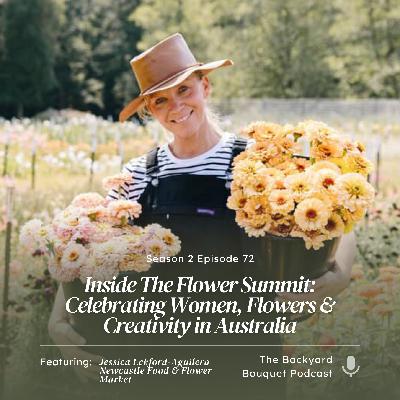
In this episode of The Backyard Bouquet Podcast, we're heading south to Australia to visit Florelie, a small-scale but highly productive specialty cut flower farm near Ballarat, Victoria. Jennifer is joined by flower farmer and dahlia breeder Lorelie Merton, who shares how a gifted bunch of homegrown peonies sparked a journey that led her from speech pathology to full-time flower farming. Today, Florelie grows flowers on just 2.5 acres of a 20-acre property, with 20,000 dahlias, a robust dahlia breeding program, and a thriving tuber business serving Australian gardeners and florists. In this conversation, Lorelie opens up about breeding dahlias specifically for cut flower performance, scaling thoughtfully, rotating crops to protect soil health, and building a true family farm alongside her husband Ethan and their three children. She also shares behind-the-scenes insight into dahlia breeding timelines, seedling selection, tuber sales, and why dahlias are such a unique crop for agritourism and education. Whether you're a backyard gardener, aspiring flower farmer, or deeply obsessed with dahlias, this episode is packed with practical insight and honest perspective. In This Episode, You'll Learn: * How Florelie grew from a hobby into a full-time flower farm * Why dahlias became the farm's primary crop * What it takes to manage and evaluate thousands of dahlia seedlings * How Lorelie breeds dahlias specifically for cut flower use * How crop rotation and paddock rest protect long-term soil health * The role Lorelie's husband Ethan plays as farm manager and agronomist * How Florelie offers workshops, tuber sales, and afternoon tea events in the dahlia fields ***Just a quick note about today's episode: We had a bit of connection lag while recording from across the world, so there are just a few spots where we ended up talking at the same time as we couldn't hear one another. It's minor, but I wanted to mention it in case you notice in this episode. The conversation is still great and I know you're going to love hearing from Lorelie! Connect with Lorelie & Florelie * Instagram: https://www.instagram.com/florelieseasonalflowers/ * Website: https://florelie.com.au [https://florelie.com.au/] Sign up for our podcast newsletter: https://bit.ly/thefloweringfarmhousenewsletter Join Us At The Profitable Dahlia Summit The first-ever virtual summit focused exclusively on growing dahlias for profit is here! Join us March 3–4, 2026 to learn from experienced dahlia growers who are selling bouquets, tubers, CSA shares, event tickets, and more — and doing it profitably. You'll walk away with real strategies to turn your passion into income, even if you're just getting started. Save your spot here: https://thefloweringfarmhouse.mykajabi.com/profitabledahiliasummit/  [https://thefloweringfarmhouse.mykajabi.com/profitabledahiliasummit/]
What's possible when you start with just a small bit of earth—and a love of flowers rooted in childhood stories? In today's episode, I'm joined by Fawn Rueckert, founder of Sego Lily Flower Farm, a thriving suburban flower farm growing on just one-third of an acre in Utah's Salt Lake Valley. Fawn's journey into flower farming began long before her first seed tray—from listening to The Secret Garden as a child to learning from generations of women who gardened before her. What started as a backyard cutting garden evolved into a farmers market business, a regional cut flower plug program serving over 100 growers, hands-on education for backyard gardeners, and leadership as a founding member and president of the Utah Cut Flower Farm Association. In this conversation, we talk about growing cut flowers in small spaces, knowing when to pivot as your business evolves, and why community matters so deeply in flower farming. We also dig into lisianthus—a flower many growers struggle to start from seed—including what it really needs to germinate, why it's so slow, and when it makes sense to grow from seed versus buying plugs. Whether you're growing on an eighth of an acre, dreaming of your first farmers market, or just trying to grow better lisianthus this season, this episode will leave you inspired to try what's possible—right where you are. Links * Sego Lily Flower Farm Website: https://www.segolilyflowerfarm.com [https://www.segolilyflowerfarm.com/]Instagram: https://www.instagram.com/segolilyflowerfarm/ * Snuck Flowers at Snuck Farm Website: https://snuckfarm.com/pages/snuck-flowers * The Backyard Cut Flower Garden Course https://snuckfarm.com/products/backyard-cut-flower-garden-course-in-collaboration-with-sego-lily-flower-farm-spring-2026 * Utah Cut Flower Farm Association Website: https://www.utahflowerfarms.com [https://www.utahflowerfarms.com/] Sign up for our podcast newsletter: https://bit.ly/thefloweringfarmhousenewsletter Join Us At The Profitable Dahlia Summit The first-ever virtual summit focused exclusively on growing dahlias for profit is here! Join us March 3–4, 2026 to learn from experienced dahlia growers who are selling bouquets, tubers, CSA shares, event tickets, and more — and doing it profitably. You'll walk away with real strategies to turn your passion into income, even if you're just getting started. Save your spot here: https://thefloweringfarmhouse.mykajabi.com/profitabledahiliasummit/  [https://thefloweringfarmhouse.mykajabi.com/profitabledahiliasummit/]
What if your garden could feed your family, support pollinators, and bring more joy into your everyday life — all at the same time? In this episode of The Backyard Bouquet Podcast, Jennifer sits down with Tasha Medve, creator of The Purposeful You and author of the bestselling book The Purposeful Gardener. Tasha shares how her journey into purposeful gardening began during early motherhood, when making conscious, sustainable choices for her family became a priority. What started as a small garden and a desire to live more intentionally grew into a thriving backyard oasis — and eventually, a global community of gardeners seeking beauty, abundance, and connection. In this conversation, we explore: * How to design a garden that works for real families and busy lives * Why growing food and flowers together creates healthier, more resilient gardens * Raised beds, vertical growing, pumpkin arches, and her famous Wall of Peas * Companion planting strategies that reduce pests naturally * Incorporating native plants and pollinators for long-term garden health * Gardening as a source of healing, meaning, and joy — even through seasons of grief Whether you're growing in two raised beds or dreaming of a larger backyard transformation, this episode will encourage you to start where you are, trust the process, and create a garden that truly feels like home. Connect with Tasha Medve & The Purposeful You * Blog/Website: https://www.thepurposefulyou.com/ * Instagram: @thepurposefulyou [https://www.instagram.com/thepurposefulyou/] * Facebook: The Purposeful You [https://www.facebook.com/thepurposefulyou] * Join the Waitlist for Tasha's Garden Club: https://forms.gle/u7L73xvQxw4VXmqj6 Show notes: https://thefloweringfarmhouse.com/2026/01/21/the-purposeful-gardener/  Mentioned In Today's Episode: The Dark Side to Floristry Article: https://www.theguardian.com/society/2026/jan/11/theres-a-dark-side-to-floristry-are-pesticides-making-workers-seriously-ill-or-worse Sign up for our podcast newsletter: https://bit.ly/thefloweringfarmhousenewsletter ***Join Us At The Profitable Dahlia Summit*** The first-ever virtual summit focused exclusively on growing dahlias for profit is here! Join us March 3–4, 2026 to learn from experienced dahlia growers who are selling bouquets, tubers, CSA shares, event tickets, and more — and doing it profitably. You'll walk away with real strategies to turn your passion into income, even if you're just getting started. Save your spot here: https://thefloweringfarmhouse.mykajabi.com/profitabledahiliasummit/  [https://thefloweringfarmhouse.mykajabi.com/profitabledahiliasummit/]
Welcome to Season 3 of The Backyard Bouquet Podcast — and to the first episode of 2026. To kick off the new year, I'm doing something a little different. In this episode, I'm sharing the full replay of a live planning workshop I hosted this past weekend called How to Plan Your Most Profitable Dahlia Season Yet. Growers joined live from all over the world — Australia, Canada, Germany, France, New Zealand, the UK, and across the U.S. — and the response made it clear this was too valuable to let disappear once the workshop ended. If you're growing dahlias or running a flower farm and want 2026 to feel more focused, profitable, and aligned, this episode will help you step out of overwhelm and into clarity. What You'll Learn in This Episode In this live workshop replay, we walk step-by-step through how to: * Reflect on your 2025 growing season — what worked, what didn't, and what you learned * Clarify what you want 2026 to look and feel like, both personally and financially * Build a realistic, actionable plan instead of guessing or reacting mid-season * Map your year season by season so you're not scrambling later * Choose the right revenue streams for your farm and stay laser-focused While this training was created specifically for dahlia growers, the planning framework applies to all flower farmers who want to grow with intention and profit in mind. Mentioned in This Episode * The Profitable Dahlia Summit (March 3–4, 2026) A 2-day virtual summit focused on real business strategies for dahlia growers — pricing, selling, marketing, tuber sales, farm events, and more. Grab your ticket here: https://thefloweringfarmhouse.mykajabi.com/profitabledahiliasummit/ There is a free 2026 planning workbook that goes along with this episode. You can download it here and follow along at your own pace: https://thefloweringfarmhouse.myflodesk.com/2026workbook Your Next Step If you make it through this entire workshop, I encourage you to choose one action to take next — even a small one. Whether that's: * Tracking your numbers * Clarifying your revenue goals * Committing to selling instead of giving your flowers away Momentum comes from action. I'd love to hear what your next step is — you can message me on Instagram or leave a review and share what stood out for you. Let's Make 2026 Count 2026 has been declared the International Year of the Female Farmer, and I truly believe this can be your most profitable and aligned growing season yet — if you plan for it. Grab the workbook, pour yourself a cup of coffee or tea, and let's start planning. Welcome to Season 3 of The Backyard Bouquet Podcast.
What if caring for land goes beyond soil tests, nutrients, and visible inputs? In this episode of The Backyard Bouquet Podcast, Jennifer is joined by Brittney Herrera, founder and creative director of Thunder Egg, to explore the concept of geotuning—a practice often described as acupuncture for the land. Through her work, Brittney helps harmonize land and spaces by identifying and correcting geopathic stress, subtle disruptions in the Earth's natural field that can impact people, plants, animals, and the overall vitality of a place. Brittney recently worked with Jennifer to tune her new farm property, and after experiencing the process firsthand, Jennifer felt this was a conversation worth sharing with the flower-growing and land-stewarding community. Together, they keep the conversation grounded and practical, discussing how geopathic stress can show up on farms and gardens, how geotuning works in real spaces, and how this approach can complement regenerative agriculture and soil-first practices. They also explore the role of water, copper, frequency, and ancient land wisdom—and how listening more deeply to the land can support long-term resilience and harmony. This episode is an invitation to curiosity. Whether you're a flower farmer, gardener, or someone who feels deeply connected to the land you care for, this conversation offers a new lens for understanding what it means to truly listen to a place. Connect with Brittney Herrera & Thunder Egg Thunder Egg: https://www.thunderegg.com [https://www.thunderegg.com/]Instagram: https://www.instagram.com/thunder_egg_collaborative/ Geotune: https://www.geotune.com [https://www.geotune.com/]Instagram: https://www.instagram.com/geotune_energy/ Brittney Herrera: https://www.brittneyherrera.com [https://www.brittneyherrera.com/]Instagram: https://www.instagram.com/brittney_herrera_designer/ Mentioned in Today's Episode: Braiding Sweetgrass: by Robin Wall Kimmerer: https://amzn.to/4s5HQhw Sign up for our podcast newsletter: https://bit.ly/thefloweringfarmhousenewsletter ***Join Us At The Profitable Dahlia Summit*** The first-ever virtual summit focused exclusively on growing dahlias for profit is here! Join us March 3–4, 2026 to learn from experienced dahlia growers who are selling bouquets, tubers, CSA shares, event tickets, and more — and doing it profitably. You'll walk away with real strategies to turn your passion into income, even if you're just getting started. 🎟️ Early bird tickets start at just $49 through January 11, 2026. Save your spot here: https://thefloweringfarmhouse.mykajabi.com/profitabledahiliasummit/  [https://thefloweringfarmhouse.mykajabi.com/profitabledahiliasummit/] **This episode may contain affiliate links. If you choose to use them, it helps support the podcast at no additional cost to you.*
What if growing dahlias wasn't about doing everything perfectly—but about showing up, finding joy, and learning to flourish right where you are? In today's episode of The Backyard Bouquet Podcast, we are joined by Anne Long of The Dahlia House, a longtime dahlia grower, educator, and creative who has spent more than two decades growing flowers—and helping others discover that you don't need a huge farm, endless time, or a picture-perfect life to fill your days with beauty. This honest, heartfelt conversation weaves together stories of resilience, loss, hope, and humor, as Anne shares how growing dahlias became both her creative outlet and her life's work. From devastating setbacks with wireworms and disease, to learning how to build a flower business that fits real life, Anne offers wisdom that will resonate deeply with gardeners, flower farmers, and anyone feeling stretched thin. This episode is a reminder that flowers don't ask for perfection—only your presence. In This Episode, You'll Learn: * How growing dahlias can teach resilience through life's hardest seasons * Why perfectionism can hold us back in both the garden and business * What flowers reveal about presence, hope, and living within our limits * How to build a dahlia-focused business that aligns with your values and capacity * Why self-care matters just as much as soil care * How boundaries, clarity, and joy lead to more sustainable success with flowers Show Notes: https://thefloweringfarmhouse.com/2025/12/23/ep-80-growing-dahlias-with-anne-long/ Connect With Anne & The Dahlia House: * Website: https://thedahliahouse.com [https://thedahliahouse.com/] * Instagram: https://www.instagram.com/the.dahlia.house * YouTube: https://www.youtube.com/@TheDahliaHouse2020 Mentioned in today's episode: Veda Austin- Instagram: https://www.instagram.com/vedaaustin_water/ ***Join Us At The Profitable Dahlia Summit*** The first-ever virtual summit focused exclusively on growing dahlias for profit is here! Join us March 3–4, 2026 to learn from experienced dahlia growers who are selling bouquets, tubers, CSA shares, event tickets, and more — and doing it profitably. You'll walk away with real strategies to turn your passion into income, even if you're just getting started. 🎟️ Early bird tickets start at just $49 through January 11, 2026. Save your spot here: https://thefloweringfarmhouse.mykajabi.com/profitabledahiliasummit/  [https://thefloweringfarmhouse.mykajabi.com/profitabledahiliasummit/] **Function Health** – comprehensive blood testing that helps you understand what your body actually needs. Currently on sale for $365 (normally $499)** 👉 https://my.functionhealth.com/signup?code=JGULIZIA10&_saasquatch=JGULIZIA10 **This episode may contain affiliate links. If you choose to use them, it helps support the podcast at no additional cost to you.* Sign up for our newsletter: https://bit.ly/thefloweringfarmhousenewsletter
loading
Comments (2)

Carol Tomkovich

Really enjoyed this!

Aug 27th
Reply

Sandra marg

🔴✅📺📱💻ALL>Movies>WATCH>ᗪOᗯᑎᒪOᗩᗪ>LINK>👉https://co.fastmovies.org

Feb 9th
Reply