


 Claim Ownership
This Climate Business
Subscribed: 67Played: 2,936
Subscribe

© Podcasts NZ / Gorilla Voice Media
Description
This Climate Business is the Kiwi podcast about turning the climate crisis into an opportunity. Every week host Vincent Heeringa talks to entrepreneurs, investors and experts about what they're doing to solve the climate crisis and get NZ down to zero emissions by 2050 – or sooner.
198 Episodes
Reverse
What does October's energy policy announcement mean for the future of NZ's electricity market and the climate? Law professor Barry Barton steps Ross Inglis through a package big on fossil fuels and very quiet about renewables.

Earlier this year New Zealand's first and largest big storage battery began selling into the grid; there are signs that it is already softening prices. So, are we on the cusp of a low-emissions electricity transformation? Climate and energy modeller Dr Jen Purdie tells Ross Inglis that we are...to a point.
Every year the fashion industry produces over 24 billion shoes made largely of synthetics, with little regard for the materials sourced, the wellbeing of the people involved or impact after disposal. Orba shoes are different. Designed in NZ, made from entirely natural materials every part of every shoe Orba makes for the next 100 years will be gone before any synthetic sneakers discarded yesterday.Orba is also included in this year’s Next List - the definitive list of the most sustainable products and businesses as judged by the Sustainable Business Network.Vincent was joined by Gillian Boucher, sustainability manager, and Scott Anderson operations manager. https://orbashoes.eco/
Auckland builder Paul Webster-Young is turning a new home for his sister into a case study for construction that sends less waste to landfill and costs less over time. The key, he tells Ross Inglis, is careful selection of materials and a new kind of collaboration with architects.
New Zealand's houses have come a long way since the '70s but there's plenty we can do to make them more sustainable. Auckland architect Mike Hartley is designing for less building waste and that, he tells Ross Inglis, starts by talking with the builder.
Ken Webster is one of the world’s leading thinkers in the circular economy. For eight years, he led innovation at the Ellen MacArthur Foundation, the world’s leading circular economy network. Visiting Professor, Cranfield University, UK; Fellow, Cambridge Institute for Sustainability Leadership. He is the author of The Circular Economy: A Wealth of Flows (2017) and co-author of The Wonderful Circles of Oz: A Circular Economy Story (2022), Sense and Sustainability (2008) and ABC&D Creating a Regenerative Circular Economy for All (2022). He also contributed to the Handbook of the Circular Economy (2023).And he is a keynote speaker at the NextFest conference in November 18-21 in Auckland. If you’re seeking hopeful solutions for a sustainable economy then NextFest is the place to be - a conference for entrepreneurs, investors, venture capital, technologists and thinkers. In addition to Ken keynotes include George Monbiot and filmmaker Damon Gameau and host of great Kiwi pioneers from Halter, Lodestone Energy, Daisy Lab, Climate VC Fund and pitches from start-ups and activists - culminating in the Sustainable Business Awards. Visit SBN.org.nz or NextFest
A chubby feline is the star of an awareness campaign for the B Corp certification that says your business is getting real about sustainability. B Lab's Australia and NZ CEO Andrew Davies tells Ross Inglis about fat cats and how B Corps are making progress even in difficult times.
Think Like a Forest is a beautiful short film about NZ’s ngahere or native forest and is now showing on TVNZ On Demand, PureAdvantage.org and soon Air NZ In Flight Entertainment. Produced by Pure Advantage as part of its Recloaking Papatuanuku programme, the film is fronted by Sam Gibson aka Sam the Trapman. Pure Advantage’s Simon Millar joined Vincent for a chat about the film, pines and thinking about forests.https://pureadvantage.org/think-like-a-forest/
The annual Climate Change and Business Conference is the biggest corporate meet-up on the climate agenda, attracting delegates from industry, politics and NGOs as well as overseas high-noters. This year’s event featured Lord Adair Turner, of UK Energy Transmissions Commission, Wang Xiaolong, the China ambassador to NZ and Cynthia Houniuhi, who led an historic delegation of Pacific youth to the International Court of Justice (ICJ) this year.Alec Tang of KPMG and Joanna Silver of Westpac were both at the conference and joined Vincent to discuss their reactions.
What would a journalist from outside New Zealand find if they ran the ruler over our current climate policies? Australian writer Royce Kurmelovs has done just that, and he tells Ross Inglis that the answer can be rendered in two words: quiet quitting.
Why is it so hard to invest in nature - not for extraction but for nature itself? We invest in human health. Why don’t we invest in nature health? Well, increasingly we are trying. Nature Based Solutions are embedded in our National Emissions Reduction Plan and in the Climate Adaption Plan - but adoption and action are slow. Just ask anyone trying raise money for conservation, predator control or green infrastructure. Investing in nature is not happening fast enough or at scale. Robin Mitchell is the founder of advisory firm Nature Positive. He is an international biodiversity management expert who advises governments, corporates and finance industry on nature climate strategies.
If you reckon our national strategy for reducing emissions is short on ambition, Jessica Palairet agrees. Jessica heads Lawyers for Climate Action which, together with the Environmental Law Initiative, is taking the government to the High Court for a judicial review of the plan. She tells Ross Inglis what's wrong with the plan and how the law can help fix it.
What does it take to build a globally significant clean tech or sustainability innovation from New Zealand? To answer that, you’d be best to talk those already doing it right? That’s exactly what the Next Wave report has done. It talked to 44 leaders of breakthrough innovations to establish the barriers, the rewards and the opportunities for more innovation in cleantech, climate tech, nature and community. And we need it, with climate and nature under threat like never before. How do we accelerate the solutions? Vincent is joined by the co-authors of the Next Wave, James Griffin from the Sustainable Business Network and Dr Kate Prendergast of the University of Canterbury.
New Zealand's dairy sector has an awful environmental record, but what if we decided to do dairy differently? Iwi-owned Miraka is figuring out how to produce lower-emissions export dairy based on the principles of kaitiakitanga. Miraka's Brendan Haigh explains.
In June, the government announced nine pilots to trial a voluntary nature credits scheme - the closest so far to a biodiversity credit. Led by Act MP and Associate Minister for the Environment Andrew Hoggard, the government says it wants to establish ‘a market that is durable, measurable and transparent to help farmers, landowners, iwi, and conservation groups unlock new income streams for looking after nature on their land.’ One of the nine is the Sanctuary Mountain Maungatautari Biodiversity Credit project an international trade-ready biodiversity credits scheme developed by advisory firm Ekos. It launched officially launch on 24th of June and Vincent is joined by Ekos found Sean Weaver and Sancturary Mountain CEO Helen Hughes.Government announcement hereEkos & Sanctuary Mountain media release here
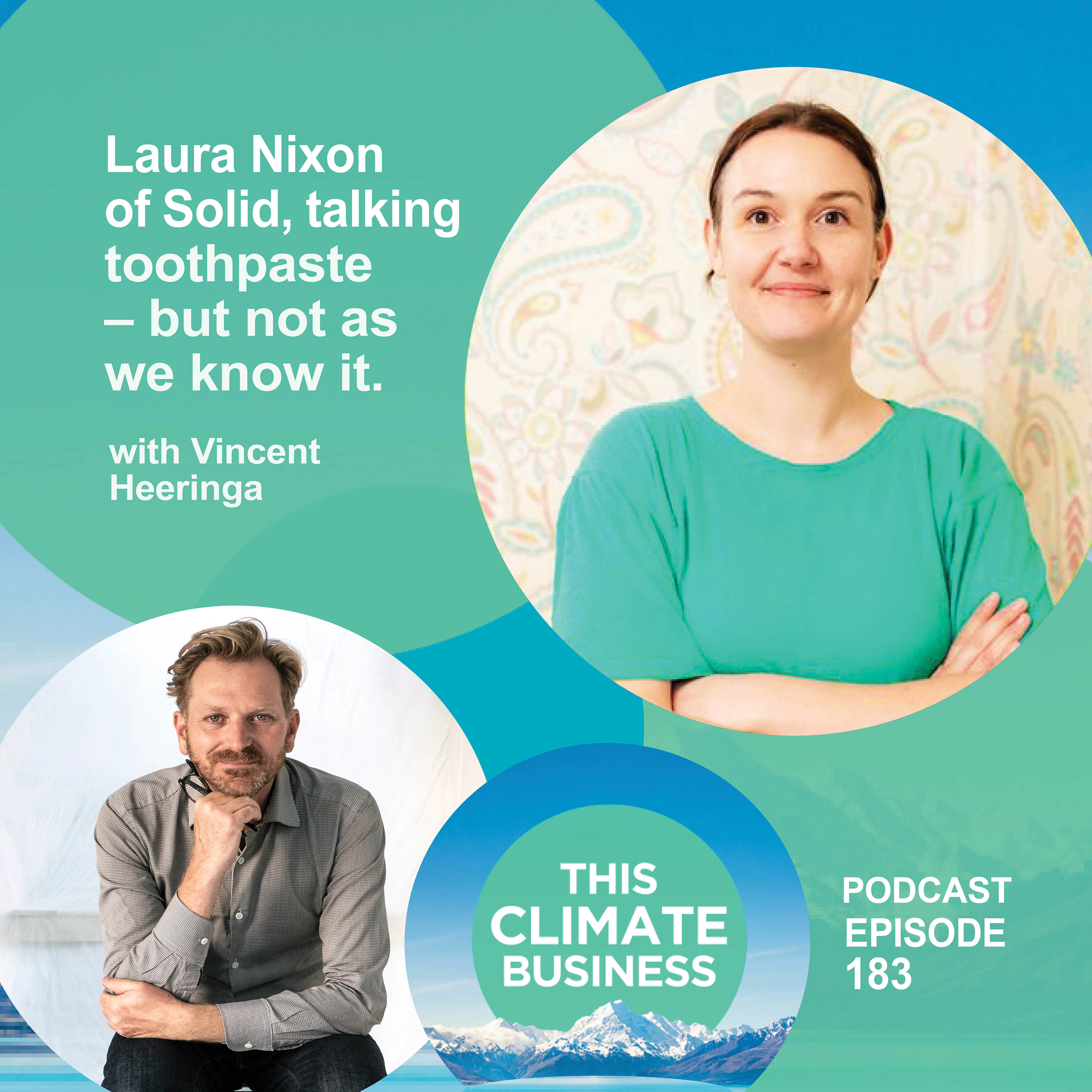
Everyone’s got an idea for a business at some point in their life. Laura Nixon did something about it. A hygienist, troubled by the volume of plastic waste in the dental sector, Laura founded Solid, which replaces unrecyclable plastic tubes with toothpaste tablets and powder in glass jars. Solid’s product lineup includes the world’s first in-store toothpaste dispenser, and teeth whitener. Solid was a finalist in the Sustainable Business Awards and was included in the exciting SBN Next 95 list of innovators.
Biochar is a much-touted but rarely used carbon-rich material derived from organic waste, great for soil health. Kind of like charcoal it’s the result of slow, anaerobic burning. But it has not yet been widely tested in perennial tree or vine crops. Until now. Zespri has been trailing biochar as part of new innovation programme. This project aims to assess the impact of biochar application in kiwifruit orchards when applied with and without the addition of compost, looking at its effect on soil characteristics and fruit production, as well as the economics of application. The results will give growers increased confidence when trialling this promising product and also reinforce Zespri’s leadership in sustainable farming practices.Vincent spoke to Eu Jin Cheah, Global Leader, New Values Opportunities and Bryan Parkes, Head of Innovation Acceleration, both at Zespri.See the innovation fund here: https://www.zespri.com/en-NZ/zagfund
Lee Stewart has written the book on sustainable business...No, actually, he really has! He’s written the e handbook ‘How to build sustainability into your business strategy’ for managers across Australasia. A Kiwi with experience in the UK, Australia and the Pacific, Lee has worked for Fujitsu and Fonterra and now heads ESG Strategies, a consulting company to corporations, and he joins me from a glorious sunny Sydney.
New Zealand was an early mover in corporate climate disclosure; these days around 200 of our largest companies publicly report on what they’re doing about their emissions and the risk they’re exposed to from climate change. Now the government is considering relaxing the reporting regime because, we’re told, it’s onerous and expensive. Victoria University’s Dr Yinka Moses has studied climate reporting practices in New Zealand, Australia and the UK, and he tells Ross Inglis that cutting back on them is simply bad for business.
The industrial adhesives essential to MDF, particle board and the like are a health hazard and a $12billion business. New Zealand company Nilo has a better, kinder glue made from recycled plastics. Managing director Tim Williams tells Ross Inglis all about a sticky business.

Comments

Download from Google Play

Download from App Store
 United States