


Technovation with Peter High (CIO, CTO, CDO, CXO Interviews)
Subscribed: 393Played: 21,001
Subscribe


Description
Twice-weekly conversations with top executives and thought leaders at the intersection of business, technology, and innovation. Each episode of Technovation explores the technology trends that are transforming business, and the leaders driving digital change inside their organizations. Produced by Metis Strategy and hosted by firm President Peter High, Technovation is the premier podcast for IT and technology professionals with the largest collection of interviews with elite CIOs, CTOs, and CDOs.
855 Episodes
Reverse
What does it really take to design for resilience in an AI-first world?
In this panel from the Metis Strategy Summit, Amtrak CDO Judith Apshago, GE Aerospace CIO David Burns, and Zoetis CDTO Keith Sarbaugh explore how resilient infrastructure is becoming the backbone of enterprise trust, uptime, and AI scalability.
Tune in to learn how these leaders are:
Responding to cloud outages and software disruption in real time
Building AI literacy, governance, and use-case portfolios at scale
Extending cyber defense and IT support to vulnerable supply chain partners
Using edge computing and sensors to enable predictive diagnostics
Converging IT and OT teams to enhance infrastructure intelligence
1036: What does it mean to manage a digital workforce?
In this episode of Technovation, we feature a panel from our most recent Metis Strategy Summit where three top executives explore how AI is reshaping work, both automating tasks, and changing the nature of management itself.
Peter High speaks with:
Jennifer Charters, Chief Information Officer at Lincoln Financial
Prasanna Gopalakrishnan, Chief Product & AI Officer at ADP
Daniel Marcu, Global Head of AI Engineering at Goldman Sachs
Together, they discuss:
Why AI agents require new thinking about team structure and oversight
How CIOs and CHROs must partner to build enterprise AI fluency
The risks of shadow AI and the need for secure platforms
How habit loops and performance incentives impact AI adoption
What it takes to balance innovation speed with organizational readiness
Our broadcast today features a panel from our most recent Metis Strategy Summit on the topic of Delivering the Product Operating Model (and Mindset) at Scale.
In this panel episode, we explore the limits and lessons of scaling the product operating model. Sal Companieh (Cushman & Wakefield), Jim Fowler (Nationwide), and Diane Schwarz (Smurfit WestRock) reflect on where product thinking thrives and where it breaks down.
Here are 5 takeaways from their candid discussion:
Why “readiness” must come before model
The risks of forcing product teams into fragmented structures
When to co-create with business leaders—and when to slow down
How agile funding models can clash with CapEx culture
What to do when the organization “doesn’t want the service”
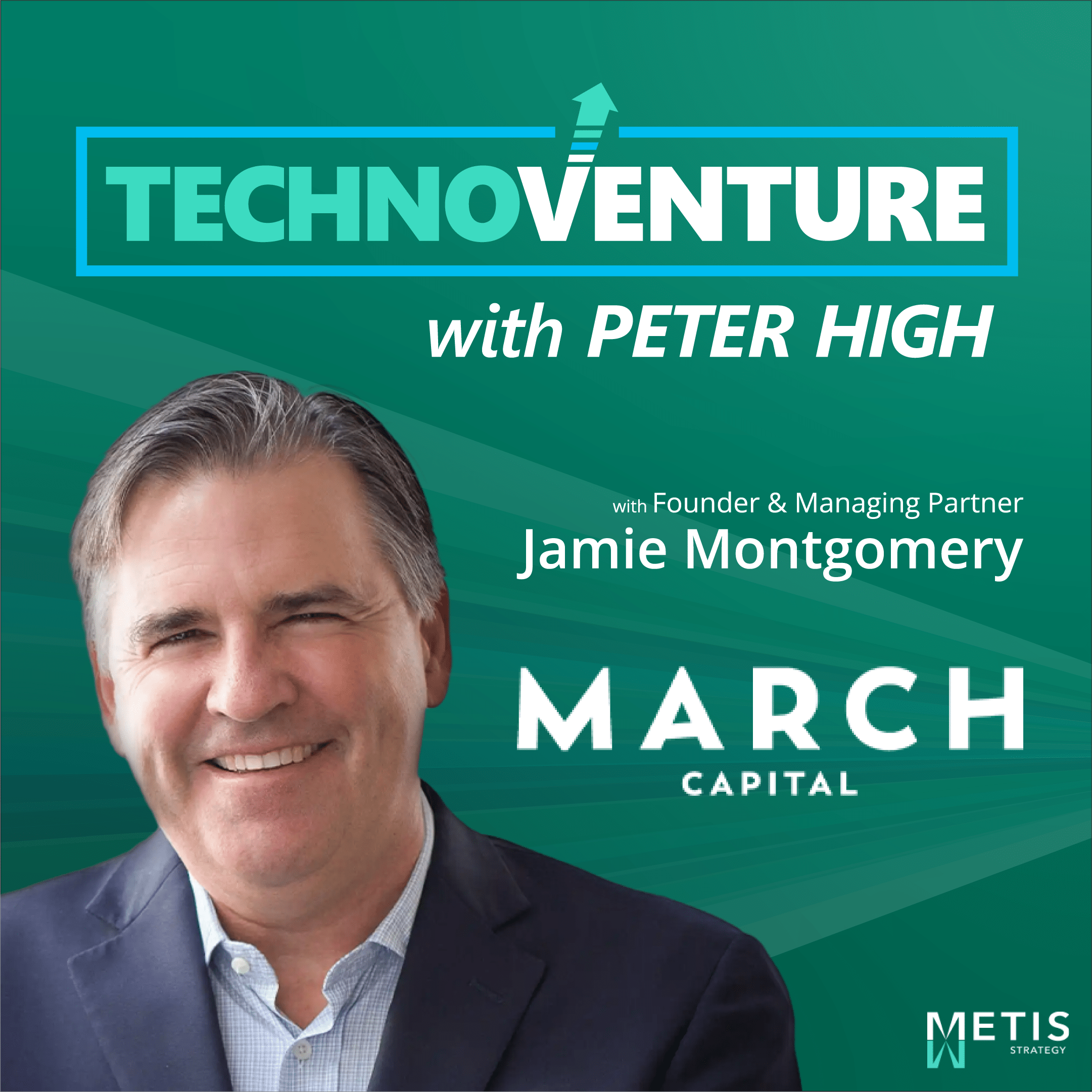
What if the most defensible companies of the AI era aren’t the ones building the infrastructure—but the ones using it to rethink workflows?
In this Technoventure episode, Peter High speaks with Jamie Montgomery, Founder and Managing Partner of March Capital, about why the firm is investing heavily in the AI application layer—not chips, not clouds, but the companies delivering real task-based outcomes.
Key topics explored:
Why workflow-based moats beat data moats in the new venture cycle
How application-layer companies are scaling faster with leaner GTM
The ripple effects of AI CapEx on the U.S. economy and tax base
March Capital’s bets on open-source LLMs and scientific discovery
Why Montgomery believes AI “bailed out” the U.S. and VC industry alike
What’s stopping AI from scaling across the enterprise? For Madhu Ramamurthy, CIO of Zurich North America, it’s not the technology. It’s the culture.
In this episode, Madhu shares how he’s navigating the paradox of AI: a tool with unprecedented potential, surrounded by institutional resistance, unclear regulations, and cultural misalignment. He outlines Zurich’s approach to responsible AI deployment, organizational change, and ethical tech use.
Key highlights include:
How “organizational antibodies” can kill innovation before it scales
The case for explainability and governance in AI development
Why domain expertise is more valuable than tech fluency
Building AI-native teams outside of legacy systems
Madhu’s warning on digital flattery and sycophantic AI
What does it really take to scale AI across a global enterprise?
In this episode, Jaime Montemayor, Chief Digital and Technology Officer at General Mills, shares the AI playbook behind the company’s digital transformation from foundational investments in cloud and data governance to business-led innovation across supply chain, e-commerce, and marketing.
With 96% of General Mills’ supply chain data now clean and governed, Jaime’s team is shifting from predictive analytics to agentic architectures that enable scalable, AI-powered automation.
Key insights include:
Why cloud migration came before ERP modernization
How trust and business integration drive AI adoption
Building a connected data foundation to serve every segment
Agentic AI use cases in supply chain and marketing
Org design strategies to “lift and shift” innovation at scale
What does it take to transform IT from a bottleneck into a business accelerator?
In this episode, Waco Bankston, Chief Information Officer at NiSource, shares how he’s repositioning the IT organization to support growth, enable speed, and shift decades of technical and cultural inertia. Leading a 6.5-year enterprise transformation effort, Waco discusses the discipline required to modernize legacy systems while instilling a new execution culture.
Key insights from the episode include:
Building a modern tech foundation to support future acquisitions
Restructuring outsourced/insourced IT mix through platform consolidation
Shaping team behavior through leadership-by-experience
Establishing unified governance across AI, cybersecurity, and innovation
Leading with operational safety and customer-back design
What does it take to reimagine a 10,000-employee enterprise for a digital-first future?
In this episode, Unum CTO Gautam Roy breaks down how he transformed the company’s operating model, culture, and technology foundation by reshaping experiences from the customer backward.
Gautam shares how Unum evolved from applications to journeys to value streams; how AI, data, and automation have become levers for acceleration; and how innovation culture and continuous learning drive enterprise adaptability.
Highlights:
Unum’s shift to digital-first architecture and “moments that matter”
How AI, data, and automation remove friction across operations
Building predictive, proactive technology employee experience
Creating safe spaces and recognition models for innovation
Developing a future-focused, cross-functional learning culture

 1
1What if your company’s greatest advantage isn’t the product—but the purpose behind it?
Mike Hayes, Managing Director at Insight Partners and former COO of VMware, believes mission clarity is more than culture—it’s a strategic asset. Drawing on 20 years as a Navy SEAL and senior tech executive, Mike shares why knowing “who you want to be” is a superpower for founders and boards.
In this episode, Mike and Peter High discuss:
How purpose-led companies outperform in high-growth markets
Mike’s “Three Circles” framework for aligning talent to mission
What Insight Partners looks for in founder-VC alignment
How to say no (with clarity) when everything seems urgent
Why values-based leadership scales in unpredictable markets
What does it take to evolve IT into a forward-looking innovation engine?
Mike Blandina, CIO of Snowflake, shares how he’s reimagined IT as “Enterprise Technology” as a way to describe what ‘IT’ really does: lead a solutions-first mindset at Snowflake designed for the AI era. In this conversation, Mike reflects on his first eight months leading tech at one of the world’s most AI-forward data cloud companies.
Key highlights include:
The philosophy behind the Enterprise Technology rebrand
Building Raven and RevOps—AI agents replacing 250+ dashboards
The Customer Zero model for product influence
Governance and localization strategies for responsible AI
Redefining staff models to include digital agents
What if your hiring strategy were fueled by the largest contingent workforce dataset in the world?
Magnit CEO Chandra Dhandapani joins Technovation to explore how data is reshaping how companies think about talent—from role design to sourcing strategy to real-time labor cost insights. Chandra also shares lessons from her journey from CIO to CEO and offers perspective on why automation—not AI—is the skill trend to watch.
Key topics covered include:
12% YoY surge in automation roles vs. 2% in AI
Data-driven frameworks for balancing contingent and permanent talent
How Magnit uses GenAI internally via its “Maggi” platform
Strategic applications of workforce analytics
Leadership shifts from digital to enterprise-wide responsibility
How can AI be designed from the customer back and not the model forward?
Hari Gopalkrishnan, Chief Technology and Information Officer at Bank of America, joins Peter High to share how one of the world’s largest financial institutions grounds its AI strategy in user behavior. From developing Erica to enabling employees with tools like Ask Merrill, Hari explains why every AI solution must begin with real customer or employee friction.
Key topics include:
The evolution of Erica from NLP to large language models
How to avoid the trap of “shiny object” AI
Bank of America’s 3-tier AI architecture: productivity, personas, and platforms
Why dismantling old workflows is the prerequisite to automation
Training 200,000+ employees in AI through “The Academy”
What does it take to scale AI from 800 siloed experiments into enterprise-wide impact?
Doug Schmitt, President of Dell Technologies Services and CIO of Dell, joins Peter High to unpack the company’s enterprise AI playbook—a journey from fragmented innovation to four scalable platforms used across software development, customer service, supply chain, and sales.
Highlights from this episode:
How Dell consolidated 800 AI initiatives into 4 core platforms
Why Doug sees AI as both tech and business model disruption
The “customer zero” approach to testing and learning at speed
Agentic AI examples in field service and internal ops
How Dell’s AI factory enables rapid experimentation across 3,000+ customers

What does it take to play the long game in innovation?
Venture capitalist Brad Feld has spent four decades answering that question as a founder, mentor, and early-stage investor in companies like Fitbit, MakerBot, and Techstars. In this episode, Feld unpacks the enduring impact of mentorship, the logic behind his “Give First” philosophy, and how startups and enterprises alike can benefit from ecosystem thinking.
Key insights include:
How a childhood visit to Frito-Lay inspired a tech career
What separates peer mentorship from transactional networking
The origin and strategic power of Techstars’ “Give First” mantra
How Feld invests in category creation (wearables, 3D printing, cloud)
Why innovation requires emotional resilience and long-term relationships
What if your company’s data could become a public good and a competitive moat?
Beaumont Vance, SVP of Data and AI at Paychex, shares how his team transforms payroll and HR data into real-time economic insight, powering everything from AI copilots to U.S. government response efforts. With 1 in 11 U.S. workers on the platform and 39 million client interactions annually, Paychex treats data as infrastructure.
In this episode, Beaumont and Peter High discuss:
How Paychex monetizes data responsibly
Why statistical precision trumps survey-based signals
Building AI-ready data from unstructured knowledge
Lessons from growth equity on “data moats”
What AI agents will unlock next
1025: What does it take to go from CIO to CEO? For Saul Van Beurden, tech leadership was the ideal proving ground.
Now CEO of Consumer, Small, and Business Banking at Wells Fargo, Saul shares how his background in IT helped him lead at enterprise scale. In this episode, he speaks with Peter High about the strategic, operational, and cultural mindset shifts that enabled his rise—and why CIOs are uniquely positioned to lead beyond technology.
Key topics explored:
Translating technology leadership into enterprise-wide strategy
Lessons from operating at scale in risk-heavy environments
Building customer-centric AI and data foundations
Driving channel parity across digital, branch, and contact center
Creating pathways for talent through neurodiversity hiring
Where is AI actually moving the needle in industrial operations?
In this episode, Anil Bhatt, Chief Information and Digital Officer of Norfolk Southern, shares how the $12B freight rail company is turning AI into measurable value without overhyping its potential.
Topics include:
A disciplined approach to AI deployment with measurable ROI
Norfolk Southern’s “3 As” framework for enterprise data strategy
Copilot adoption to augment associate workflows
Lessons from customer-centric redesign of freight experiences
The role of AI in enabling safety, resilience, and transformation
What does it really take to scale AI responsibly across a global enterprise?
In this episode, Ramon Richards, Chief Technology Officer at T. Rowe Price, shares how his team is advancing AI capabilities with discipline and speed—balancing innovation with the need for risk controls, data readiness, and workforce enablement.
Ramon unpacks T. Rowe Price’s multi-pronged approach to artificial intelligence, from founding an AI Labs function to piloting autonomous agents, all while modernizing infrastructure and investing in talent development.
Key topics include:
Building an enterprise AI strategy with embedded risk and legal oversight
Launching “ChatTRP” to enable AI access across the organization
Preparing data and cloud architecture for scaled GenAI use cases
Developing human-in-the-loop frameworks and change management tactics
Piloting agentic AI to explore the future of autonomous workflows

How can venture investors consistently identify the next breakout market?
Barry Eggers, Founding Partner at Lightspeed Venture Partners, reveals the firm’s thesis-driven approach to venture capital of using early “learning investments” to test conviction, then scaling fast into emerging markets before the crowd arrives.
In this episode, Barry shares insights from Lightspeed’s foundational bets in enterprise tech, Snap’s billion-dollar rise, and how the firm built multi-company portfolios around early themes like flash storage and analytics.
Key highlights include:
Lightspeed’s strategy for placing early bets to gain market insight
The story behind the firm’s $500K Snap investment and $1B+ return
Why EQ matters more than technical depth in founder partnerships
How globalization and secondaries have reshaped venture economics
What it takes to defend against competition in the AI era
What if your innovation team operated more like a venture fund than a lab?
In this episode of Technovation, Peter High speaks with Andres Vazquez, Chief Digital Intelligence Officer of América Móvil, about how he leads open innovation at scale, evaluating thousands of companies a year to drive customer value, operational efficiency, and revenue.
Key topics explored include:
How Andrés acts as a “VC without capital” inside a $46B telecom
Why América Móvil avoids trendy tech experiments without clear ROI
Three strategic filters for external innovation: revenue, efficiency, and CX
The company’s infrastructure advantage in the AI age
Lessons from building a telco empire alongside Carlos Slim

Comments

Download from Google Play

Download from App Store
 United States