


Air India 787 Crash Investigation: NTSB–India Standoff, Black Box Battle & Stunning Near Misses
Description
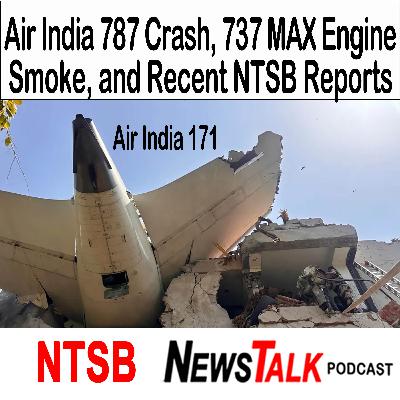
Episode 18 begins with an extraordinary behind-the-scenes dispute surrounding the Air India Boeing 787 crash investigation. Max and Rob open with a Wall Street Journal report describing how U.S. technical experts arrived in Delhi last summer expecting to assist with the black-box analysis, only to be told they would need to board a late-night military flight to a remote facility. NTSB Chair Jennifer Homendy expressed concerns about U.S. personnel and equipment being moved into an area under State Department terrorism advisories, especially given rising tensions in the region. The NTSB pushed instead for data extraction either in Delhi or in Washington, triggering a rapid series of high-level calls involving the U.S. Secretary of Transportation, Boeing, and GE Aerospace.
Indian officials insisted they had full capability to download the recorders, yet simultaneously requested more than 30 pieces of specialized equipment from the NTSB, further complicating the diplomatic dynamics. Homendy ultimately issued a 48-hour ultimatum: select Delhi or Washington for the data download, or the U.S. would withdraw from the investigation entirely. India chose Delhi, but the episode highlights how political sensitivities can shape technical investigations—especially when early evidence, as reported, suggested the possibility of intentional fuel-cutoff switch manipulation. The hosts note that pilot-suicide scenarios, though rare, account for more fatal commercial accidents than many pilots realize, citing EgyptAir, Germanwings, Malaysia 370, and other historical cases.
From the geopolitical, the episode shifts to more traditional NTSB investigations. A midair collision in Canada between a Cessna 172 and a Piper Seminole resulted in the 172 losing a wing and crashing, while the Seminole landed safely. Max shares the surprising statistic that roughly half of U.S. midair collision victims survive and recounts how a midair experienced by Cirrus co-founder Alan Klapmeier helped inspire the CAPS parachute system.
The next story involves a Piper Arrow III that crashed during a nighttime arrival in Pittsfield, Illinois. The pilot had flown nearly five hours from Alabama—an exceptionally long time in that type of aircraft—and arrived as conditions were deteriorating to low visibility and a 300-foot overcast. Max emphasizes the difficulty of recognizing inadvertent IMC at night and discusses how fatigue and lack of instrument proficiency may become factors once more details emerge.
A TBM 700 accident in Monroe, Wisconsin offers another sobering look at missed-approach challenges. With visibilities down to a quarter-mile and ceilings around 300 feet, the aircraft attempted a GPS approach to Runway 12, then initiated a missed approach. Instead of climbing outbound on the published track, radar data shows the aircraft turning prematurely, losing airspeed, and entering a stall and loss of control. Max highlights how even experienced instrument pilots often under-practice missed approaches in actual IMC, making it one of the most common fatal accident points in general aviation.
The episode then examines a dramatic near-miss involving an Air Arabia Maroc Airbus A320 departing Catania, Italy. A ferry crew failed to load weight-and-balance data into the MCDU, meaning no V-speeds were computed. The aircraft rotated late, climbed shallowly, then descended toward the sea at night, triggering multiple GPWS warnings before the crew recovered at just 41 feet above the water. With moonless, dark-night conditions and no visual horizon, this oversight nearly resulted in a hull loss. Both pilots were highly experienced—proof that skipping basic procedures can endanger even seasoned crews.
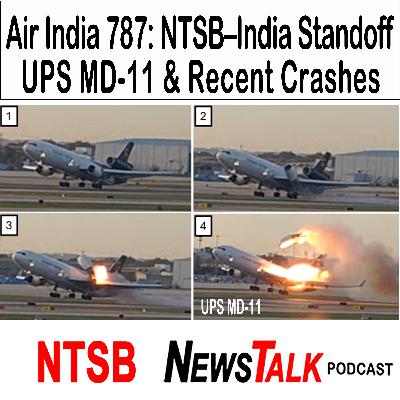
Next, Max and Rob turn to the UPS MD-11 engine-separation crash in Louisville. New preliminary findings show fatigue cracking in engine-pylon attachment lugs, reminiscent of the American Airlines DC-10 crash in 1979 where a maintenance procedure overstressed the pylon. The MD-11 fleet remains grounded as inspections continue, and Max notes how fortunate it is that inspectors have since found additional cracks on other aircraft. Even with a rapid emergency-response drill completed just weeks earlier, the flight crew had no survivable options the moment the engine detached at rotation.
Finally, the hosts analyze new details from the Cirrus SR22 crash in Lincoln, Montana. The pilot, attempting his first-ever night arrival at a mountainous airport with no instrument approach, lined up over a highway before maneuvering at low altitude, with flaps changing configuration and the autopilot still engaged while turning in the pattern. A stall warning sounded, followed by a steep bank and loss of control. Max emphasizes a longstanding teaching point: pilots should avoid first-time nighttime arrivals at unfamiliar mountain airports, especially those without instrument procedures—which often signals surrounding terrain too challenging to support one.
Across all these stories, Max and Rob reinforce a common theme: safety is not a static condition but an ongoing behavior. Pilots must maintain awareness, practice critical skills like missed approaches and go-arounds, and respect how quickly conditions or workload can change. The episode offers practical insights for every pilot seeking to build resilience and margin into their flying.













 United States
