


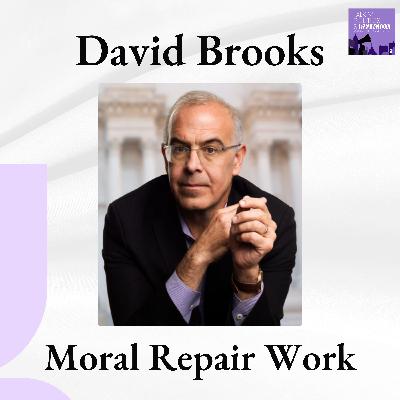
ICYMI: David Brooks on Moral Repair, Friendship, Faith, and the Inner Work of Democracy
Description
One of TP&R’s all-time standout conversations—perfect for new listeners discovering the show this week.
In this special ICYMI release, Corey revisits his deeply human, deeply honest conversation with David Brooks—New York Times columnist, bestselling author of The Second Mountain and How to Know a Person, and one of the most thoughtful public voices on moral formation, democracy, and what it takes to live well with one another.
This episode has become a listener favorite not because it’s political in the usual sense… but because it’s personal. Corey and David talk candidly about depression, friendship, loss, faith, identity, community-building, and the inner transformations required for a democratic people to live together without coming apart.
If you’re new to TP&R thanks to the Podbean or Overcast promotions, start here. This is TP&R at its best: honest, vulnerable, intellectually rigorous, and grounded in real moral imagination.
📣 Calls to Action
✅ TELL A FRIEND ABOUT TP&R!!! Help spread the message of meaningful conversation.
✅ Subscribe to Talkin' Politics & Religion Without Killin' Each Other on your favorite podcast platform.
✅ Leave a review on Apple Podcasts, Spotify, or anywhere you listen
✅ Join the community on Substack: coreysnathan.substack.com
✅ Watch & subscribe on YouTube: youtube.com/@politicsandreligion
⏱️ Timestamps & Key Topics
[00:00 ] Corey welcomes new listeners & explains the ICYMI series
[00:02 ] Introducing David: columnist, author, moral observer
[00:04 ] On Mets fandom, heartbreak, suffering, and hope
[00:08 ] Camp friendships, identity formation & “Brooksy”
[00:13 ] Depression, presence, and “the ministry of ‘that sucks’”
[00:20 ] Loving presence, bathmats, and practical compassion
[00:23 ] Growing up Jewish → becoming Christian
[00:30 ] Jesus as a Jew, a renegade, and a revolutionary in a real historical world
[00:33 ] Identity, peoplehood, and ambivalence in a time of antisemitism
[00:36 ] Christianity beyond “the Shire”: Keller, Wehner, Rauch
[00:38 ] The rise of loneliness, social fragmentation & the birth of Weave
[00:41 ] Meeting America’s “weavers”: trust-builders & quiet healers
[00:46 ] David’s writing practice: piles on the floor, synthesis, and deadlines
[00:51 ] Actors, empathy, and the craft of deeply seeing others
[00:53 ] The TP&R Question: how do we talk across differences?
[00:57 ] Moni Guzmán, Crucial Conversations & asking “Why you?”
[00:58 ] On Michael Gerson, Tim Keller, loss & gratitude
[01:04 ] How to follow David Brooks and dive deeper into his work
🧠 Key Takeaways
Presence > solutions. When someone is suffering, the most healing thing isn’t fixing—it’s showing up.
Everyone has a soul. David’s turning point toward faith began in a subway station, noticing the invisible depth of every person around him.
We need weavers. America’s social fragmentation is being repaired by local, trusted community-builders showing quiet, everyday courage.
Curiosity is a moral virtue. Asking “How did you come to believe that?” opens the door to empathy across political and religious divides.
Conversation is a craft. Don’t top stories. Don’t multitask attention. Find the disagreement under the disagreement.
We inherit peoplehood as much as belief. David discusses living as a Jew ethnically and culturally, even as a practicing Christian.
Faith involves ambivalence—but also joy. “If you can believe it three or four days out of ten, believe it with laughter.”
💬 Notable Quotes
“Life has not stopped expecting things of you.”
“Your first job in conflict is to stand in the other person’s standpoint.”
“Presence is the core of friendship—words often fail, but presence doesn’t.”
“We’re beggars who tell other beggars where we found bread.”
“Jesus wasn’t a wispy Renaissance figure—he was a badass Jewish revolutionary in a world of occupation and revolt.”
“The smartest Christians are Jews.” (Brooks, joking-but-not-joking)
“Argument is prayer.”
🛠️ Resources Mentioned
David Brooks — How to Know a Person
Weave: The Social Fabric Project — https://weavers.org
Mónica Guzmán — I Never Thought of It That Way
🔗 Connect with Corey
Corey is @coreysnathan on all the socials...
🙌 Our Sponsors
Pew Research Center: www.pewresearch.org
The Village Square: villagesquare.us
Proud members of The Democracy Group
May your next conversation be a little braver—and a little kinder. 🎙️✨













 United States
