


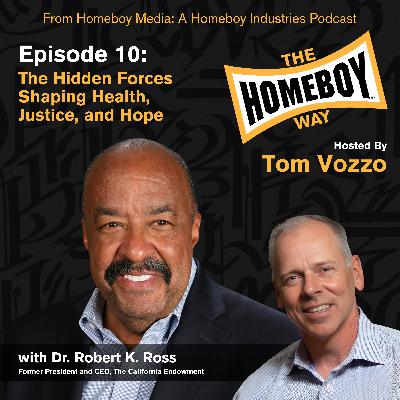
The Hidden Forces Shaping Health, Justice, and Hope with Dr. Robert K. Ross
Description
In this episode of The Homeboy Way, Tom Vozzo sits down with Dr. Robert K. Ross, former CEO of The California Endowment, for a powerful conversation about healing, justice, and what it means to truly see people living at the margins. Reflecting on decades as a pediatrician, public health leader, and philanthropic executive, Dr. Ross revisits the moments that shaped his path from the crack epidemic of the 1980s to the rise of public health as a movement to the day the Homeboy way reshaped how he understood philanthropy.
Through vivid stories, he explains why foundations must stop fixing communities and start listening to them. He shares how Homeboy helped him move from research-driven decision-making to a more human, moral, and spiritually grounded approach.
Tom and Dr. Ross explore how policy shifts when data meets lived experience, why the government keeps missing the mark, and what real support for marginalized leaders requires.
Key Takeaways
Real community change starts with seeing beyond individual problems.
Dr. Ross’ journey shows that healing must shift from clinical care to addressing the deeper forces that shape people’s lives. Poverty, violence, addiction, and trauma are not isolated issues but interconnected conditions that require a wider lens.
Social determinants must guide every decision.
Health is shaped by safety, opportunity, environment, and dignity. The example of women walking in cemeteries for safety makes clear that neighborhoods influence wellness more than medical systems do. Policy and funding must prioritize these realities.
Philanthropy works best when it listens.
Dr. Ross learned to move from top-down decision-making to partnership. Communities hold wisdom born from lived experience, and real change happens when that wisdom shapes programs, funding, and strategy.
Grants carry strategic, moral, and spiritual purposes.
They support services, challenge unjust systems, and affirm the humanity of those served. When philanthropy sees people rather than problems, the work becomes deeper, more honest, and more transformative.
Invest in Infrastructure, Not Just Mission.
For charismatic, mission-driven organizations to endure, funders must also support the operational and business-side capacity building.
In This Episode:
00:00 – Opening and introduction to Dr. Robert K. Ross
01:03 – Dr. Robert K. Ross from pediatrician to philanthropy
02:00 – The impact of crack cocaine on communities
03:37 – A family story that shifted everything
05:08 – Transition to public health and philanthropy
09:51 – Challenges and lessons in philanthropy
16:27 – The broader view of health and community
21:07 – Government’s role in community policy
21:47 – The power of stories and data
22:15 – School discipline and health
24:12 – Campaigning for change with Schools Not Prisons
26:08 – Supporting Homeboy Industries
29:07 – Challenges and lessons in funding
37:52 – Faith and philanthropy
41:08 – Conclusion and gratitude
Notable Quotes
"I wanted to be a healer for a community and not just a patient." — Dr. Ross (05:41 )
"No numbers without stories. No stories without numbers."—Dr. Ross (21:44 )
"Poor people pray hard."— Dr. Ross (39:48 )
“We see you, we hear your story, your pain, your trauma, your hopes and dreams.”Dr. Ross (13:34 )
"I’ve always been attracted by the power of listening and humility" — Dr. Ross (27:41 )
Resources and Links
Homeboy Industries
Homeboy Media
Dr. Robert K. Ross
Thomas Vozzo
The Homeboy Way: A Radical Approach to Business and Life: https://www.amazon.com/Homeboy-Way-Radical-Approach-Business/dp/082945456X
Credits:
Hosted by: Tom Vozzo
Produced by: Podify, and Alexa Rousso and Melody Carter of Homeboy Media




 United States
