



Compounded Retatrutide? What the Judge Said
Description
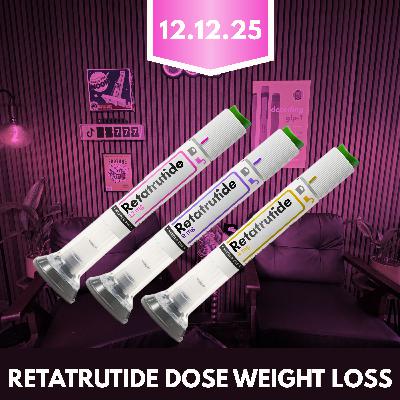
Retatrutide is years away from FDA approval and yet the fight over access, price, control of this medication is already well underway. That's what this podcast is going to be about today. There's well over a hundred thousand people by my estimates who are already on some form of this medication today. And that should tell you enough about how disruptive this molecule is and will be. It is a game changer among game changer. We've been talking about it for three years here at On The Pen, well before any of your favorite gym bros were talking about Retatrutide. We were talking about Reta, who tried Retatrutide here at On The Pen. And that's because we identified this triple agonist as a game changer among game changers. So This is going to be a very Retatrutide heavy episode, and so I hope you'll join us and stick with us if this is a topic you enjoy, because I think this is really going to effectively lay the groundwork for what accessibility to this medication will look like. So let's get into it.
Welcome to the On The Pen Podcast with your host, Dave Knapp. Welcome to the On The Pen, the weekly dose podcast. This is our weekly roundup in incretin memetic news. And frankly, there's no news that is bigger than Reta-Trutide news. Just find me any news that is bigger than the data that we got on Reta-Trutide. Now, we already did a video about the Triumph Phase II clinical trials that we got in osteoarthritis of the knee. You can go back and check out that video if you'd like more data. So we're not gonna super... rehash the data. We'll go over at a high level what the data showed us. We're not going to go over how the medicine works, because by now we all know that it's the triple agonist, right? If terzapatide was a dual agonist, GLP-GIP, Retatrutide is the triple agonist that adds to it a glucagon component, which is absolutely just shredding, shredding liver fat. It is absolutely revving up people's metabolism and showing a tremendous amount of weight loss.
So let's get into what the weight loss looked like in this first trial, because there are longer obesity trials where, where the primary outcome is the weight loss this was again a specific trial in measuring pain reduction in folks with osteoarthritis of the knee but check out these numbers these are placebo adjusted meaning it's taking the two percent out that people lost on placebo but looking at these numbers Folks on one milligram over forty eight weeks lost seventeen percent. They bumped up to four milligrams. Those folks lost twenty two percent. So right there at the lowest dose, you're already reaching the efficacy of today's drugs that are on the market, like triseptide and semaglutide in their various forms. If you bumped up to eight milligrams, you saw twenty four percent placebo adjusted weight loss and at twelve milligrams, twenty six point four percent weight loss. Adding back in that two percent of the placebo that those on placebo loss, that's twenty eight point four percent weight loss in these forty eight weeks at the highest dose.
When you adjust for some of the more real world outcomes, you kind of ding the numbers a little bit based upon people who quit the drug, et cetera. Those numbers look more like a twenty percent weight loss and twenty three point seven percent weight loss at the highest dose. But even then, you're still seeing a drug that is better than the current drugs that are on the market. around forty eight percent of patients on Retatrutide lost greater than twenty five percent. And then if you were at that twelve twelve milligram dose, that highest dose patients lost fifty nine percent of patients lost more than twenty five percent of their body weight. There was a subset that lost thirty percent of their body weight and some even over thirty five percent of their body weight on Retatrutide.
So the lower doses compete with today's best drugs and the upper doses are entering into bariatric surgery level weight loss. And that's putting the whole obesity system on notice and probably a lot of surgeons nervous because typical body weight loss was something like the street sleeve gastrectomy. For example, it's about eighteen to twenty five percent body weight. The Roux-en-Y gastric bypass twenty five to thirty five percent weight loss or the duodenal switch thirty to forty percent weight loss. So the upper doses of Ritutrutide overlap with sleeve and bypass outcomes without any surgery. It's incredible. It is a game changer among game changer. It is the new benchmark in obesity medicine. And there's actually more data, like I said, landing in later twenty twenty six. The longer duration will historically, if history is a marker, equal more weight loss than we even see here at this forty eight weeks.
We have an interview that will be airing later this week on our channel and on our podcast with our friend Mimi from Australia who just wrapped up her clinical trial on Retatrutide. They ended it like ten weeks early on her, which was a huge bummer to her. So we're going to hear from her because she had to end abruptly. We're going to hear her story, an incredible story. She's one of those folks that got up that thirty five percent body weight loss in the time that she was on Retatrutide. So, this is just showing you that these drugs are not simply an alternative to bariatric surgery. We are approaching a point in time where these are on par with bariatric surgery, and as people are on this Reta-Trutide trial, you see that these numbers aren't plateauing either. So we will see stronger weight loss numbers the longer that these folks are on this trial. And I think you'll see some of those numbers in that population of folks on the higher doses eclipse maybe even some of what we see with some of these bariatric surgeries.
the real story that i think is taking shape here is not in how powerful Retatrutide is because we've literally been expecting or anticipating this kind of data for more than three years at on the pin we've been talking about this and i think that's sort of reflected in the fact that you didn't see this massive spike in eli lilly stock wall street was expecting this as well Um, so it was on par, I think with expectations, but the expectations are astronomical compared to previous options that were available to patients and all the innovation in the world. All of these drugs, we talked at last week about WV, E double Oh seven, the James Bond of weight loss that targets fat, not only targets fat loss, but it also targets the promotion of building of, of lean muscle mass. We're talking about an insane future in obesity medicine. But none of it means anything if people can't access it.
And that's really where we are today in terms of ensuring that there's going to be an option for everyone. And that's sort of what I want to get into today, because Lilly wants Retatrutide to be classified as a biologic, so not a traditional small molecule drug like you've seen every other incretin and nutrient-stimulated hormone-treating obesity on the market to date. They're trying to get this classified as a biologic. Now, we talked about this before on the podcast. That matters in three major ways. It affects the exclusivity length of time that a pharmaceutical company has on a drug. That goes from, I believe, five years of market exclusivity to twelve. It affects compounding rules because biologics cannot be compounded. And then that gives the pharmaceutical companies a tremendous amount of pricing power in the marketplace, because essentially there's no competition and there's no competition for a long time.
But this whole argument about getting this classified as a biologic is not about safety. It's about protection and we're going to get into it. So let's explain this here. This is why Retatrutide really is not a biologic arguably. So biologics are large proteins. There are hundreds of or even thousands of amino acids grown in living cells that are sensitive to tiny manufacturing changes. Retatrutide is a short chain peptide. It's chemically synthesized and it is below the traditional biological size thresholds when it comes to how those things are defined. We'll just leave it at that. So even though it acts like a biologic in the body, it's made like a drug. It's made like a small molecule drug. And if it's treated as a drug, they get, like I said, five years of market exclusivity.
Now, really a lot of confusion around what this means, but essentially the first five years of the life of a drug, the patent can be challenged for a number of reasons. We've seen patent challenges right now are going on in the courts for both semaglutide and terzepatide. But these companies are guaranteed that five years of market exclusivity, no matter how those patent lawsuits shake out. That five years jumps to twelve years with the biologic. So ultimately, there's no biosimilars that are allowed during that twelve year window. Again, with terzapatidin and semaglutide, it's five years. They could lose their market exclusivity within five years of the release of the patent. twelve years with a biologic. So if they lose their patent challenges on Trezabitide, they still have some time left with market exclusivity for the drug. They likely will not lose those, but that jumps to twelve years.
And I think the most important thing to understand about the reclassification of Reta-Trutide to a biologic would mean that, 503A and 503B pharmacies are effectively locked out of compounding this medication, 503Bs would have some latitude arguably, but they would face extreme barriers. Routine compounding becomes legally and technically restricted because biological status doesn't slow compounding down. It actually shuts the door or almost completely shuts the door. Biologics not only would allow Lilly to have longer market exclusivity, no compounding, but it would allow them to command a hig















 United States
