


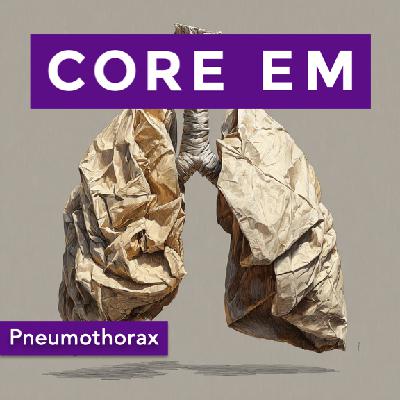
Episode 213: Pneumothorax
Update: 2025-09-01 1
1
1Description

We break down pneumothorax: risks, diagnosis, and management pearls.
Hosts:
Christopher Pham, MD
Brian Gilberti, MD
Download
Leave a Comment
Tags: Chest Trauma, Pulmonary, Trauma
Show Notes
Risk Factors for Pneumothorax
- Secondary pneumothorax
- Trauma: rib fractures, blunt chest trauma (as in the case).
- Iatrogenic: central line placement, thoracentesis, pleural procedures.
- Primary spontaneous pneumothorax
- Young, tall, thin males (10–30 years).
- Connective tissue disorders: Marfan, Ehlers-Danlos.
- Underlying lung disease: COPD with bullae, interstitial lung disease, CF, TB, malignancy.
- Technically, anyone is at risk.
Symptoms & Differential Diagnosis
- Typical PTX presentation: Dyspnea, chest pain, pleuritic discomfort.
- Exam clues: unilateral decreased breath sounds, focal tenderness/crepitus.
- Red flags (suggest tension PTX):
- JVD
- Tracheal deviation
- Hypotension, shock physiology
- Severe tachycardia, hypoxia
- Differential diagnoses:
- Pulmonary: asthma, COPD, pneumonia, pulmonary edema (SCAPE), ILD, infections.
- Cardiac: ACS, CHF, pericarditis.
- PE and other acute causes of dyspnea.
Diagnostics
- Bloodwork: limited role, except type & screen if intervention likely.
- EKG: reasonable given chest pain/shortness of breath.
- Imaging:
- POCUS (bedside ultrasound)
- High sensitivity (86–96%) & specificity (97–100%).
- Signs:
- Seashore sign: normal lung sliding.
- Barcode sign: absent lung sliding.
- Lung point: most specific for PTX.
- CXR
- Sensitivity ~70–90% for small PTX.
- May show pleural line, hyperlucency.
- CT chest (gold standard)
- Defines size/severity.
- Rules out mimics (bullae, pleural effusion, hemothorax).
- Guides intervention choice.
- POCUS (bedside ultrasound)
Management
- First step for all: Oxygen supplementation (non-rebreather if possible).
- Accelerates resorption of pleural air.
- Stable vs. unstable decision point:
- Unstable/tension PTX
- Immediate needle thoracostomy (14-g angiocath, 2nd ICS midclavicular).
- Temporizing until chest tube/pigtail placed.
- Stable, small PTX (<2 cm on O₂)
- Observation, supplemental O₂, conservative management.
- Stable, larger PTX or symptomatic
- Chest tube or pigtail catheter insertion.
- Pigtail catheters: less invasive, more comfortable, similar efficacy for simple PTX.
- Large bore tubes: indicated if associated with blood, pus, large collections.
- Unstable/tension PTX
Disposition
- Admit all patients with chest tubes; cannot be discharged with tube in place.
- Service responsible varies by hospital: trauma, CT surgery, MICU, etc.
- Level of care (ICU vs. floor) depends on stability:
- ICU if unstable course, intubated, shock physiology.
- Stepdown/floor if stable and straightforward.
Take Home Points
- Always broaden differential in dyspnea/chest pain → don’t anchor on asthma/COPD.
- Exam findings + history (trauma, risk factors) crucial to raising suspicion.
- Ultrasound is more sensitive than CXR and highly specific when lung point found.
- Oxygen is first-line; intervention determined by size + stability.
- Pigtail catheters increasingly favored for simple, stable PTX.
- All patients with intervention require admission; service varies by institution.
Read More

Comments
In Channel
















Download from Google Play

Download from App Store
 United States
00:00
00:00
x

