



 Claim Ownership
I Believe
Subscribed: 14Played: 63
Subscribe

© Joel K. Douglas
Description
118 Episodes
Reverse
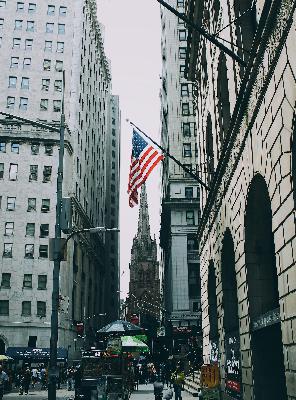
Act I. Tick Tock[SFX: The noise of New York City][Narrator] New York City in December. Manhattan. No snow yet, but the cold sits like it’s waiting for something.A kid walks home from work. Twenty-four years old. Jacket zipped to the throat. Same route he always takes. Down from Midtown, cutting through the side streets. Too many tourists on the main streets.He wants to move through the world without it touching him.It’s 6:12 PM. The sun is already gone. The crosswalk timer across the street blinks 12, then 11, then 10. Tick. Tick.Cars honk. Little beeps, long beeps, the ones that hold down the horn. Trash trucks. Ambulances with sirens blaring. Delivery drivers on bicycles. All stuck.The kid walks by the way he walks by everything. Eyes forward. Keep moving.Cops on almost every corner. Keeping the peace. On the buildings, American flags, lit from below, snapping in the wind that cuts between the towers. Red and white and blue against the black.And the steam.It comes up through the grates, the vents. Somewhere underneath. The water in the gutter catches it, and the whole street looks like it’s breathing. Like the city has lungs.A waist-high stack painted orange and white hisses near the curb. Warm air in cold air.He asked someone once. Why does it do that? Why is there always steam? Like the water is smoking.The subway, they said. The pipes. The heat below. The cold above. The whole city is a machine, and the steam makes it run.[Daniel] I love it. The city breathes. Exhales. Makes it feel alive. Like something’s happening under the surface, even when nothing’s happening at all.I put my headphones on.The noise is still there. I can see it. Mouths moving. Cabs lurching. Cops talking into their radios. But I can’t hear it. I’m inside my own head now.The tourists look up. They stop in the middle of the sidewalk to take pictures. Big coats. Shopping bags. Walking three across, like the city belongs to them.The New Yorkers move like water around rocks. They don’t stop. Just flow toward wherever they’re going.I’m one of them now. Four years in. The headphones that say don’t talk to me, don’t see me, I’m not here.[Narrator] The lights from a bodega spill onto the sidewalk. Red and gold. A pizza place on the corner, line out the door. A woman arguing into her phone in a language he doesn’t recognize.He turns onto his block. Streetlights tinge yellow-orange. A guy smokes on his stoop, looking at nothing. Somewhere above, music loud enough that the bass comes through the walls.Home.He steps inside.[Daniel] There he is. My little brother. Sitting on the couch. Looking at me like he’s got something to say.[Narrator] Daniel stands in the doorway. Doesn’t move. His brother looks up. People call him “K.” Nineteen years old. Named after his great-grandfather. Same face Daniel’s known his whole life, but something’s different now. The way he sits. The way he holds himself. K speaks first.[K] “I tried to call you. A few times.”[Narrator] Daniel pulls off his jacket. Tosses it on the chair. He moves to the kitchen, opens the fridge.[Daniel] He’s right. I never pick up.“You hungry? I’ve got leftover Thai. The good place.” K says he’s not hungry.[Narrator] Daniel grabs two beers. Pops the caps. Sets one on the coffee table in front of his brother and sits down across from him. K has been waiting for him to sit down.[K] “I joined the Navy.”[Narrator] Silence. Daniel’s beer stops halfway to his mouth.[Daniel] “What?”[K] “The Navy. I leave in two days.”[Daniel] I don’t say anything. I’m trying to hear it again. Navy. Two days.“When did you decide this?”[K] “A while ago.”[Daniel] “And you didn’t tell me?”[Narrator] The brother looks at him. Doesn’t flinch. Doesn’t apologize.[K] “I’m telling you now.”[Daniel] “That’s a waste.”[Narrator] It comes out before Daniel can stop it. K’s jaw tightens.[Daniel] “You’re smart. You could do anything. You’re going to swab decks and take orders from guys who peaked in high school?”[Narrator] K doesn’t look away. But something closes behind his eyes.[K] “Great-Grandpa Kenneth was Navy.”[Daniel] “That was different. That was a real war.”[Narrator] The words hang there. K picks up his beer. Sets it back down.[K] “I needed to do something.”[Daniel] “You were doing something. You had a job.”[K] “I was delivering packages.”[Narrator] K stops. Looks down at his hands. Then back up.[K] “I wanted to matter.”[Daniel] He says it like it’s simple. Like that explains everything.And I just told him it was a waste. Told him his war wouldn’t be real enough.[Narrator] K stands up.[K] “I should go. Early flight.”[Daniel] “K—”[K] “It’s fine.”[Narrator] It’s not fine. Daniel can hear it. But K is already at the door.[Daniel] “Be safe. Okay?”[Narrator] K nods once. Doesn’t look back.[Daniel] The door closes. I sit there with two full bottles and the thing I said still in the room.He wanted to matter. So he signed a contract. Raised his right hand. And now he belongs to something I don’t understand.Act II. Duration[SFX: Train wheels on tracks, rhythmic, then slowing. Station announcement muffled.][Narrator] The train pulls into the station. New Jersey suburbs. Christmas Eve.Daniel is on the platform. Cold air. Gray sky. Not cold enough to bite. Just there. He didn’t want to come. His mother called three times. The third time, she didn’t ask. She just said what time dinner was. So. Here he is. The house is twenty minutes from the station. His father picks him up. They don’t talk much. The radio fills the space. Sports. Weather. Traffic.[Daniel] Dad asks how my place is. He asks if work is good. We talk about sports. That’s the whole ride.[Narrator] The house is already full when they arrive. Cars in the driveway. Lights on in every window. A wreath on the door. Same wreath since Daniel was a kid.Inside, the house is warm. The smell of food. Voices overlap. Christmas music competing with a movie playing in the other room.His grandmother finds him first. “There he is. Look at you. So skinny. Are you eating?”[Daniel] “I’m eating.”[Narrator] She doesn’t believe him. She never believes him. She tells him she made a brisket and pulls him toward the kitchen.His mother finds him before he gets there. Hugs him like she’s checking if he’s real.[Daniel] She says I look tired. She asks about work. She asks if I’m seeing anyone.And there it is. I say no.She tells me about a girl. Rachel’s daughter. In law school. Very pretty. She could introduce us.“Mom.”She’s just saying.I need air. Quiet. To be anywhere but in the middle of this.[Narrator] He escapes. The back room. Used to be his grandfather’s study. Now it’s just a room with old books and a chair nobody sits in.Except tonight.Kenneth is there. In his late nineties. A circle of cousins around him, laughing at something he just said. He’s holding a glass of wine like a prop. He won’t drink it. Just likes having something in his hand.[Daniel] Great-Grandpa Kenneth. Everyone’s favorite person. Always has been.He’s the one who remembered every birthday. Sent five dollars in a card until I was ten, then switched to twenties because, in his words, “inflation is a thief and you deserve to keep up.”He’s sharper than anyone expects. Mixes up some names. Thinks my cousin Mike is still in college, even though Mike is thirty-two and sells insurance. But he knows what year it is. Knows who’s President. Has opinions about both.[Narrator] The cousins drift away when someone announces food. Kenneth stays in his chair. Daniel sits down across from him.[Daniel] “Do you think the Jets will make the playoffs next year?”[Narrator] Kenneth laughs. A real laugh. Starts in his chest. [Kenneth] “I’ve been waiting on the Jets since nineteen-seventy. I thought we were going to repeat.”[Narrator] He looks out the window. His fingers tap the arm of the chair. Something shifts behind his eyes.[Kenneth] “You know what waiting really is? I learned it in the Pacific.”[Narrator] Daniel didn’t expect this. But you don’t interrupt Kenneth.[Kenneth] “Picket duty. Small ship. Radar watch. You sit out there and wait. Okinawa, 1945. We were the first thing the kamikazes would see. That was the job. Spot them. Report them. Hope they didn’t get through.”“We were at sea when Roosevelt died. April. Someone came through the ship saying the President was dead.”[Daniel] “What did you think?”[Kenneth] “We didn’t believe it. He’d been President my whole life. Since I was a kid. Didn’t know there could be another one.”“You know what they told us when we signed up? ‘Duration Plus Six.’ That was the contract. You serve for the duration of the war, plus six months. No end date. Just... until it’s over. However long that takes.”[Daniel] “What if you wanted a different deal?”[Kenneth] “Only deal there was. You signed, or you didn’t. I signed. I wanted to matter.”[Narrator] He looks at Daniel. Eyes clear. Present.[Kenneth] “I heard your brother signed up.”[Daniel] “He just started boot camp.”[Kenneth] “I know. Your mother told me. Navy. Like me.”[Narrator] He nods. Proud. But something else crosses his face.[Kenneth] “I enjoyed serving. Proud of it. Still am.”[Narrator] He pauses. Looks at Daniel like he’s deciding whether to finish the thought.[Kenneth] “But the men who send them. The men who decide where they go. What we did was right, but it isn’t always right. Those men should be bound too.”[Daniel] “What do you mean?”[Kenneth] “Limits. A clock on them. Something that says you can’t keep sending boys forever just because you feel like it.”[Narrator] Someone calls from the other room. Dessert. Kenneth waves his hand. He’ll be there in a minute. Daniel waits for more. But Kenneth is looking out the window now. Somewhere else. Sixty years back. Small ship. Radar. Waiting.[Daniel] I sit there another minute. Then I get up. “Thanks, Grandpa. You want me to bring you some food?” I walk back into the noise. The laughter. The questions. But I’m not there. I’m somewhere else.The men who send them. They should be bound, too.[Narrator] Daniel l

[SFX: Solo Guitar playing Auld Lang Syne]Should old acquaintance be forgot, and never brought to mind? Should old acquaintance be forgot, and the days of long ago?We’ve forgotten the meaning of the song playing in the background when we toast on New Year’s Eve.Let’s remember.Back to Ulysses S. Grant. He couldn’t hear music. Not wouldn’t. Couldn’t. And the most important moment of his life would be defined by a song.Act I. The Man Who Couldn’t Hear MusicWashington, D.C., March 8, 1864.Ulysses S. Grant walks into Willard’s Hotel. Forty-one years old. Filthy from four days on a train. He is the most famous man in America, and nobody recognizes him.The hotel is famous. Senators swagger and generals preen across its thick, patterned carpet. Gas lamps throw a yellow light that doesn’t reach the corners, so faces drift in and out of shadow. Furniture packed in tight clusters. Little tables and chairs arranged for waiting, not resting, crowded by hats, gloves, and half-empty whiskey glasses.The desk clerk eyes Grant as he crosses the room. Mud-spattered coat. Rumpled uniform. No entourage. His boots are caked with Tennessee mud, red clay flaking onto the carpet. The clerk judges his station in life and says there’s nothing available but a cramped room in the garret. The attic.Grant takes it. He signs the register in a plain hand: U.S. Grant & Son, Galena, Illinois.The clerk reads the signature. His face goes white. Suddenly, the Presidential Suite, the rooms Abraham Lincoln occupied before his inauguration, is available after all.Grant declines. The garret is fine.This is Grant. No drama. No ceremony. And something even more peculiar.Ulysses S. Grant cannot hear music.It’s not that Grant “doesn’t like music.” Not that he “has no taste for music.”He can’t hear it.When a band plays, Grant hears only noise. A choir sings, Grant hears chaos. Marches. Hymns. Sentimental ballads. They all register the same way. Pots banging. Wagons rattling. Nothing more.He once described it this way: “I know only two tunes. One of them is ‘Yankee Doodle,’ and the other isn’t.”People took this as a joke. A curmudgeon’s quip. But Grant wasn’t joking. He could recognize “Yankee Doodle” because it came wrapped in parades and flags and ritual. He knew it by context, not by sound. Every other tune in the world was the same to him. Noise.Doctors today call it congenital amusia. The brain can’t process pitch. Each note disappears as soon as it sounds. The pattern never forms.In 1864, they had no name for it. Grant just lived with it. He never explained why music meant nothing to him. But other officers noticed he would leave the room when bands played. He didn’t grimace. He didn’t complain.He just drifted away.Back to Willard’s Hotel. That evening, Grant cleans up and goes down to dinner.He and his thirteen-year-old son Fred take a small table in the crowded dining room. He orders. Within minutes, someone recognizes him. A congressman stands and bellows across the room: “Ladies and gentlemen! The hero of Donelson, of Vicksburg, and of Chattanooga is among us! I propose the health of Lieutenant General Grant!”The chant begins. Grant. Grant. Grant.The diners surge toward his table. He stands awkwardly, bows, tries to eat, gives up. The mob presses closer. For three quarters of an hour, he shakes hands with strangers. Finally, he escapes to his room. He never finishes the meal.Later that night, politicians appear at his door. They rush him through the rain to the White House, where President Lincoln is holding his weekly reception. The East Room is packed. Hundreds of Washington society figures, all hoping to glimpse the western hero.The crowd parts. Grant walks through.Abraham Lincoln stands waiting. They have never met, though they are now the two most famous men in the country. Lincoln is a head taller, six foot four. Grant is five eight.Lincoln steps forward, smiling, and extends his hand. “Why, here is General Grant. I am most delighted to see you, General.”Grant answers with a nod and a few words so quiet Lincoln has to lean in.The Union Army of Grant’s time was saturated in music.More than 500 regimental bands. Drummers and fifers at every unit. Bugles structured the entire day. Reveille. Assembly. Mess call. Sick call. Taps. Music lifted spirits. Stiffened resolve. Gave orders.And Grant was deaf to all of it.He understood music strategically. He watched what it did to other people. Saw men weep at certain songs. Stiffen at others. The way someone colorblind might notice how others respond to a sunrise.After West Point, Grant was a young lieutenant in Mexico. His regiment’s band raised morale, but it needed funding. Bands were absurdly expensive, and politicians loved them. Congress would argue over rifles, but bands needed paid.So Grant ordered the unit’s daily rations in flour instead of bread, at significant savings. Then he rented a bakery. Hired bakers. Sold fresh bread through a contract he’d arranged with the army’s chief commissary. The profit went to music he could not hear.This is who Grant was. Practical. Unsentimental. Results-oriented.Sentiment in the Union Army was a liability.The next morning, Lincoln hands Grant his commission. Lieutenant General of the United States Army. The highest rank in the army.Grant is now in command of all Union forces. More than half a million men.The war is in its fourth year. Two hundred and fifty thousand Union soldiers are already dead or wounded, with little progress to show. Every general Lincoln has appointed to fight Robert E. Lee has failed. They engage. Suffer losses. Retreat north to regroup. Then they do it again.The reality is that the Civil War is a war of attrition. Wars of attrition aren’t clever. Force meets force until one side can no longer continue.To achieve the nation’s ends, Lincoln needs someone different. Someone who doesn’t retreat.Days after the ceremony, Lincoln’s assistant asks what kind of general Grant will be. Lincoln thinks for a moment.“Grant is the first general I’ve had. He doesn’t ask me to approve his plans and take responsibility for them. He hasn’t told me what his plans are. I don’t know, and I don’t want to know. I’m glad to find a man who can go ahead without me.”Lincoln pauses, then adds.“Wherever he is, Grant makes things git.”The Army medical corps had made it official. They called it nostalgia.Not nostalgia like we use the word today, a warm feeling about the past. Nostalgia as a diagnosis. A disease. A killer.Union surgeons wrote down thousands of cases. Men who wasted away, moaning for home. The symptoms look like what we would now call severe depression. Insomnia. Loss of appetite. Withdrawal. Despair. In the worst cases, they just stopped. Refused food. Refused nursing. Died.The army identified a trigger. Music.Sentimental songs did it. Ballads about home. Mothers. Sweethearts left behind. The most dangerous song in camp was “Home, Sweet Home.” Men heard it and broke. So officers barred bands from playing it.Songs like “Auld Lang Syne” carried the same danger. Remembering friends from long ago. Remembering home. Memory as a weapon turned inward. The song that made you weep for the past was the song that could kill you in the present.Grant would have understood that logic perfectly.Now Grant is in Washington, his new commission in hand. Culpeper, Virginia waits, his headquarters with the Army of the Potomac. Robert E. Lee waits, fifty miles south.Grant lays out his philosophy in a single sentence: “The art of war is simple enough. Find out where your enemy is. Get at him as soon as you can. Strike him as hard as you can, and keep moving on.”No sentiment. No retreat. Attrition.Act II: The Overland CampaignThe Wilderness, Virginia. May 5, 1864.Grant crosses the Rapidan River at midnight. Sixty thousand men. Pontoon bridges sway in the dark. By dawn, the Army of the Potomac is deep inside a seventy square mile tangle of vines and second growth so dense the soldiers call it, simply, ‘the Wilderness.’The Union Army was routed here one year earlier. Lee’s bold flanking maneuver sent them running. The bones of the dead from that battle lie in the undergrowth. Skulls grin up at passing troops. The new soldiers try not to look.Grant’s plan is simple: move fast and get through the forest before Lee can react. Fight in open country where Union artillery and superior numbers can be decisive.Lee reacts faster.By midmorning, the Wilderness becomes a killing ground that neutralizes every Union advantage.Soldiers couldn’t see twenty yards in any direction. Brush so thick you lose sight of the man next to you. Smoke from musket fire fills the gaps between trees. You only see the enemy by the muzzle flash when he shoots at you.There is no battle line. No coordination. No grand strategy. Only chaos. Small groups of men stumbling through the brush, firing at sounds, bayoneting shapes.Then the forest catches fire.Muzzle flashes ignite the dry leaves. Flames race through the underbrush. Men who are wounded and cannot crawl burn alive. Screams rise above the gunfire. The smoke turns black.The fighting goes on for two days. When it ends, 18,000 Union soldiers are dead, wounded, or missing. Nobody knows how many Confederates. The forest is eerily quiet.To this point, every Union army that faced Robert E. Lee followed the same pattern. Engage. Suffer terrible losses. Retreat north to regroup. Lick wounds. Try again in a few months.Grant’s men expect the same. They’ve been through this before with other commanders. They assume their next march will take them back toward the Rapidan. Back toward Washington. Back toward safety.That night, the army begins to move.The columns form up and start marching. At first, the men don’t know which direction they’re heading. The road winds through the forest. It’s dark. They’re exhausted.Slowly, as the stars wheel overhead, they begin to realize something.They are not marching north.They are marching south.Toward the enemy. Toward Richmond. T
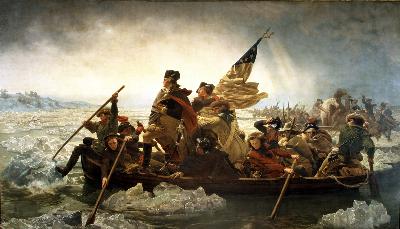
This story is true. Except for the parts with the ghosts. [SFX: Theater applause]Dim the lights.Prologue. London. December, 1776.One lone leaf on the London plane outside the King’s window trembles in the light breeze, like the whole city just let out a quiet breath.It had clung to its branch through the long autumn, through winds that had stripped its companions and sent them spinning across the grounds of Windsor Castle. But now, in the stillness of a December evening, with no wind at all to speak of, it fell. The branch did not shake. The leaf simply let go, as if it had finally grown too tired to hold on, and drifted downward through air that smelled of coal smoke and coming snow.It landed on the stones of the courtyard without a sound. A guardsman’s boot crushed it a moment later, unknowing. The groundskeeper would collect it soon enough.Inside the palace, candles burned against the early dark. Servants moved through corridors with the particular silence of those who have learned that kings prefer not to be reminded of their presence. Fires crackled in grates throughout the residence, and the smell of roasting meat drifted up from kitchens where cooks prepared for the Christmas feast. The King had already declared he would not attend.George William Frederick, by the Grace of God King of Great Britain, France, and Ireland, Defender of the Faith, sat alone in his private study. Most called him King George III. He was not yet forty. His hair had not gone white. His eyes had not drifted to that far-off place that later painters would catch. He blinked once, slow, like the weight of the crown had its own gravity. He was still a young king, or youngish. The rebellion in the American colonies had aged him in ways the mirrors had only begun to report.On the desk before him lay dispatches from America.He had read them twice already. He would read them again before bed. Again, when he woke. Again, mid-morning. Searching for the thing he could not find in them. An explanation. The reason. The sense of it all.The rebels would not break.This was the fact that he could not understand. Would not. By every measure that mattered, this rebellion should be over. The Continental Army had been driven from New York. Their capital had fallen. Their soldiers deserted by the hundreds, slipping away in the night to return to farms and families, to sanity, to submission. Washington’s forces had dwindled to a ragged few thousand, starving and frozen on the Pennsylvania side of the Delaware River.And still they would not break.George set down the dispatch and walked to the window. The courtyard below lay empty save for the guards at their posts, still as statues in the cold. Beyond the palace walls, London prepared for Christmas. He could not see the preparations from here, but he knew them well enough. The garlands and the wassail, the church bells and the charitable distributions. The goose being fattened in every household that could afford one, and many that could not.Christmas. The celebration of a child born in poverty who had somehow overthrown an empire. George did not make this connection consciously. It floated somewhere beneath the surface of his thoughts, unexamined.He touched the back of a couple of fingers against the glass. It was cold. On the other side of that glass, on the other side of an ocean, men wrapped their feet in rags, leaving bloody footprints in the snow. Men were choosing to freeze.Why? What word had reached them that could make men choose cold over comfort?He did not doubt the outcome of this rebellion. He had the strongest Army and Navy the world had ever seen. His generals would see to their submission. But didn’t they understand what he offered? Order. Protection. The steady hand of a Crown that had outlasted plagues and pretenders, fires and mobs. A world where the rules did not change because a crowd felt hot blood in its throat.Obedience, in return. That was all. One plain word, and it was suddenly the only word nobody in America could stand to hear.He had read their pamphlets. Their petitions. Liberty was a thing you could hold in your palm and keep clean. As if “freedom without order” could live out in the open without turning into smoke and shouting.He told himself they would come back. This rebellion was a fever, not a cause. Noise. A few men with printing presses and loud mouths. The larger crowd would quiet down the moment winter did its work.But right now, his eyes refocused from the daydream. The light grew dim. The glass fogged at the edges, as if someone had breathed on it from the other side. Odd, but no matter. It must be the snow coming. George turned from the window and walked to his desk.The candle nearest him flickered, then steadied. The shadows in the room shifted and resettled themselves. Outside, the temperature dropped, the smell of snow in the air. A white Christmas for London, if the clouds obliged.In the fireplace, a log cracked and sent up a shower of sparks. George watched them rise and wink, rise and wink, like small rebellions burning themselves to nothing against the indifferent air.The clock on the mantel struck nine. Somewhere beyond the walls, a watchman sang the hour into the cold.George gathered the dispatches. He placed them in the locked drawer where he kept such things, away from prying eyes and gossiping servants. He would read them again tomorrow. He would search once more for the explanation that was not in the dispatches. The King prepared for bed. His evening routine varied little from one night to the next. He allowed his valet to help him undress. He said his prayers, more habit than devotion. He climbed into the vast bed with its heavy curtains, warming pans, accumulated weight of royal tradition.He closed his eyes.His sleep came and went, shallow and troubled. George tossed in the darkness, talking in his sleep. Words that his attendants, just outside the door, could not quite make out. The fire burned low. The candles, one by one, became a trail of smoke. The room, black.Outside the window, the first flakes of snow began to fall on London. Gentle. Silent. It covered the courtyard where the plane leaf had landed. The city asleep in a blanket of white that looked almost like a fresh page.He heard the clock strike midnight and keep ticking.George, alone in his royal bed, surrounded by luxury and power that brought no comfort, found the wee small hours. The thin place where a man is neither awake nor asleep. Some time later, the room, which had been empty, was suddenly not. A voice spoke out of the dark, as if it had been waiting for him.Act I. The Ghost of Christmas PastThe voice came from nowhere and everywhere, the way a church bell finds you three streets away.(inaudible) “George.”“George.”The King opened his eyes. The room was dark, but had not changed. The same heavy curtains and dying fire. Winter pressing against the windows. But this dark was different. Breath. Presence. “Who’s there?” His voice came out steadier than he felt. A king’s training. “Guards…”“They cannot hear you. Nor you them. We are between the ticks of the clock, you and I. In the space of memory.”“There’s no one here.”“There is,” the voice said, not unkindly. “Come. The night will not wait.”George sat up. His eyes adjusted. There was no figure in the room. Only shadow, and within the shadow, a deeper shadow. Not a person. Breath on the air.“What are you?”“I am what was. The road behind you. The roads behind that road. The choices made before you drew breath.”George felt his feet touch the cold floor, though he hadn’t moved. His hand reached for a robe that was not there, and he found himself in only his nightshirt, shivering slightly. A pale light gathered at the window. The glass, which should have been solid, yielded like water. He passed through it without feeling it pass, and then he was somewhere else entirely.London. But not his London.The streets were narrow and filthy. Choked with mud and offal and crowds that moved with dread. George had seen etchings of this time. He had read the history. But nothing had prepared him for the smell. Blood and smoke and fear. The smell coated his tongue.“Sixteen forty-nine,” the voice said. “The thirtieth of January.”The crowd pressed toward a scaffold erected in front of the Banqueting House at Whitehall. George moved with them, unable to resist. A ghost among ghosts. A woman near him wept openly. Through the crowd, George saw him.King Charles I walked to the scaffold with the careful dignity of a man who had practiced this moment in his mind. His shirt was white. His hair, gray. His eyes found no one in the crowd, as if he had already departed for some place beyond their judgment.“He wore two shirts,” the voice said softly. “So that he would not shiver in the cold. He wanted to look dignified. Strong.”George’s throat tightened. He watched Charles kneel. He could not watch. He looked away.But he heard it. The blade found its mark. Then another sound, a moan rising from the crowd. Thousands of throats releasing something that had no name. Not triumph. Not grief. “Why do you show me this?” George whispered. “I know this story. Every king knows it.”The ghost looked at him but did not speak.Britain had torn itself apart in those years. Men who had been neighbors became enemies. Law vanished. Titles meant nothing. Thinkers had dreamed of a solution, a sovereign so absolute that chaos itself would bow before him. It was a dream born of blood. Control that would not last.Then, George and the ghost in a different London. Cleaner. Calmer. Wider streets, newer buildings. Dawn breaking over the Thames, the water in shades of rose and gold.“Sixteen eighty-eight,” the voice said. “Forty years after the axe.”George watched a procession move through the streets. Not a mob this time. Something orderly, almost festive. A parade. People lined the route, cheering. At the center of the procession rode a man George recognized from portraits: William of Ora

2025. The president fires an FTC commissioner before her term is up. The statute says he can’t without cause. He does it anyway. Now the Supreme Court has to decide whether ninety years of precedent was real law, or a bluff. Act I. The Wager[SFX: casino room, cards dealt, chips stacked, ice clinking in glasses]Players stare at each other across a poker table. Four cards are up. One card is face down. The last card decides everything, but nobody gets to see it until somebody commits.You can stare at the felt and pretend time is on your side. But the cost of waiting goes up anyway. You have to put in a bet to keep playing, and that bet keeps getting bigger. The pot grows. The pressure rises. Sooner or later, you have to act with incomplete information.New York City. Late Spring, 1789.George Washington took the oath on April 30. He is the first President of the United States. He has duties. He has no government.No State Department. No Treasury. No War Department. No one to answer a foreign minister or respond to a crisis. The executive branch exists on paper. In reality, it is one man in a rented house with a small staff and a pile of unanswered letters.The Constitution is eight months old. The ink is barely dry. And the world is not waiting.The British still occupy forts on American soil. Forts they agreed to vacate six years ago. Native attacks keep coming from those regions. Plenty of Americans suspect the British, but Washington has no department to respond with.Spain has closed the Mississippi River to American trade. Western settlers are talking about leaving the union. Diplomacy might help. Threats might help. But there is no one to conduct diplomacy. The president cannot do everything himself.American merchant ships are being seized in the Mediterranean. Algiers declared war on the United States four years ago. Sailors are chained in North African prisons, waiting for a ransom that cannot come because we have no Treasury and no Navy.The pot is already enormous. The blinds are rising. And Congress has a problem.The Constitution gives the president the power to appoint officers “by and with the advice and consent of the Senate.”It says nothing about firing them.Nothing.That silence is not calm. It’s cards sliding out. Sideways glances. Men looking across the table, trying to decide what the other man is holding.Sixty-five men crowd into Federal Hall on Wall Street. A repurposed city building that still smells like fresh paint. May turns to June. The weather thickens. No ventilation worth mentioning. Wool coats. Wigs. Windows that don’t open properly. Paper everywhere. Quills scratching. Men sweating through their shirts while arguing about the shape of executive power.They have to build a working government, but the game is already underway. The cards are on the felt. The pot is growing. And they’re still arguing over who gets to deal, who sets the rules, and who can push a man out of his seat.The question before the House is simple to ask and impossible to answer:Who can fire a cabinet secretary?James Madison rises to make a motion.He is thirty-eight years old. A hundred forty pounds soaking wet. He speaks so softly that reporters lean forward to hear him. He is brilliant, but he has never seen combat. He has never led troops. He spent the Revolution in the Virginia legislature, arguing about paper while other men bled.But Madison wrote the Constitution. He wrote most of The Federalist Papers defending it. He has thought more carefully about the structure of American government than anyone alive. When Madison speaks, the room listens.His motion concerns the Department of Foreign Affairs. A department that does not yet exist. A secretary who has not been named. He is writing the job description for a position that is still an idea on paper.Madison proposes one line:He says that the secretary shall be “appointed by the president, by and with the advice and consent of the Senate; and to be removable by the president.”Four words. Nine syllables. “Removable by the president.”The room erupts in disagreement.They can see the future in that sentence. A future president. A future fight. A future Congress trying to bind a president’s hands. They are not arguing about today. They are arguing about every president and every Congress that will ever follow.And they are terrified. But not of the same thing.To understand why the room erupts, you have to understand the ghost in it. That ghost is King George III. Theodorick Bland commanded cavalry in the Revolution. James Jackson of Georgia fought at Cowpens, Augusta, Savannah. Hand to hand when it came to that. Jackson fought twenty-three duels in his lifetime. He settled disagreements with pistols. When he stood up to speak, men listened because they knew what he was capable of.Elbridge Gerry was asleep at the Menotomy Tavern on the night of April 18, 1775. The night Paul Revere rode. British troops marched past his window toward Concord. The weapons they were marching to seize were weapons Gerry had put there. His roommate during the siege of Boston was Joseph Warren. Warren died at Bunker Hill with a British bullet in his skull.On and on. The room was full of men who bled for independence. They sent their sons to bleed. They watched friends die at Brandywine, at Germantown, at the frozen hell of Valley Forge.The Declaration of Independence was thirteen years old. It was a list of crimes committed by a king who answered to no one. These men had signed it. Some had nearly died for it.Now, James Madison, who spent the war arguing about paper, stands before them and proposes giving one man the power to fire anyone in the executive branch.To some of them, it sounds like the first step toward a throne.Underneath that knife’s edge urgency, they are dueling with words while playing this game of American poker. Uncertainty. Ambiguity. They’re all fearful, but not of the same thing. One man hears “removable by the president” and sees a king. Total loyalty. Total control. Every officer knowing he serves at the president’s pleasure. Every officer afraid to disagree. William Loughton Smith of South Carolina places his bet here. He points to the Constitution: the only removal it mentions is impeachment. If you start inventing powers out of silence, you are training future presidents to do the same.Theodorick Bland of Virginia throws in chips next. He hears “removable by the president” and sees the Senate being erased. The Constitution says the president appoints “by and with the advice and consent of the Senate.” The Senate has a role. Would you let a man hire but not fire? Strip the Senate of removal, and you strip the bridle from the horse.Roger Sherman of Connecticut adds to the pot. He hears “removable by the president” and sees chaos. Drift. Officers who answer to no one because no one has clear authority. He says Congress creates these offices, Congress sets the terms, Congress can decide. The Constitution doesn’t give removal power to anyone specifically. So Congress fills the gap.And then there is Madison.Madison has watched legislatures become tyrants.State assemblies under the Articles of Confederation printed worthless money. Exposed private contracts to public violation. Trampled the rights of minorities, religious dissenters, anyone without the votes to protect themselves. In Rhode Island, the legislature printed currency to pay off debts, and the creditors fled the state.Kings were dangerous. Madison knows that. But legislatures were also dangerous. They claimed to speak for the people. They wrapped their tyranny in democratic legitimacy. And they could do it faster than any king because they did not have to pretend to be anything other than the majority.Madison fears Congress more than he fears the president.He could not foresee a Congress that would voluntarily surrender its power. A Congress that would create agencies to avoid making hard choices. A Congress that would build a government designed to answer to no one.He places a large wager. Madison bets on a weak executive fighting a strong legislature. One man against an assembly. The president needs defensive weapons just to survive. If the president cannot remove officers who defy him, you have no accountability. You get paralysis. You get officers who answer to no one. Not to the president, who cannot fire them. Not to the people, who cannot reach them.Madison says it plainly: “If any power whatsoever is in its nature executive, it is the power of appointing, overseeing, and controlling those who execute the laws.”Article II vests the executive power in the president. Not some of it. All of it. The Senate’s role in appointments is an exception, spelled out explicitly. Removal is not spelled out as an exception. Therefore, removal belongs to the president.The room considers the wager. Each man sees a different future. A king. A runaway Senate. A paralyzed executive. A tyrannical Congress. They are reading each other across the table, trying to guess which fear is the right one, knowing they cannot wait for certainty.They look at Madison’s bet. Call, or fold.The British are not leaving those forts. Spain is not opening the Mississippi. American sailors are not freeing themselves from Algiers. Foreign ministers are waiting for someone to talk to. Crises do not pause for constitutional debate.And the pressure. The government has to start. Someone has to be in charge. Someone has to be able to be fired for failing.Then, a breakthrough. A congressman trying to get the room to move on changes the language. The final bill doesn’t say the president “has” the power to remove. It does not say Congress “grants” the power to remove. It says that when a secretary “shall be removed,” certain things happen.The House votes. Madison’s side wins, but there is no consensus. The Senate splits exactly in half. Vice President John Adams casts the tie-breaking vote. The president will have the power to remove officers.They sidestepped

Act I. The Sky WarSFX: Thunder rolling in the distance. A slow rotor hum. Laos. March 20th, 1967.A C-130 Hercules lifts off from Udon Royal Thai Air Force Base just after sunset. The crew has the cargo bay loaded with canisters. Not bombs, not supplies; canisters of silver iodide mixed with lead iodide and acetone. Command briefed the crew separately from every other unit on base. The flight plan logs say the crew's mission is “weather reconnaissance.”Their actual mission: to make it rain over the Ho Chi Minh Trail.Not to predict rain. Not to wait for rain. To make rain. To pull water from clouds that weren’t ready to give it up yet. We weren’t trying to win the weather. We were trying to weaponize it and choke off the supplies that kept the war alive in the South.This is Operation Popeye. And for the next five years, it will remain the most classified weather experiment in American military history.SFX: C-130 rotor hum. Wyatt: “Hell, son, we weren’t tryin’ to predict the weather. We were tryin’ to break it.”The problem started with a road. Except it wasn’t really a road. A network of trails, footpaths, rivers, tunnels, and jungle passages ran from North Vietnam through Laos and Cambodia into South Vietnam. The Americans called it the Ho Chi Minh Trail. The North Vietnamese called it the Truong Son Road. And no matter what the Air Force threw at it, the damn thing wouldn’t die.We tried bombing it, thousands of sorties under Operation Steel Tiger. The jungle swallowed the craters. We tried napalm. The canopy grew so thick that the fire barely reached the ground. We tried defoliants, including Agent Orange by the truckload, and managed to strip some foliage, but the trail just shifted a hundred yards east or west, braiding through the forest like a living thing.We even considered using nuclear weapons, but decided they wouldn’t end the war and would only invite the enemy to use them back. The North Vietnamese moved at night. They built the trail in sections. Different units maintained each section. They camouflaged each one during the day with cut branches and woven bamboo mats. When American reconnaissance planes flew over, they saw nothing. When the bombs came, the crews scattered into prepared bunkers, waited out the strike, then came back out and filled in the holes.By 1966, as many as 20,000 North Vietnamese troops moved down the trail every month, along with enough supplies to sustain the Viet Cong insurgency in the South. Trucks rolled south. Bicycles carried 500-pound loads. Porters balanced bamboo poles across their shoulders. The trail functioned as the circulatory system of the war. Cut it, and you would bleed the enemy dry. But nothing we tried would work.Bombs couldn’t stop the trail. Fire couldn’t stop it. But water could.During monsoon season, May through October, the trails turned to soup. Trucks bogged down axle-deep in mud. Bicycles were useless. Porters slogged through conditions that turned a day’s march into three days. The North Vietnamese themselves estimated that supply capacity dropped by sixty percent during heavy rains.So someone at the Pentagon had an idea. What if we could extend the monsoon?Aida: “Cloud seeding had existed since 1946. Vincent Schaefer at General Electric discovered that dry ice dropped into supercooled clouds could trigger ice crystal formation. Essentially, you could start the rain process manually. By the 1960s, people used it commercially. Ski resorts, farmers, even some cities experimented with it.”But this was different. Farmers weren’t trying to coax an extra inch of rain onto their fields. The United States military wanted to manipulate weather patterns over a foreign country to gain a tactical advantage in a war.The Pentagon classified the operation at the highest level from the start. So secret the program didn’t officially exist, and only a select few even knew about it. The Joint Chiefs approved it in 1966. Secretary of Defense Robert McNamara signed off. President Johnson knew. But almost no one else did. Someone told the crews that the missions were “weather modification experiments” and that the details exceeded their clearance level. The planes, C-130s and F-4 Phantoms modified with cloud-seeding equipment, flew out of bases in Thailand.Crews ignited the silver iodide canisters at altitude. The canisters released microscopic particles into the clouds. These particles acted like ice crystals. In the right conditions, with supercooled clouds that had plenty of moisture, the crystals would grow, become heavy, and fall as rain. The theory sounded solid. The question remained whether it would work at scale.The first test runs happened over the Laotian panhandle in March 1967. Someone gave the operations pastoral codenames: “Motorpool,” “Intermediary,” “Compatriot.” Publicly, if anyone asked, these were agricultural flights. Crop dusting.And it worked. Quietly, invisibly, and just enough to tempt us into thinking we could control the sky. We increased rainfall in the targeted areas by around twenty-five to thirty percent. Roads that should have dried out stayed muddy. River crossings that should have become fordable stayed swollen. Entire sections of the trail turned into bogs.Wyatt: “We’d fly the pattern they gave us, release what they told us to release. Sometimes a few hours later you’d see weather building that didn’t make sense for the conditions. Made you wonder what the hell was in those canisters.”We expanded the operation. By 1968, Popeye missions flew regularly during the rainy season, focusing on the sections of the trail in Laos and the demilitarized zone. Command mixed the sorties in with regular bombing runs so they wouldn’t stand out. The pilots treated it like any other mission: brief, fly, return, debrief.If cloud seeding could have put the entire Ho Chi Minh Trail underwater for months, cut those 20,000 troops down to zero, and stopped the supply flow completely, we would have seeded clouds until the whole jungle was mud. That was the job. That could have meant winning.But it didn’t do that.It worked, but not well enough. Twenty-five percent more rainfall meant muddier roads and slower convoys. It meant frustrating the enemy. It meant some marginal degradation of their logistics. But it didn’t cut the trail. It didn’t stop the war. It didn’t change the outcome.What it did do was teach the wrong lesson. Not that the tool was weak, but that the temptation was strong.If the United States could make it rain over Laos, even imperfectly, then the Soviet Union could make it rain over West Germany. China could trigger droughts in Taiwan. Weather could become an instrument of policy. Did we want that? If we can turn weather into strategy, then weather becomes politics. SFX: Thunder closer now. Rain beginning to fall.Congress didn’t learn about Operation Popeye until 1971, when investigative journalist Jack Anderson broke the story. Anderson had a reputation as a muckraker, but the hearings that followed made people uncomfortable. Senators asked military officials to explain how the program had been approved and executed in secret for years.The answer always took some version of the same form: “It was necessary. It was effective. It was war.”Except it wasn’t effective enough. We’d spent five years secretly weaponizing the sky for results that barely moved the needle. We’d opened Pandora’s box on weather modification for marginal tactical gains.By 1972, the Pentagon shut down Popeye. By 1977, the United Nations drafted and ratified the Environmental Modification Convention which prohibited military or hostile use of environmental modification techniques. Forty-eight nations signed it. The United States signed first. A done deal, right? No more cloud seeding.But here’s where the story turns.Let’s go back to 1915 and a man who claimed he could make it rain. And it worked!Act II. The RainmakerSan Diego. December 13th, 1915.A man stands before the city council. He’s forty years old, pale-skinned, blue-eyed, dressed in a dark suit. His name is Charles Mallory Hatfield. He sells sewing machines for the New Home Sewing Machine Company. But that’s not why he’s here.He’s here because San Diego is dying of thirst.The Morena Reservoir is only one-third full. The city’s population had doubled in a decade. The Panama-California Exposition is entering its second year, and civic boosters worry the drought will scare off tourists. A group called the San Diego Wide Awake Improvement Club has been pressuring the council to do something. Anything.And so Charles Hatfield makes them an offer.He will fill the Morena Reservoir to overflowing. If he fails, they owe him nothing. If he succeeds, they pay him ten thousand dollars.Councilman Walter Moore explains the logic: “If he fills Morena, he will have put 10 billion gallons into it, which would cost the city one tenth of a cent per thousand gallons; if he fails to fulfill his contract, the city isn’t out anything. It’s heads the city wins, tails Hatfield loses.” The council votes four to one. Only Councilman Herbert Fay objects, calling it “rank foolishness.”No one draws up a written contract. A handshake is enough.SFX: Footsteps on gravel. Wind picking up.Hatfield wasn’t a con man. Not exactly.He was born in Fort Scott, Kansas in 1875. His father moved the family to Southern California in 1886. Although a salesman by trade, Hatfield was no smooth-talking huckster. He had a polite, homespun manner.As a young man, he was inspired by the way a boiling kettle attracted the water vapour rising from an adjacent, steaming pan on his mother’s stove. That got him thinking. By 1902, he had created a mixture of 23 chemicals in tanks that he claimed attracted rain. One news editor remarked that the chemicals smelled so bad that the sky rained in self-defense.But it seemed to work. Hatfield claimed at least 500 successes. Was he a fraud? Maybe. Later commentators would say his success was mainly weather prediction, detailed study

Act I. The Golden Handcuffs(SFX: Blizzard wind.)January 1914. Highland Park, Michigan. Six degrees above zero.Ten thousand men press against the iron gates of the Ford Motor Company. Wool coats thin as paper. Broken boots stamping frozen mud. The guards inside are terrified. The mob is too large, so they turn the fire hoses on them. The water hits. Soaks through. Freezes instantly to ice on their coats.The men don’t leave. They stand there, shivering, because a rumor has spread through the tenements of Detroit. A rumor that sounds like salvation:Henry Ford is going to pay five dollars a day.Understand what this means. At this moment in history, a factory man earns two dollars and thirty cents. He sleeps in a boarding house. Eats cabbage. Works ten hours until his back locks, then drinks away the pain at the saloon.Ford is offering double for eight hours of work. An invitation for a laborer to live like a human being.The men freezing at the gate think Henry Ford is their savior. They don’t know the whole truth. Ford didn’t actually raise wages to five dollars. Base pay stayed at two-thirty-four. The rest, two dollars and sixty-six cents, he classified as “profit sharing.”To get the profits, you had to pass inspection.Ford created something called the Sociological Department. This wasn’t just Human Resources. This was a private intelligence agency. He hired 150 investigators. Gave them badges. Cars. And a mandate:Go to the homes.Here’s how it worked:You finish your shift. Go home. Sit down for dinner.A knock at the door. A man in a suit walks in, doesn’t ask permission. Opens your cupboards. Checks your bankbook. Questions your neighbors.Does he drink? Is the house clean? Is he living with a woman who isn’t his wife?If the investigator didn’t like what he saw, if your wife was working, if you bought a luxury before you bought property, he marked a red check on his clipboard. It tracked half the workforce. It pushed them into ‘Americanization’ classes to scrub away their accents and teach them how to be proper, obedient citizens.Next payday? Two-thirty-four. The “profits” withheld. You’re on probation. Fix your life, or you’re fired.Now imagine you’re one of those men.You’ve been standing at the gate for three hours. Your coat is frozen stiff. Your children are hungry. Your wife is coughing blood because the tenement has no heat.Ford’s man finally opens the gate. He hands you the paperwork. He explains the terms.You read it. You understand it. You know what you’re trading. And you sign.Because what kind of person wouldn’t? You resent the privacy invasion, but your children need a warm house. Your wife needs a doctor. You need to stop drinking yourself to death just to get through the week.Ford is offering you a way out, and all it costs is permission. Permission for a stranger to walk through your door. Permission to judge how you live.That’s the trade. Autonomy for comfort. Privacy for security.And you take it. Who among us wouldn’t? Because we love our children more than we love our pride. We make the deal.What they thought would make their children richer came with a cost they didn’t see yet.The men took the deal. They stopped drinking. Cleaned their houses. Learned English. Bought the Model T. They became “materially better.” They had heat. Meat on the table. Shiny shoes.We judge prosperity in income, consumption, and lifespan. By every measure, Ford’s workers won.Their children grew up in warm houses. Went to school with full bellies. Had shoes without holes.The workers looked at their fathers, men who died at fifty with nothing, and they knew they’d made the right choice. They’d bought their children a better life.Ford’s productivity went up too, just like he planned. In 1913, Ford had to hire 52,000 men just to keep 14,000 on the floor. Turnover was running at 370% a year. Training a new man cost the company roughly $100 in today’s money every time someone quit after a week. The $5 day, even with the strings attached, was still cheaper than that chaos. And it worked.Absenteeism dropped. Turnover collapsed. It used to be 370% annually, but fell to 16%. Workers showed up sober. Worked faster. Made fewer mistakes.Productivity went up. Way up. In 1914, it took 12 hours and 8 minutes to assemble a Model T. By 1920? One hour and 33 minutes.Ford didn’t pay five dollars a day out of charity. He paid it because it was cheaper than chaos. A sober, stable, surveilled workforce was more profitable than a desperate, drunk, transient one. He cut turnover costs and saved $100M annually in today’s dollars. Profits doubled from 1914 to 1916. Every boss in America took notes. They called it ‘Welfare Capitalism.’ It sounded generous. It was actually a leash. The inspections weren’t about morality. They were about profitability. Ford’s workers paid for their own compliance. He didn’t force them. He bought them. He made submission profitable.The men took the deal. They quit the saloons. They scrubbed their floors. They opened savings accounts. They learned English in Ford’s mandatory classes. They bought Model Ts on installment, often from the same company that was watching them. Their kids went to school with shoes that didn’t leak.They didn’t clean their houses because he ordered it. They wanted the money. They didn’t stop drinking because he banned it. They couldn’t afford to lose the profit-share. They invited the inspector in because their children were counting on it.Other companies watched the numbers and copied pieces of it. General Electric, International Harvester, and dozens more launched profit-sharing plans. “Welfare capitalism” became the buzzword of the 1920s. An effort to control workers while, at the same time, giving the state no excuse to cross the property line. But once you accept that the price of a good life is constant inspection, you can’t unmake the deal. It becomes normal. The cost of living well. You trade your autonomy for comfort.Ford called this the Five Dollar Day. He called it profit-sharing. We still call it the birth of the Middle Class. We hold the products of the plans in high regard. Profit-sharing bonuses. Retirement plans. Medical services. What Ford proved, accidentally or not, is that he could get a huge chunk of the population to trade a very specific kind of liberty, the privacy in your own home and freedom from moral judgment by your employer, for material goods. And most of us would consider it a bargain.Pensions, profit-sharing, and the company doctor were born inside a surveillance program. In the 1920s, with no regulation, these tools controlled workers. We still call them benefits. We just stopped noticing the handcuffs. Act II. The Fugitive and The TenantHere’s the question that should bother us: Ford’s workers got the money. The cars. The warm houses. Did they actually get richer?To answer that, we need to go back to the old definition of property. Not the modern one, based on the number in your bank account. The old one. The one that defined what it meant to be free before anyone ever heard of an assembly line.Back to a fugitive on the run.1683. London. Past midnight.A man is packing by candlelight. One candle. Any more would draw attention from the street.His name is John Locke. Fifty-one years old. A philosopher, not a soldier. He’s spent his life in libraries, writing treatises on medicine and education that offended no one. But now his hands won’t stop shaking.He’s deciding what to bring. What to leave. What might get him killed if they search his bags.At the bottom of his trunk, wrapped in oilcloth, sits his life’s crown jewel. A manuscript. Two hundred pages arguing that kings rule by consent, not by God. That when a king becomes a tyrant, the people have the right to remove him. By force if necessary.If the King’s men find it, they won’t need a trial. Because King Charles II remembers.Charles was eighteen years old when Parliament put his father on trial. Eighteen when they declared that the people had the right to judge their king. Eighteen when they marched Charles I to a scaffold outside the Banqueting House in Whitehall, made him kneel, and took his head off with an axe while a crowd watched.Charles II spent the next eleven years in exile, begging foreign courts for money. He watched Oliver Cromwell and then Cromwell’s son sit on his family’s throne. He got it back in 1660, but he never forgot what happens when subjects start believing they can say no.So he kept lists. He paid informants. And when a group of rebels plotted to ambush his carriage at a place called Rye House, he didn’t just hunt down the gunmen. He hunted down everyone who’d ever given them ideas.Algernon Sidney. Beheaded. His crime? A manuscript found in his study arguing that people could resist tyrants. The judge declared that “scribbling is treason.”Lord William Russell. Beheaded. He’d spoken too freely about the rights of Parliament.John Locke watched his friends die. And he knew his manuscript was more dangerous than anything Sidney had written. Sidney argued resistance was sometimes justified. Locke was building a philosophical system that made resistance a duty. He was explaining, in precise and careful prose, exactly why Charles I deserved what he got.It wasn’t philosophy. It was sedition. A manual for revolution. Boots on the cobblestones outside. Voices. He doesn’t know if they’re coming for him or just passing by.He wraps the manuscript tighter. Buries it beneath his shirts. And slips out the back door into the English fog.He made it to the coast, probably a southern port. Locke was careful not to leave any records. He crossed the Channel to Holland and surfaced in Amsterdam before settling in Rotterdam.He changed his name. Called himself Dr. van der Linden. Grew a beard. Lived among a community of English exiles who had backed the wrong side and were waiting for the tide to turn.The English crown knew he was there. They pressured the Dutch government to return him. At one point, the t
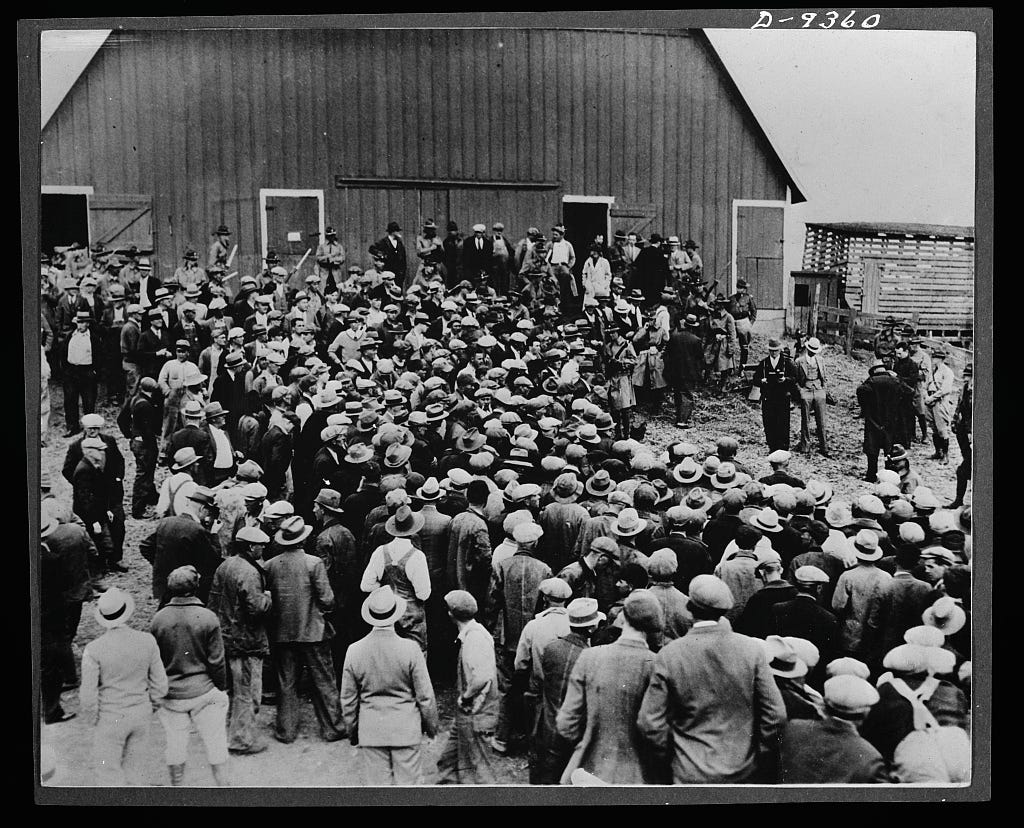
Act One. The Penny AuctionsNebraska, October 6, 1932. Five and a half miles southwest of Elgin, in the middle of farm country. Theresa Von Baum, a widow who worked her 80-acre farm with only the help of her sons after her husband’s death, couldn’t make the payment on her $442 mortgage. The bank moved to foreclose. The bank expected to make hundreds, or even thousands, of dollars for the farm.Nearly 3,000 farmers from Antelope and neighboring counties showed up at the Von Baum farm that day. They stood in silence. Waiting.The receiver, the bank’s man, wanted to reschedule. The farmers didn’t move. After some back and forth, the receiver finally backed down. The auction would proceed.The auctioneer started. Cows went for 35 cents apiece. Six horses sold for a total of $5.60. Plows, a hay binder, and a corn planter all brought just a few cents. Harvey Pickrel remembered it later: “Some of the farmers wouldn’t bid on anything at all - because they were trying to help the man that was being sold out.” When it was over, the farmers passed the hat among themselves. The total came to $101.02. They immediately returned the animals and equipment to Theresa Von Baum. Then the farmers handed the money to the receiver. He looked at the crowd. Probably counted heads. Probably decided that forcing the issue wasn’t likely to get him a cent more, and might get him a broken nose, or worse. He accepted the money as payment in full for the mortgage, got in his car, and drove back to town.People called them “penny auctions.” Others called them “Sears Roebuck sales,” because a penny was what you paid for something in a catalog. A joke price. This wasn’t for just one widow in Nebraska.In 1931, about 150 farmers showed up at another foreclosure auction, the Von Bonn family farm in Madison County, Nebraska. The first bid was five cents. When someone else tried to raise it, he was forcibly requested not to do so. Item after item got only one or two bids. The total proceeds were $5.35. The farmers expected the bank to accept this sum to pay off the loan. In Wood County, Ohio, on January 26, 1933, some 700 to 800 farmers stood out in the cold at Wally Kramp’s farm. Kramp owed $800 on a loan he couldn’t repay. He’d been hospitalized with appendicitis, and crop prices had collapsed. The farmers bid pennies on each item, then returned everything to Kramp on a 99-year lease. They passed the hat. Even the auctioneers donated their take from the sale. In some places, farmers threatened outsiders who might think about bidding with physical harm and death threats. These were not empty threats. This was happening all over the Midwest. There were maybe a dozen auctions a day in early 1933. Iowa, Nebraska, Wisconsin, Minnesota. Farmers who had paid their mortgages for ten, fifteen, twenty years, never missed a payment, were losing everything. The banks had structured the loans to fail when credit dried up.Before the 1930s, most mortgages in America were five to ten years, interest-only, with a huge balloon payment at the end. You paid the bank for years. Then you had to refinance the whole thing all at once. If you couldn’t roll it over, the bank took the farm. Or the house. When the economy crashed in 1929, banks stopped lending. In 1932, 273,000 people lost their homes to foreclosure. By 1933, banks foreclosed on more than 200,000 farms. Between 1930 and 1935, farmers lost a third of all American farms. Some communities didn’t take it quietly. It wouldn’t be the first time that farmers threatened nobles, even if they didn’t use pitchforks. And it wouldn’t be the last.Le Mars, Iowa. April 27, 1933. A Thursday afternoon. Judge Charles Clark Bradley, 54 years old, a bachelor with fifteen years on the bench, looked up from his desk at a rowdy crew shoving their way into his small courtroom. Some were farmers in ragged overalls. Others looked like ruffians from nearby Sioux City. They kept their hats on. Kept smoking. They’d come to demand that Judge Bradley suspend foreclosure proceedings until recently passed state laws could be considered. One farmer remarked that the courtroom wasn’t Bradley’s alone. Farmers had paid for it with their taxes. Judge Bradley refused. He said, “Take off your hats and stop smoking in my court room.”Next thing he knew, dozens of rough hands were mauling him. They yanked him off his bench and dragged him out to the courthouse lawn. “Will you swear you won’t sign no more mortgage foreclosures?” demanded a man with a blue bandana across his face. Judge Bradley’s quiet answer: “I can’t promise any such thing.” Someone struck him in the mouth. “Will you swear now?” The jurist toppled to his knees. His teeth felt loose but he managed to reply: “No, I won’t swear.” A truck rattled up. The men threw Judge Bradley into it. His kidnappers tied a dirty handkerchief across his eyes. The truck drove a mile out of town and stopped at a lonely crossroads. Again they asked the judge to sign no more foreclosures. Again he refused. They slapped and kicked, knocked him to the ground, and jerked him back to his feet. They tied a rope around his neck, the other end thrown over a roadside sign. They tightened the rope. Judge Bradley wheezed, thought they were killing him. “Now will you swear to sign no more foreclosure orders?” A man unscrewed a greasy hubcap from the truck and placed it on his head. Judge Bradley looked at them and said, “I will do the fair thing to all men to the best of my knowledge.” They pulled the noose tight. Just in time, a local newspaper editor arrived in his car and intervened. Judge Bradley refused to identify his assailants or press charges. Iowa Governor Clyde Herring called the attack “a vicious and criminal conspiracy and assault upon a judge while in the discharge of his official duties, endangering his life and threatening a complete breakdown of law and order.” He declared martial law in Plymouth County. He sent in three National Guard companies from Sioux City and a fourth from Sheldon. The case made the front page of the New York Times.Twelve days later, Governor Herring lifted martial law. Seven men were eventually tried for the attempted lynching. They got sentences ranging from one to six months. The penny auctions effectively forced the banks to release the property without an opportunity to be paid the balance of the loan. If the pennies didn’t clear the bank debt, the farmers physically threatened the bank officers. So legally, the farmer still owed. But practically, the system had broken down. With the beginning of Roosevelt’s presidency in 1933, creditors and debtors began to work together to refinance and resolve payment of delinquent debts. Between 1933 and 1935, twenty-five states passed farm foreclosure moratorium laws that temporarily prevented banks from foreclosing. The Federal Farm Bankruptcy Act of 1934 aimed to provide farmers with the opportunity to regain their land even after foreclosure.The penny auctions didn’t erase the debt. But they made normal foreclosure impossible. They created chaos. Mobs dragging judges out of courtrooms. Nooses at farm auctions. Armed farmers blocking highways. This chaos threatened domestic tranquility.That’s one of our six national goals outlined in the Preamble to the Constitution. “Insure domestic tranquility.” When hundreds of farmers are willing to lynch a judge to stop foreclosures, you no longer have domestic tranquility. You have the early stages of revolt.So the federal government had a choice.It could side with the lenders and use force to restore order. Send the National Guard to areas of interest. Arrest citizens. Or it could step in and redesign the system so that foreclosure wasn’t the only option when credit dried up.Roosevelt chose the second path.In 1934, Congress established the Federal Housing Administration (FHA) as part of the New Deal. The idea was simple. The government would insure mortgages for private lenders, which would get banks lending again. But FHA came with a condition. If the government was going to insure a mortgage, that mortgage had to be fair to the borrower. No more interest-only traps. No more time bombs. Every payment would include a portion of the principal. And the term had to be long. Initially, 15 years or more, later extended to 20, and eventually to 30. At the end of the term, the borrower would own the house free and clear. That was the deal. The government would step in to set conditions to make the housing market fair for Americans, and those loans would be designed to end. Designed to turn debt into property within a normal working life. Designed to make the borrower an owner, not just a lender from a bank. Someone with equity and security. Then, in 1938, Congress created Fannie Mae, the Federal National Mortgage Association, to buy those FHA-insured mortgages from banks and create a secondary market. They built the whole system around the principle that mortgages had a finish line achievable by working Americans in their lifetime.When government first stepped into housing finance, it used its power to limit how long the debt could last. Because the alternative, letting the old system grind on, meant more Judge Bradleys with ropes around their necks. More penny auctions. More bricks through windows. More breakdowns of law and order.The government stepped in on behalf of borrowers because not stepping in meant civil unrest.Fast forward to 2025.Today, we have the same basic structure. Now, there’s a new proposal.The White House and housing industry leaders are proposing a 50-year mortgage. It would cut your monthly payment by maybe $150. But because the term is longer, it would add hundreds of thousands in extra interest over the life of the loan. And, if you buy at 40, the current average age of a first-time homebuyer, you’re making your last payment at 90. Only about 25% of those who reach 65 live to be 90. Instead of using government power to shorten the road from debt to ownership, we are proposing to
Act 1. Andrew CarnegieIt’s 1892. Homestead, Pennsylvania.Andrew Carnegie pays his steelworkers an average of $1.68 a day. About $56 in today’s money. Twelve-hour shifts. Six days a week.The workers and their families shared rooms that smelled like smoke and steel dust. The beds were never cold because workers on different shifts all used them. They ate bread, onions, sometimes meat. The lucky ones had shoes that fit. Nutrition, sanitation, and health were poor. Workplace injuries were common.Meanwhile, Carnegie’s personal annual income in 1892 was approximately $25 million. That’s $830 million in today’s dollars. Per year.Here’s a simple question: Why didn’t he just pay the workers more?Not out of charity or kindness. Just pay them enough that they didn’t have to send their children to work at age ten. Pay them enough that they could afford doctors when they got injured. Pay them enough that their widows didn’t end up in poorhouses.Carnegie’s answer, laid out in his 1889 essay The Gospel of Wealth, was surprisingly direct. He argued that giving workers higher wages would be wasteful. Most workers lacked the judgment to use extra money wisely. They’d spend it on alcohol, gambling, and frivolous consumption. He wrote, “It were better for mankind that the millions of the rich were thrown into the sea than spent to encourage the slothful, the drunken, the unworthy.”Better, Carnegie said, to keep wages low, accumulate wealth, and then give it away strategically. To libraries or universities. Institutions that would uplift the deserving poor, not reward the undeserving.Were his workers not deserving? But in the case of Carnegie, it was also something deeper. A theory about the nature of giving. About the difference between waste and virtue.Let’s test the logic.In 1892, Carnegie Steel employed about 40,000 workers across all operations. If Carnegie had taken just $5 million of his $25 million annual income and distributed it evenly among those workers, each one would have received an extra $125 per year, about $4300 today.That’s not life-changing money. But it’s enough to buy winter coats for your kids. Enough to see a doctor instead of dying from an infected cut. Enough to not send your twelve-year-old to work in the mill.But Carnegie didn’t do that.Instead, over his lifetime, he gave away $350 million to build libraries, concert halls, and universities. He gave 2,811 libraries to communities. So here’s the next question: Why did he consider the second option virtuous, but the first wasteful?A worker who needs $2 a day to feed his family needs it whether you hand it to him on Friday or donate it to a library that his grandchildren might use.We all need heat in the house and food on the table. The need doesn’t change. Only the giver’s relationship to it does.There’s an old idea, older than Carnegie, older than America, that we owe two kinds of debts. Give to Ceasar what is Ceasar’s, and to God what is God’s. First, our debt to Ceasar. This debt is civic. What we owe to the state, to the community, to the infrastructure that makes our lives possible. Roads, courts, defense, clean water. We pool our resources to build what none of us can build alone.The other debt is moral. What we owe to each other as human beings. Compassion, dignity, the recognition that suffering is real and we have some responsibility to ease it.The civic debt is the price of civilization. We choose to escape chaos. We pay taxes because without a functioning state, there is no property to protect, no contracts to enforce, no prosperity to enjoy.The moral debt is civic friendship, the sense that we share a common life and therefore share some responsibility for each other’s welfare. Our neighbors. Communities. Churches. For most of human history, these debts lived in separate accounts.We paid taxes to keep the state running. We gave alms to benefit those around us in our communities.One was mandatory. One was voluntary. One was civic duty. One was personal virtue. They didn’t compete with each other.But then something changed.By the late 1800s, charity wasn’t just feeding a beggar on the street corner anymore. It was building hospitals. Funding schools. Running orphanages. Feeding entire cities during economic panics.And government wasn’t just maintaining roads anymore. A series of economic depressions and rapid industrial revolution brought a dramatic increase in individual and community needs. People started to ask: What if the state could do what charity does, but bigger, more reliably, for everyone? Suddenly, the two debts started to overlap. State duty, and civic duty, blended together. Blending the two brought philosophical questions. If the government funds hospitals through taxes, do we still need to donate to hospitals?If the state provides old-age pensions, does that make personal charity for the elderly obsolete?If the government takes care of the poor through mandatory taxes, does that rob us of the opportunity to be virtuous?There’s an argument that an act is only morally praiseworthy if it’s done freely, out of genuine choice, not out of compulsion. That we should voluntarily give in secret. By that logic, paying taxes to fund welfare isn’t a moral act. It’s just compliance.But choosing to donate to a soup kitchen is virtue. Proof of your moral character.Carnegie never framed it in philosophical terms, but his entire worldview rested on keeping those two debts separate.The civic debt, what we owe the state, should be minimal. Low taxes, limited government, just enough to keep order and protect property.The moral debt, what we owe our fellow man, should be voluntary, personal, strategic. We give when and how we see fit. And most importantly: the moral debt is where virtue lives.But there’s a problem with this framework: it only works if we assume that our wealth is our own to begin with.What if our wealth is civic obligation? What if the wages we don’t pay, the safety equipment we don’t buy, the unions we crush, weren’t private business decisions? What if they are civic failures?Then our philanthropy isn’t generosity. We are just hurting our neighbors in the name of virtue. Americans donate about $500 billion to charity every year. That’s 2% of GDP.Meanwhile, we spend about $3.7 trillion on what we call government social programs. These are programs like Social Security, Medicaid, SNAP, and housing assistance. That’s roughly 12% of GDP.Americans prefer smaller government and lower taxes, but at the same time support programs like Social Security and Medicare. So the tension isn’t really about whether government should help people, but about how we want to frame that help, and whether we get credit for it. It’s not because charity is more efficient. Government programs have competitive or lower costs than private charities. Medicare’s administrative costs are competitive or better than private health insurance overhead at 12-18%.It’s not because charity reaches more people. SNAP alone feeds 42 million Americans. Feeding America’s charity network serves about 50 million people annually, including 12 million children and 7 million seniors. One program doesn’t dwarf the other.So is charity better? Some are convinced that only voluntary giving counts as virtue. Paying taxes, even if that money feeds hungry children, is obligation. Donating to a food bank is morality.Same outcome. Different emotional accounting.There’s research on this from blood donation systems. When you compare voluntary donation to paid systems, people value their donated blood more highly.The gift matters because it is a gift. Payment turns a moral act into a transaction.We do the same thing with charity versus taxes. Taxes feel like payment for services. Charity feels like a gift. And we reserve our sense of virtue for the gift.When Carnegie built his libraries, he put his name on them.Not only because he was vain. He sought to demonstrate personal virtue. To show that he, Andrew Carnegie, chose to help. Nobody builds a library with their tax dollars and gets a plaque.June 1892. Carnegie’s workers go on strike. They’re not asking for charity. They’re asking for wages. Enough to live on, enough to not watch their children work twelve-hour shifts in a steel mill.Carnegie refused.We celebrate Carnegie for philanthropy. But paying fair wages wasn’t charity. It was obligation. It’s what he owed workers for their labor. But he thought his workers would just waste their money. He wanted to give, on his terms, in his time, to causes he deemed worthy. Carnegie told himself his wealth was earned purely through genius. His philanthropy let him keep believing that lie. July 6th. Henry Clay Frick, Carnegie’s right-hand man, brought in 300 armed Pinkertons. The battle lasted fourteen hours. Ten men died.He breaks the strike. Destroys the union.And twenty-seven years later, Andrew Carnegie died having given away $350 million to libraries, universities, and concert halls.We remember Carnegie, the philanthropist. We forget Carnegie, the draconian union-buster.Carnegie proved at Homestead that charity alone doesn’t work.When helping people is voluntary, some people simply don’t get help.Carnegie chose libraries over living wages. He chose concert halls over safety equipment. He chose universities over unions.He decided who deserved help, and his workers didn’t make the list. Charity only works when people feel generous, and Carnegie didn’t feel generous toward the men who made him rich.So forty years later, when the Great Depression hit and the soup lines stretched around the block, America made a different choice.We pivoted. If charity fails when it’s voluntary, maybe helping our neighbors needs to be mandatory.Act 2. The New DealIt’s October 28, 1929. The stock market crashes. By mid‑November the market surrendered half its value. It took twenty-five years and twenty-five days, an entire generation, to recover. Only on November 23, 1954, did the Dow Jones Industrial Average climb bac
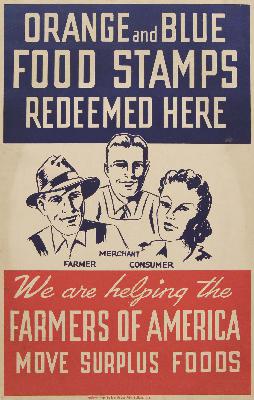
Act 1. The First Food StampScene One: May, 1939. The Machinist and the SurplusOn the morning of May 16, 1939, Ralston Thayer stood first in line at Rochester, New York’s old post office. He was thirty-five years old. A machinist. A veteran of the Great War. He had been out of work for nearly a year. Newspaper reporters crowded around him. Photographers jockeyed for position. Thayer was making history, and they wanted a piece of the action. He walked up to the cashier window and handed over four dollars from his latest unemployment check. The clerk gave him four dollars in orange stamps and two dollars in blue stamps, free. The orange stamps could buy any food. The blue stamps could only buy whatever the Agriculture Department declared surplus. Eggs nobody wanted. Butter that wasn’t selling. The stuff farmers couldn’t move because nobody could afford to buy it. Grocers could exchange the food stamps of both colors at the bank for real dollars. The banks would then redeem the stamps with the US Treasury. Ralston Thayer became the first food stamp recipient in American history.Throughout that day, thousands of Rochester residents did as Thayer had done. They handed over cash and got back more purchasing power than they’d walked in with. That afternoon, they flooded the grocery stores with their crisp new booklets of orange and blue stamps. The grocers couldn’t believe their luck. By December, they were ecstatic. The government had sold more than a million dollars’ worth of orange stamps in Rochester alone. That meant hundreds of thousands in free blue stamps pumped directly into hundreds of grocery stores. It was a welfare program for retailers and banks as much as for families. But the question nobody asked in 1939 was why: Why was Ralston Thayer hungry?It wasn’t because there wasn’t enough food. American farms were producing too much food. The government was purchasing massive amounts of crops, transporting them, storing them, distributing them. The surplus was so large they didn’t know what to do with it. The grocery stores were full. The problem wasn’t scarcity.The problem was that the economic system had stopped working. The Depression had destroyed demand. Thayer had worked as a machinist his entire adult life. He had fought in France. He had skills, experience, discipline. Then the Depression hit, and the work vanished. Not because he was lazy. Not because he lacked ability. The entire circular flow of the economy had frozen solid.Three problems. Farm surpluses nobody could sell. Grocery stores with weak sales. Hungry citizens with seventeen percent unemployment.So the government created a solution. Tax citizens. Use that money to buy surplus crops from farmers. Give stamps to the needy. Let grocery stores profit from the influx of purchasing power. Then, banks could exchange the food stamps of both colors at the Treasury for real dollars. Supporters estimated the program would increase grocery sales by two hundred fifty million dollars a year. The grocers loved it. The banks loved it. The farmers loved it. Congress loved it. The surplus problem was solved.It was a brilliant emergency response. And it was temporary. Everyone knew it was temporary.The first Food Stamp Program lasted four years. From 1939 to 1943, it reached millions of Americans in half the country. Four million people at its peak.Then it ended. Not because Congress acted to end it. Because the conditions that created it disappeared. By 1943, America’s response to World War II had created full employment. Wages rose. People could afford food again.Many vilify President Franklin D. Roosevelt for his social programs. After all, he began food stamps in 1939. But President Franklin D. Roosevelt also ended them in 1943. Not because they didn’t work, and not by executive order. They ended because his administration made them no longer necessary. The economy had recovered. People had work. That work paid enough to buy food. The emergency was over. FDR restored the ancient principle that by the sweat of your face, you shall eat bread. This is the decisive point relevant to today. Ending food stamps is possible when people have jobs that pay enough to buy food. When workers could earn living wages, food stamps weren’t necessary. The government didn’t need to redistribute property through taxation because workers’ labor produced property. They could eat from the sweat of their brow. When we mix our labor with the dirt, what we create becomes ours. The Constitution protects this. Work and eat. Your labor produces your sustenance. It is the most basic property right in human civilization. Scene Two: 1961–1964. The ReturnBut then the food stamp program came back.President Kennedy revived the program in 1961. On May 29, Mr. and Mrs. Alderson Muncy of Paynesville, West Virginia, became the first recipients. They bought ninety-five dollars in food stamps for their fifteen-person household. Their first purchase was a can of pork and beans.Why did food stamps come back? Kennedy had campaigned in West Virginia and Appalachia. He was appalled by what he saw. Children in poverty. Families living on surplus lard and corn meal. But those families weren’t living on lard and corn meal because there was a famine. This wasn’t the Depression. The national economy was growing. Unemployment was falling. The problem wasn’t that the entire economic system had collapsed. The problem was that prosperity wasn’t reaching everyone. Entire regions had been left behind.President Johnson signed the Food Stamp Act of 1964 and declared it would be one of the most valuable weapons for the war on poverty. Johnson’s choice of the word ‘war’ is interesting. War is the continuation of politics with other means. Everything in war is simple, but even the simplest thing is difficult. A simple goal. Eliminate poverty. The challenge is setting conditions for success when you know that success will be fleeting. Victory is temporary. People adapt. Conditions change. So you set limited, measurable, achievable objectives. You define what winning looks like. You establish the conditions that will allow you to declare victory and go home.FDR understood this. His food stamp program had a clear objective: keep people from starving during an economic collapse. The conditions for success were equally clear: full employment and rising wages. When America met those conditions, the program ended. Mission accomplished.Johnson declared a war on poverty but never defined victory. No conditions for winning. No way to know when the war could end. We have never tried to figure it out.If we don’t set conditions for success, temporary relief becomes permanent. If we don’t define victory, emergency becomes normal. If we don’t make and achieve limited objectives, war becomes endless.That’s what happened to Johnson’s war on poverty.Scene Three: Today’s Constitutional FailureMore than sixty years later, we call the food stamp program SNAP. SNAP reaches forty-one million people nationwide. Ten times the peak participation of the original program. Half of American children will rely on food assistance at some point during childhood.Ralston Thayer needed food stamps because unemployment hit seventeen percent and the Depression destroyed the economy. What’s our excuse now?The problem in 1939 was no work. The problem now is work that does not pay.Ralston Thayer could not find a job. Today’s SNAP recipients have jobs. They work forty hours a week. They stock shelves at Walmart. They flip burgers at McDonald’s. They go to work, they sweat, they come home exhausted. But they can’t afford to buy food.A 2020 government report found that 70% of SNAP recipients worked full-time. The government still redistributes property through taxation. Grocery stores still profit. But now corporations benefit from cheap labor subsidized by taxpayers instead of unemployment checks.Businesses are not the villain here. They are doing exactly what businesses are supposed to do. Maximize profits within the rules Congress sets. The problem is the rules Congress set. Let’s follow the money. Businesses pay wages competitive enough to attract workers. Workers apply for SNAP. Taxpayers fund the benefits and support business wages. Workers spend SNAP benefits at businesses.This is not business corruption. This is the system working exactly as Congress designed it. Congress created the conditions where paying low wages and relying on SNAP makes perfect business sense. Any rational business would do the same.This is not a market failure. This is a constitutional failure.When a man works and cannot eat from the sweat of their brow, someone is stealing his property. The question is who.Act 2: The Government’s DutyThe answer begins with an agreement made before there were governments.Even before Adam and Eve, hands blistered from work, and children’s bellies ached for food that depended on that work. When we work, we are entitled to the bread we create. The oldest law of life itself. Older than the Ten Commandments by maybe fifty thousand years. This human condition is the foundation of all property rights. You own yourself. You own your labor. When you mix your labor with the world, what you create belongs to you. The American Founders built this philosophy into the Constitution.The Fifth Amendment says government cannot take your property without due process of law. The Fourteenth Amendment extends this protection against the states. But … what is property?Most people think property means things. Your house. Your car. Your land. The Founders saw it more deeply. James Madison, more responsible for the US Constitution than any other, wrote that a person has property in their opinions, in their religious beliefs, in the safety of their person. And most importantly, they have property in their labor.Your labor is yours. The wages you earn through that labor are your property. This is not a metaphor. It’s constitutional law. When you work, you are exercisin

A president offers to buy beef from a country we just bailed out. Argentina. American ranchers call it betrayal. Economists say it won’t lower prices. Everyone calls it stupid.But that same country just sold seven million tons of soybeans to China instead of us. And three-quarters of their beef exports go to China. And we just gave them twenty billion dollars. And their president is our president’s ideological ally.Maybe it’s not about beef. Maybe it’s about China.But the ranchers still get hurt. The consumers still don’t see lower prices. And we don’t know if Argentina will actually pivot away from China, or just take our money and keep selling to Beijing. Maybe we weaken China’s food supply. Or maybe we just weaken our own ranchers.So…Should American cattle ranchers sacrifice for China?Act 1. Nixon and the Beef Freeze: When Politics Meets MarketsMarch 29, 1973.President Richard Nixon had a problem.Actually, he had several problems. The Senate had just voted 77-0 to investigate Watergate. The cover-up was unraveling. John Dean was about to flip. Dean knew he was going to be the scapegoat in the scandal and chose to cooperate with investigators to save himself. But today, right now, the problem was beef.Beef prices were up 20% in three months. Housewives organized boycotts. One woman in Chicago told reporters she was pricing hamburger like filet mignon. Another said her family had switched to beans and rice.Fifty million people joined them. The largest consumer protest in American history.The evening news showed empty shopping carts and angry voters. Walter Cronkite was covering it. Which meant everyone was seeing it.Nixon’s economists told him to let the market work, and it would self-correct. George Shultz at Treasury. Herbert Stein at the Council of Economic Advisers. They said this was a supply problem. Bad weather. Reduced corn harvest. Feed costs up. Drought in the Southwest meant fewer cattle. Higher prices would drive the market to adjust and incentivize production. Give it time.But Nixon wasn’t interested in time. He was interested in the evening news.He’d already broken with Republican orthodoxy in 1971. Imposed wage and price controls. First peacetime controls in American history. Froze wages. Froze prices. Took the dollar off gold. His Treasury Secretary, John Connally, had sold him on it. 5% inflation doesn’t produce great election results. The controls had worked politically. Nixon won 49 states.But by early 1973, the controls were creating problems everywhere. Shortages here. Surpluses there. The price system was breaking down. Nixon didn’t care. Controls were decisive. Presidential. You announce something and prices stop going up. At least for a while. At least long enough.On March 29, Nixon made his decision.He would freeze beef prices. No more increases. Prices were locked at current levels. Which were already at record highs. The freeze would last indefinitely.Shultz and Stein thought it was madness. You can’t freeze one price in a market economy. Everything is connected. Freeze beef and you’ll create chaos.Nixon announced it anyway.The Ranchers RespondThe cattlemen understood the economics immediately.If beef prices were frozen but feed costs kept rising, you lost money every day you fed a steer. The math was simple. The response was simpler.Stop selling cattle.“Ranchers stopped shipping their cattle to the market, farmers drowned their chickens, and consumers emptied the shelves of supermarkets.”Within days, cattle auctions reported volume dropping. Thirty percent. Then forty. Then fifty. Ranchers held cattle off the market. Some waited. Others started culling herds. Selling breeding stock they’d normally keep. Getting out entirely.The packers had fewer cattle to process. They ran plants below capacity. Sent workers home. The cattle they did get, they couldn’t make money on. Frozen prices. Rising costs.Then came the shortages.Empty Meat CasesBy mid-April, grocery stores across the country had no beef.The beef that existed was lower quality. More hamburger. Less steak. Ranchers were liquidating herds instead of finishing premium cattle. Some stores limited purchases. Two pounds per customer. Others had empty display cases.Nixon had promised to solve high beef prices. Instead, he’d created beef shortages.The evening news showed housewives staring at empty meat counters. Before, they could buy beef, even if it was expensive. After the controls, there was no beef to buy at any price.The black market appeared fast. Ranchers who’d held cattle sold directly to restaurants. To butcher shops willing to pay above the frozen price. Cash transactions. Off the books. The official market was frozen. The actual market found a way.Restaurants got squeezed the worst. They couldn’t raise menu prices because of the controls. But their costs kept rising as they competed for scarce beef. Some switched to chicken. Others reduced portions. A few high-end steakhouses closed.Washington ReactsThe American National Cattlemen’s Association flooded Washington with members. Their argument was simple. They called Nixon’s approach “The Wreck.” The freeze was destroying the industry. Ranchers were losing money every day. If it continued, there would be massive liquidation. Breeding stock slaughtered. Herds dispersed. Ranchers bankrupt. Years to rebuild.The National Farmers Union backed them. Farm-state Senators backed them, Republican and Democrat alike.Senate Agriculture Committee Chairman Herman Talmadge of Georgia called it the most short-sighted agricultural policy since Smoot-Hawley.The data supported them. Cattle slaughter was up 15% as ranchers liquidated. But beef production was falling. Ranchers were slaughtering younger, lighter animals instead of finishing them. More cattle killed. Less beef produced.Nixon’s political calculus was failing. The freeze was supposed to show action. Instead, it showed incompetence. Empty meat cases were worse than high prices.The ReversalSeptember 12, 1973. Five months after the freeze.Nixon lifted it.He didn’t call it a reversal. The announcement said the freeze had “served its purpose.” That “market conditions now warrant” flexible pricing.Everyone knew what happened. The policy failed.Beef prices immediately shot up. Higher than before the freeze. Pent-up demand. Disrupted supply chains. Liquidated herds reduced future supply.By year’s end, beef prices were 30% higher than when the freeze began.The freeze hadn’t stopped inflation. It deferred it and made it worse.The Long DamageBut the real damage took years to show.Cattle don’t turn on and off. A cow has one calf a year. That calf takes time to mature. If you’re building your herd, you keep the female calves so they can grow up and have calves of their own. Half your calves don’t go to market.When ranchers liquidated in 1973, they sold breeding stock. Fewer calves in 1974. Fewer yearlings in 1975. Fewer finished cattle in 1976.The hole in the pipeline lasted into the late 1970s. Prices stayed volatile. The cattle industry lost trust in government. They didn’t have much to lose.When Carter’s Agriculture Secretary tried cattle programs in 1977, ranchers told Washington to stay out.What Nixon Was Playing ForNixon froze beef prices for one reason: Political theater. He wanted the evening news to show him taking action on inflation. He wanted housewives to see a president who cared about grocery prices. He wanted voters to stop being angry.There was no strategy beyond that. No long-term economic plan. No foreign policy objective. No national security consideration.Just make the political problem go away before the next election.It didn’t work. Not even politically. The shortages were worse than the high prices. The reversal looked weak. The long-term damage was real.The LessonMarkets work, or they don’t. Agriculture markets are mature and connected.You can’t freeze one price without creating chaos everywhere else. You can’t solve a supply problem by controlling prices. You can’t make political time match cattle cycle time.Nixon sacrificed the cattle industry for short-term politics. He ended up with empty meat cases, angry ranchers, and a disrupted market that took years to fix.Fast Forward to 2025President Trump is proposing to use beef imports to lower prices. American ranchers are furious. Economists say it won’t work. People are calling it Nixon all over again.But there’s a difference.Nixon had no strategic objective beyond the next news cycle. What if Trump does? What if this isn’t about beef prices at all? What if it’s about China?Argentina just sold seven million tons of soybeans to China instead of us. China buys three-quarters of Argentine beef. We just gave Argentina twenty billion dollars. Their president is our ideological ally.What if the beef import offer is really about pulling Argentina out of China’s orbit? What if we’re trying to become their agricultural market so they don’t need Beijing? What if this is an attempt at strategic positioning disguised as price policy?Then it’s different than Nixon’s play. It’s something else.But American ranchers still get hurt, because cattle profits need to be high to rebuild herds. Consumers don’t see lower prices. And we don’t know if Argentina will pivot to America or just take our money and keep selling to China.Nixon sacrificed the rancher for politics and got nothing.Trump might be sacrificing the rancher for strategy. But what if the strategy doesn’t work? What if Argentina takes the bailout, accepts the beef deal, and keeps selling to Beijing anyway?Then we’ve disrupted our own cattle industry. For nothing. Again.The question stands: Should American cattle ranchers sacrifice for China?And the tougher question beneath it: What if they sacrifice and we still lose?Act 2. US Beef MarketsUS beef prices are at record highs. Steak prices are up 17% year-over-year. Ground beef up 13%. Beef roasts up 14%. USDA projects beef and veal prices will rise 12% in 2025, compared to less t

A successful elk season has come and gone. Elk season isn’t just about the harvest, or packing heavy loads out of the mountains, though those activities are often involved.Elk season is communion. With the mountain, and with each other. It’s a time of remembrance. Checking on kids and wives. Eating and drinking together. You might hunt with someone you see often, or someone you haven’t seen in ten years.Nearly every hunter in the camps I frequent is a veteran. We tell old war stories, curse aging, lament losses. We help each other hunt. We carry heavy loads on our backs for each other. We share food, water, motivation.This year, like most years, military service comes up. Every member is proud to have served. Proud of the combat capability we generated for America.But we also talk about what’s changing. Fewer kids can pass a military physical. Fewer towns send their sons and daughters to serve. The gap between those who defend America and those who benefit from it keeps widening.So this week we’re sharing three stories we talked about in camp this year. Stories about opportunity, about standards, about the investment required to maintain both. No old personal war stories though. To hear those, you have to come to camp. The Story of Audie MurphyJune 1925. Hunt County, Texas. Audie Leon Murphy is born in a sharecropper’s shack outside Kingston. And when I say shack, I mean it had a dirt floor. No electricity. No running water. His father, Pat Murphy, was a sharecropper who worked other men’s land for a cut of the cotton crop. His mother, Josie, bore twelve children. Nine survived infancy.The Depression hits Texas like a hammer. Pat Murphy starts disappearing, for days at first, then weeks. He’s drinking, chasing work that doesn’t exist, abandoning his family in slow motion. Audie is the sixth child, small for his age, but he becomes the provider. At age twelve, he’s dropping out of school to pick cotton. A dollar a day if he’s fast. He hunts rabbits and squirrels with a borrowed rifle to keep his siblings fed. He becomes an excellent shot because he has to be. Every missed shot is a missed meal.Audie is sixteen. His mother dies of complications from malnutrition, exhaustion, and poverty. The family disintegrates. The younger children are farmed out to relatives and an orphanage. Audie and his older brother pick cotton and sleep in barns to survive. Pat Murphy is long gone, fully vanished now. Audie weighs maybe 110 pounds. He looks barely fourteen.December 7, 1941. Audie Murphy decides to enlist. He’s seventeen, has a fifth-grade education, and weighs 112 pounds soaking wet. He tries the Marines first. The recruiter takes one look at this skinny kid with hollow cheeks and laughs him out of the office. “Come back when you’ve grown some, son.”He tries the paratroopers. Rejected. Too small.He tries the Navy. Rejected.His sister helps him falsify his birth certificate to prove he’s eighteen. He tries the Army. June 1942. The recruiter is skeptical, but the Army needs bodies. They take him. Private Audie Murphy. 112 pounds. Five-foot-five. Baby-faced. Assigned to the 15th Infantry Regiment, 3rd Infantry Division.They ship him to North Africa in 1943. Then Sicily. Then Italy. The kid can shoot! Everyone notices immediately. He’s calm under fire in a way that unnerves the older soldiers. No hesitation. At Anzio, he kills two Italian officers attempting to escape, drops them both at distance with a carbine. His platoon sergeant gets wounded. Murphy takes over, leads the men through German positions, takes prisoners. He’s nineteen years old.Southern France, 1944. The 3rd Division lands at Saint-Tropez, pushes north. Murphy’s collecting medals now. Bronze Star, then another. Silver Star. His superiors keep promoting him. Corporal. Sergeant. Staff Sergeant. He’s still barely old enough to vote. His friends keep dying. He keeps replacing them, learning their names, watching them die, replacing them again.One night in the Vosges Mountains, Murphy’s best friend, a man named Lattie Tipton, gets killed by German machine gun fire, cut nearly in half. The Germans had been waving a phony white flag of surrender. His death hardens Murphy. By late 1944, Murphy has a Distinguished Service Cross and battlefield commission to Second Lieutenant. The sharecropper’s son from the dirt-floor shack is now an officer. He’s twenty years old and has personally killed approximately 240 enemy soldiers, though he doesn’t brag about it, doesn’t talk about it much at all.January 26, 1945. The Colmar Pocket, Alsace, France. Temperature near zero. Murphy’s company of 128 men gets orders to hold a position near the town of Holtzwihr against a German counterattack. Six Panzer tanks. Over 250 infantry. Murphy has about 40 effective soldiers left; the rest are wounded or dead.The Germans attack. Murphy orders his men to fall back to the woods. He stays forward with his artillery observer to direct fire. A German tank shell hits an American M10 tank destroyer near Murphy’s position. It catches fire, ammunition cooking off. The artillery observer is wounded and runs. Murphy is alone.He climbs onto the burning M10.Understand that the tank destroyer is on fire. Fuel tanks could explode any second. The Germans can see him, one man, silhouetted against burning metal. He grabs the M2 Browning .50 caliber machine gun mounted on the turret. It’s loaded.For the next hour, Audie Murphy stands on a burning tank destroyer and kills Germans.He’s wounded in the leg but ignores it. The radio headset lets him call fire missions to his artillery battery while he’s shooting. German infantry gets within ten yards. He kills them. The Panzers fire at him and miss. He swivels the .50 cal, rakes their supporting infantry, calls in artillery to adjust fire onto the tanks. Rounds are snapping past his head. The tank destroyer is still burning under his feet.Finally, his ammunition gone, Germans retreating, Murphy climbs down. He walks back to his men. Refuses medical attention until he’s reorganized the defensive line. The citation for his Medal of Honor says he killed or wounded approximately 50 German soldiers during that hour. Some historians think it was more.The war ends three months later.Audie Murphy, now Lieutenant Murphy, became the most decorated combat soldier of World War II. Twenty years old, three Purple Hearts, and the Medal of Honor.The Army sends him on a publicity tour. Life Magazine does a spread. In Hollywood, he meets James Cagney, who suggests Murphy try acting. He’s got the face for it, still baby-faced, unthreatening. Universal Pictures offers a contract.Murphy uses his GI Bill benefits to take acting lessons. He’s awkward at first, uncomfortable with the attention. But he works. Makes his first film in 1948. Over the next two decades, he appears in forty-four films, mostly westerns. In 1955, he plays himself in “To Hell and Back,” adapted from his memoir. It becomes Universal’s highest-grossing film until “Jaws” twenty years later.The military gave Audie Murphy what poverty never could. Training, discipline, purpose, opportunity. He buys a house in California. Invests in oil wells and breeding horses. Brings his siblings out of Texas, sets them up, breaks the generational cycle. The sharecropper’s children become middle-class Americans.But Murphy never pretends military service is easy or cost-free.He has nightmares. Sleeps with a loaded pistol under his pillow. His first marriage collapses; his wife says he wakes up screaming and unreachable. He struggles with what we now call PTSD, what they called “battle fatigue” or “shell shock” then. The VA doesn’t know how to treat it. Most veterans don’t talk about it.Murphy talks about it.He testifies before Congress. Uses his celebrity to advocate for veterans with psychological wounds. Pushes for better VA funding, better mental health care, better recognition that war doesn’t end when the shooting stops. He’s open about his own struggles in ways that are radical for the 1950s and ‘60s. A Medal of Honor recipient admitting he’s damaged, that he needs help.May 28, 1971. Murphy is flying from Atlanta to Virginia in a private plane. Bad weather. The plane crashes into Brush Mountain near Roanoke, Virginia. Audie Murphy dies on impact. He’s forty-six years old.They bury him at Arlington National Cemetery with full military honors. His grave: Section 46, Grave 366-11, becomes the second most-visited site at Arlington after President John F. Kennedy’s. People still leave medals, coins, flowers. They leave notes thanking him.From a dirt-floor shack in Hunt County to Arlington. From a dollar a day picking cotton to Captain. From fifth-grade dropout to college courses on the GI Bill. From generational poverty to homeowner, breadwinner, advocate.The military didn’t just give Audie Murphy a paycheck. It gave him a ladder. And he climbed it all the way to the top.Murphy’s story isn’t unique in American history. The military has always been the most reliable ladder out of poverty America offers. Training. Discipline. Purpose. Healthcare. Education benefits. A path to homeownership. A chance to break the cycle.Nearly every veteran has some version of Murphy’s story. Maybe not Medal of Honor level, but the same trajectory: grew up poor, served, came out qualified for something better. The GI Bill. VA home loan. Skills that translate to civilian work. A network of people who’ve supported you along the way.The men around the fire this year talked about this openly. The financial benefits. The medical coverage their families needed. The education they couldn’t have afforded otherwise. The home they were able to buy. None of them are ashamed of it. They earned it. They carried loads, literal and metaphorical, that many Americans will never carry.But there’s a disconnect. We know this ladder works. We are living proof that it works. But back home, many of us see generational poverty, families stuck on social programs for decades,

The Chicken TaxScene. It’s 1962. American farmers have cracked the code.We can raise chickens cheap. Like, really cheap. Industrial-scale factory farms, efficient as hell. We start shipping frozen chickens to Europe by the boatload. German housewives love it. French families love it. Half the price of local chicken. Maybe even tastier!European chicken farmers do not love it. They’re getting destroyed. So, France and West Germany do what countries do when their people scream loud enough. They slap tariffs on American chicken. Problem solved. Lyndon B. Johnson is President. He’s not amused. You slap our chickens? We slap back!In 1963, LBJ announced retaliatory tariffs. 25 percent on potato starch, dextrin, brandy. And … 25 percent on light trucks?The first three make sense. Targeted. Tit for tat. But light trucks? That was aimed at one company: Volkswagen. Their vans and little pickups were selling like crazy in the States. Detroit hated it. Johnson just gave them what they wanted: A 25 percent wall against the competition.Here’s the thing about the Chicken War. It ended fast. Europe backed down on chicken tariffs. Trade negotiations happened. The fight over poultry faded into the history books.But the truck tariff? That one never came down. Sixty-two years later, it’s still the law of the land.First, let’s clear something up. A tariff isn’t some clever penalty on foreign companies. It’s a tax on us. American importers pay it. Then they pass it along to businesses. Then businesses pass it along to you. At the dealership. At the grocery store. That’s what tariffs are. A tax on Americans buying foreign goods.That 25 percent wall around light trucks was supposed to be temporary leverage, but it stuck. It became a hidden tax we’ve been paying for six decades.And with foreign competition locked out, American trucks transformed. They got bigger. Heavier. More luxurious. Way more expensive. The Ford F-150 became the profit machine that drives Detroit. Not because it had to compete on price, but because it didn’t. Roll back the tape for context. An early 1980s F-150 had a base MSRP under six thousand dollars, roughly nineteen to twenty-four thousand in today’s money, depending on the exact model year and adjustment method. Even after inflation, trucks have leapt to a very different price tier. Now, seventy grand for a well-equipped pickup.Why would Ford lower prices when the moat was there? Why would GM? They wouldn’t. That’s not how business works.What started as a spat over frozen chicken became the permanent business model for America’s most popular vehicle.Harvard PhD Economist Milton Friedman would have loved the Chicken Tax story. The social responsibility of a business isn’t charity. It isn’t fairness. It isn’t “doing good.” It’s one thing: increase profits. That’s it. Maximize shareholder value. The sacred duty of a business is to make money.From that view, what Ford and GM did wasn’t shady. It wasn’t corruption. It was textbook. If consumers will pay $70,000 for a truck that costs half that to build, your duty is to keep charging $70,000. Dropping the price voluntarily isn’t noble. It’s malpractice. You’re throwing away profit that shareholders hired you to capture. It might even be wrong for a business to reduce prices. Voluntarily reducing prices reduces profits. And their duty is to maximize profits. Now, you can overturn a tariff in court. You can roll back a policy. You can refund the tax.But you can’t un-ring the bell. You can’t un-teach the consumer what they’re willing to pay. You can’t force a company to charge less when charging more is their duty.The Supreme Court might rule the tariffs unconstitutional. They probably should. The president doesn’t have the authority to enact sweeping tariffs. It’s about whether one man can impose the largest tax hike on the American people since 1993 without Congress. But even if the Court strikes them down, even if importers get refunds, your grocery bill isn’t going back to 2024 prices. Your furniture costs aren’t dropping. The new floor is set.That’s the lesson from the Chicken Tax. Tariffs might be temporary. But once prices go up, they don’t come down. The damage is permanent. It begs the question: What’s the purpose of these taxes?Why Congress, and Not KingsWhy do we tax ourselves at all?For most of human history, we didn’t. Early humans lived in bands of fifty, maybe a hundred. Small enough that everyone knew everyone. Cooperation was personal. You helped me hunt, I shared the meat. You watched my kids, I watched yours. No roads. No armies. No infrastructure. No need for taxes, because everything was face-to-face.Then came agriculture. Cities. Suddenly, humans lived with thousands of strangers. Tens of thousands. Millions. Our brains didn’t evolve for that. We evolved to cooperate with people we know. People we see. People in our tribe.How do you get a million strangers to cooperate? To build roads none of us would build alone? To fund armies that protect people we will never meet? To create systems like courts, schools, and infrastructure that benefit everyone but cost everyone? We told stories. Stories big enough that strangers could believe them together. Nations. Laws. Religions. The story of money we all believe is that a one-hundred-dollar bill is worth more than the cotton paper it’s printed on, that invisible numbers on a piece of plastic are worth anything at all. Taxation is one of those stories. The story says we’re not just strangers, we’re a people. Americans. Because we’re a people, we pool resources. We choose to tax ourselves, to build what none of us could build alone. Interstates, the power grid, the military, the internet.And tariffs? They’re not some foreign penalty. They’re taxes on us. American importers pay them. Then businesses pass them down. And right now, Americans are paying hundreds of billions through these tariffs. By the time the Supreme Court rules, the total bill could top a trillion dollars.When one person can tax us without consent, we no longer believe the story. We’re not citizens anymore. We’re subjects.The American Founders knew this. They’d lived it. James Madison, the architect of the Constitution, said, “Give all power to the many, they will oppress the few. Give all power to the few, they will oppress the many.”The British Crown taxed the colonies. The colonies had no representatives in Parliament. No voice. No vote. Just the bill. Taxation without representation.So when the Founders wrote the Constitution, they made a choice. A radical choice for 1787. They gave the taxing power to the American people’s representatives: Congress. Not the President. Article I, Section 8 declares Congress has the power “to lay and collect Taxes, Duties, Imposts and Excises.”That’s the philosophy of taxation in a republic. We don’t tax because a king demands it. We tax because we agree, through representation, to build something together.The Founders believed in something higher than the Crown. They believed in natural law. Rights granted by God, not kings. Life. Liberty. Property.Benjamin Franklin proposed a motto for the Great Seal of the United States: “Rebellion to tyrants is obedience to God.”That wasn’t a flourish. It was philosophy. If rights come from God or nature, no human has the authority to strip them away. So when a king taxes without consent, it isn’t just unfair, it’s illegitimate. Resisting isn’t rebellion. It’s duty.So, our choice. Citizen or subject. Representation or tyranny. Republic or monarchy.America owes allegiance to no king.Rebellion to tyrants is obedience to God.But the Matter Isn’t Settled…Of course, Congress has delegated some authority to the President over trade. In 1977, they passed the International Emergency Economic Powers Act for times of genuine crises. Freeze terrorist assets. Sanction rogue nations. That kind of thing.But hundreds of billions in new taxes on American importers, passed straight to American families because of trade deficits? Is that a threat to national security?The courts didn’t buy it. Not one. The Court of International Trade ruled the move illegal. Another federal court agreed. Then the Court of Appeals, three judges, unanimous, said the same thing. All concluded the law was written for emergencies, not long-standing trade policy. Letting the President tax unilaterally would rewrite the Constitution.Congress gave itself authority to tax in Article I, Section 8 of the Constitution for a reason. If Congress wanted to give the President authority to impose hundreds of billions in new taxes, they have to say so explicitly. The Emergency Powers Act doesn’t do that. It authorizes responses to specific emergencies. Not permanent, sweeping taxation of the entire economy. Letting presidents declare trade deficits “emergencies” and impose massive tariffs would essentially rewrite the Constitution. It would transfer the taxing power from Congress to the executive branch. We don’t amend the Constitution through executive order and creative reading of a 1977 statute.So the tariffs are illegal. Case closed, right?Hold your horses, cowboy!The administration appealed. The appeals court paused its own ruling. Meaning the tariffs remain in effect while the case goes up to the Supreme Court. The government keeps collecting the tax. You keep paying it. Even though three separate courts have ruled it’s unconstitutional.The Supreme Court agreed to hear the case. Oral arguments are scheduled for November 5, 2025. We’ll have a decision probably by year’s end. Maybe early 2026.In the meantime, the government keeps collecting. Importers keep paying. And we keep paying. By the time the Court rules, the total tab could top a trillion dollars.If the Court strikes them down, the companies that paid the tariffs will get refunds. Ford. Walmart. Target. Amazon. Every business that imported goods and paid the tax. They’ll get their money back. But the consumer? We already paid. And even if the Supreme Cou
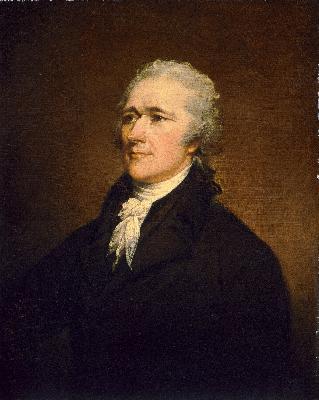
The Six-Hour Bomb: When Alexander Hamilton Almost Killed the ConstitutionJune 18, 1787. Philadelphia. The temperature in the Pennsylvania State House had already hit 85 degrees. Fifty-five men in wool coats and powdered wigs sat trapped in a room with the windows nailed shut and doors guarded for secrecy. The delegates chose privacy over performance so they could speak freely. They had been arguing openly for three weeks about how to build a government. Nothing was working.Alexander Hamilton finally stood. Brilliant, abrasive, born a b*****d in the Caribbean. He’d watched the Continental Congress dither while soldiers froze at Valley Forge. He’d seen New York burn while thirteen states bickered over tax policy.He had been quiet, boxed in by his own New York colleagues. Then he said the hard part out loud. “I have well considered the subject,” he began, “and am convinced that no amendment of the confederation can answer the purpose of a good government, so long as state sovereignties do in any shape exist.”In short, there could be no fix to the Articles of Confederation, the governing document that existed before the Constitution. Maybe it was the heat. Or frustration from the gridlock. But Hamilton was done with democracy’s inefficiency. State sovereignty would always gridlock national purpose. He rejected the proposals on the table from Virginia and New Jersey and aimed higher.He spoke for six hours. All day. The room heard a full design for a national government.What Hamilton wanted: A president elected for life. Absolute veto over all state laws. Power to appoint every governor of every state. Senators serving for life. A government that Madison judged to be suspiciously like the monarchy we had just defeated in a prolonged war.Madison noted, “Give all power to the many, they will oppress the few. Give all power to the few, they will oppress the many.” In the end, America would owe allegiance to no king.Hamilton’s model pushed far past what most men in the room would accept. Delegates from Connecticut started whispering to each other. The Virginians exchanged glances. By hour three, some walked out. By hour five, even his allies from New York looked uncomfortable. Benjamin Franklin, 81 years old and sitting near the back, closed his eyes, unclear whether from boredom or horror.No one took it up for a vote. The plan was never seriously considered. His audacity branded him a monarchist to some. The day after, the Convention went back to the real fight over representation. But something had shifted. The center of gravity slid toward Madison’s national vision because Hamilton had stretched the frame.What happened next tells you how the room felt. Hamilton left Philadelphia on June 29. He drifted in and out. He returned briefly in mid-August and early September. Fleeting presence meant little influence.In the end, Hamilton signed anyway. He was the only New Yorker who did. On signing day, he told the other delegates: sign it, even if it’s not perfect. The country needs this.Then he went home and did something remarkable.New York wouldn’t ratify the Constitution. The state legislature hated it. Too much federal power, they said. Too much risk of tyranny. So Hamilton spent seven months writing essays in New York newspapers under the pen name “Publius.” He wrote fifty-one of them. Madison and John Jay wrote the rest.These became The Federalist Papers. The most important commentary on the Constitution ever written.Hamilton’s task was to convince New Yorkers that a strong executive wasn’t a king. That energy in government didn’t mean tyranny. That the Constitution he’d argued against in private was actually the best hope for the republic.He lost the room in Philadelphia. But he won the argument in the newspapers. New York ratified. Barely. By three votes.Hamilton defended a Constitution that rejected his vision because he understood something crucial: a flawed republic beats no republic at all.Read Madison’s notes closely, and you see he understood the logic of the six-hour speech, even though he disagreed. Hamilton believed human passion would wreck any loose confederacy. He feared both gridlocked democracy and entrenched kings. His cure was durability: long terms, firm vetoes, national supremacy over state mischief. He said the British constitution best united strength with security. Now, the decisive matter. America’s founders did not fear a British king. They feared an American one. They feared what would happen when blind ambition gathered enough levers to bend the entire machine. They wrote a Constitution that mixes energy with friction so no single person or group could run away with the Republic. The secrecy and sealed windows were tools to make that compromise possible, not symbols of elitism.Hamilton lost the day, but not the argument. His extreme plan made the moderate path possible. But ideas never really die. His left a permanent temptation on the table: trade our Republic’s checks and balances for speed, trade gridlock for efficiency, trade debate for decisiveness. The room said ‘no’ in 1787. That decision created the Republic of the United States of America.Hamilton lost, but his argument never died. It waits for every moment when efficiency and allegiance sound better than divided power. That moment is now.The Shutdown’s Shadow. When the President’s Memo Becomes a WeaponOctober 1, 2025. Midnight. The lights went out across Washington. The federal government shut down for the first time in six years. Congress couldn’t pass a budget, and now 2.1 million civilian employees brace for days without pay. National parks lock their gates. Passport offices close. Air traffic controllers work without paychecks. Food stamp checks bounce in rural counties.This is the machinery of America, seized. Gridlock isn’t the problem. We have no king. But this shutdown isn’t like others. Back in Washington, Russell Vought, Project 2025 author and now head of the Office of Management and Budget, directed federal agencies to prepare “reduction in force” notices. To fire employees whose programs don’t match “the President’s priorities.”Not illegal programs. Not wasteful ones. Programs the president doesn’t like.It begs the question: Does the power of the purse still reside in Congress, or has it quietly migrated to the White House?Hamilton wanted the president to veto laws. The room in 1787 said no. This week, we’re watching what happens when Congress gives up.The shutdown impacts real people, but the crux of the matter is not the impacted programs. It’s not whether the EPA should exist or the CDC deserves its budget. It’s not even whether these firings save money or waste it.The crux is Hamilton and Madison.Hamilton wanted a king, or close enough. A president who could veto laws or Congressional policies they found distasteful. Not just unconstitutional laws. Not just illegal spending. Policies the executive simply disagreed with.Madison said no. He built a system where Congressional power over spending was sacred. Where the president couldn’t just refuse to execute laws because he thought they were bad policy. Where gridlock wasn’t a bug. It was the entire point.The question in 1787: What happens when the legislature passes something the executive hates? Does the executive get to ignore it? Does one person’s judgment override the people’s representatives?The Convention answered: No. The president executes the laws. Congress controls the purse. If you don’t like what Congress funds, you veto the bill before it becomes law. Once it’s law, you follow it.But what we’re watching now is Hamilton’s vision, 238 years late. A shutdown that becomes a veto. An executive using Congressional paralysis as permission to act. Not just managing the crisis. Reshaping government during it.This isn’t about President Trump. It’s about whether America still believes what Madison wrote in 1787: that ambition must check ambition. That we must divide power to limit power. That even good policy imposed by one person is tyranny.Hamilton lost that argument. But his idea never died. It keeps popping up, waiting for the right moment.Nixon’s Impoundment Crisis: When a President Tried to Be His Own CongressRichard Nixon looked at the federal budget in 1972 and saw waste. Not illegal spending, just programs he thought were stupid. He blamed the Democratic-led party for excess spending. Water treatment plants in Democratic districts. Rural development funds. Clean water grants.Congress had passed these appropriations. Nixon had even signed some of the bills. But he decided: I’m just not going to spend this money.He called it “impoundment.” What it meant: The president can refuse to spend money Congress allocated if he thinks it’s a bad idea.By 1973, Nixon had impounded over eighteen billion dollars, about twenty percent of controllable federal spending. Clean Water Act funds. Highway construction. Housing assistance. Food stamps.When Congress asked why, his answer was simple: These programs are wasteful. I’m protecting the economy.Nixon’s position was that the president has inherent constitutional authority to refuse to spend money he deems unnecessary, regardless of what Congress wants.Congress sued. The Supreme Court unanimously ruled against Nixon in Train v. City of New York. The law said money “shall be allotted,” not “may be” or “at the president’s discretion.” Shall meant shall.The courts said clearly: The president cannot refuse to spend appropriated funds based on policy disagreement.Congress passed the Impoundment Control Act of 1974. The law was simple: The president cannot permanently cancel spending that Congress appropriated. To rescind funds, the president had to ask Congress. Both chambers must approve within forty-five days. If they didn’t, the money must be spent.The president can temporarily delay spending, but must notify Congress. Congress can force immediate release anytime.The law was bipartisan. Senate Republicans joined Democrats. Be
October 17, 1933. New York HarborAlbert Einstein stepped off a passenger ship at the Port of New York, carrying two suitcases and a violin case. He and his wife, Elsa, had fled Nazi Germany. His books were being burned. There was a bounty on his head: one million dollars. He had to flee. The Institute for Advanced Study in Princeton, New Jersey, offered him refuge. American universities, including Harvard, Princeton, and Yale, kept Jewish faculty to a minimum under quotas that lingered into the late 1940s. In 1933, Germany barred universities from employing Jewish instructors. But Einstein’s unparalleled scientific reputation made him an exception. By 1940, he became a US citizen. A hunted mind found safety and gave its work to the country that offered it. His was the story of America’s ability to attract extraordinary talent in times of global crisis, benefiting both the individual and the country.Then, a great war… (artillery shells in the distance)Twelve years later, in September 1945, Wernher von Braun arrived at Fort Strong, Boston Harbor, under very different circumstances. He was a prisoner under military control, not a welcome guest.Von Braun had been a key figure in Germany’s rocket program. He surrendered to the US Army in the Alps and denied Nazi allegiance. Through Operation Paperclip, the Army shifted his custody into contract work. In total, we brought over more than sixteen hundred German scientists in similar fashion. America faced a critical shortage of expertise in rocketry, and the Germans were good at rockets. Operation Paperclip prioritized strategic advantage in a rapidly escalating Cold War. We acquired technical skills to compete with the Soviet Union. Yes, Von Braun’s past and role in Germany’s rocket program were controversial. But his expertise helped lay the foundation for America’s space program, including the Apollo missions. Von Braun would lead teams that researched space programs and weapons technology. He later became the director of NASA’s Marshall Space Flight Center in Huntsville, Alabama. Our stories highlight two faces of America’s approach to global talent. Einstein’s arrival was a humanitarian and intellectual triumph. We welcomed a persecuted genius. He enriched our scientific landscape.Operation Paperclip, by contrast, was a shortcut. We imported expertise rather than developing it. We chose to prioritize providing for the national defence over the longer work of creating homegrown American rocket scientists.It would not be the last time we brought in talent rather than build it here at home.November 29, 1990. The White HouseIt was the day after Thanksgiving. President George HW Bush was about to sign what seemed like routine paperwork. The Immigration Act of 1990 sailed through Congress with bipartisan support. Democrats held strong majorities in both the House and Senate, but Republicans voted for it too. Senator Ted Kennedy shepherded it. Bush praised it as expanding basic entry rights beyond numbers.Buried in technical language was a new tool. An H-1B visa for temporary workers in specialty occupations. A cap of 65,000. It felt generous for the handful of firms that might need niche skills. The press barely noticed the H-1B provision. Nobody understood we had just created a constitutional time bomb. By 1998, the dot-com boom raged. Tech companies begged for more skilled workers in STEM fields. For the first time, we reached the 65,000 visa cap. Instead of asking why American universities weren’t producing the workers American companies desperately needed, Congress simply raised the cap.Then, we raised the cap again to 115,000. Today, the nominal cap is 65,000 plus 20,000 for US advanced degrees, with exemptions and extensions that let total approvals exceed the cap. It’s the same pattern each time: Companies complain about shortages, and Congress increases the supply of foreign workers. Nobody asked the hard question: Why can’t we train Americans to do these jobs?Thirty-five years later, that same temporary program turned constitutional failure just got a $100,000 price tag. But the underlying problem, the broken infrastructure we need to develop human capability, remains untouched.If this is a temporary measure we’ve already had for 35 years, let’s ask some easy questions. What conditions must we achieve to reach readiness? How will we know we achieved those conditions? How long is too long to keep the program? How much preference is too much? If the goal is a tech-ready American workforce, who decides when we should kill the program?What Ted Kennedy and George Bush created in 1990 wasn’t an immigration program. It was an admission of constitutional failure. A Band-Aid slapped over a bleeding cut. Our inability to fulfill two of our founding promises: to promote the general welfare and establish justice.Our constitutional goals often compete. We sometimes ignore one to prioritize another. But not in this case. In this case, we flat-out ignore two of them at the same time.Call infrastructure what it is: the general welfare. If we expand H-1B, we admit we failed to build the system that produces capability. Justice is the fierce guardian of opportunity. We withhold that protection when we keep Americans born in even our poorest areas from the system.We’re still overlooking our constitutional requirements today. September 25, 2025. Capitol HillSenators Chuck Grassley and Dick Durbin, Republican and Democrat, sent identical letters to America’s biggest companies. Amazon. Apple. Microsoft. Google. JPMorgan Chase. The question was simple: Why are you hiring foreign workers while laying off tens of thousands of Americans?The numbers told the story Congress refused to see for thirty-five years. Amazon alone got approval for more than 14,000 new H-1B hires in fiscal 2025, the most of any company, even as it announced layoffs affecting tens of thousands of American jobs. Microsoft, Meta, Google followed the same pattern: hire foreign, fire domestic.The senators wrote to CEO Andy Jassy…“With all of the homegrown American talent relegated to the sidelines, we find it hard to believe that Amazon cannot find qualified American tech workers to fill these positions.”The median H-1B salary hit $120,000 in 2024, nearly double what the average American worker earns. These aren’t low-skill jobs being outsourced. They are exactly the high-paying careers we promise American students they can achieve through education and training.But here’s the constitutional violation hiding in plain sight: We built a system where companies find it easier to import talent than develop it. Amazon can process 14,000 foreign visa applications, but claims it can’t find qualified Americans. We’ve abandoned the infrastructure that should create American capability and the general welfare in favor of global recruitment.But there’s another question we have to ask. Is there justice for small businesses?These big tech companies can absorb the new $100,000 fee and keep hiring foreign workers. Amazon processed 14,000 H-1B applications. What’s another $1.4 billion to them? Microsoft, Google, and Meta can simply pay the tax and move on.But the startup in your town? The small software company trying to compete with Amazon? The local engineering firm bidding against Deloitte? They can’t afford a $100,000 visa fee. Because we haven’t built our necessary tech infrastructure, they get priced out of skilled talent entirely.When we create a two-tiered system where only the biggest corporations can access global talent, we’re rigging the game against small business owners. The fee doesn’t solve America’s skills shortage. It hands Amazon an even bigger competitive advantage.The Constitution promises to establish justice, not auction it off to the highest bidder. We didn’t fix the pipeline. We priced out the people who could.Eighty years of shortcuts have brought us here. But the Constitution offers a different path.In Case We’re not Picking Up on the Pattern…In 1945, we imported German rocket scientists instead of training Americans. In the late 1990s, we imported H-1B tech workers instead of training Americans. In 2025, we raised H-1B fees instead of training Americans. Rather than decisive efforts to fix our deficiency, we bring in skilled immigrant workers from nations that do a better job of achieving our goals than we have.Each time, we chose the shortcut over the constitutional path. Each time, we treated symptoms instead of causes. Each time, we failed to ask the fundamental question: What would it take to make these visas unnecessary?The answer isn’t complicated. It’s just hard. Lucky for us, America is a great nation with tremendous resources. If we’re serious about reducing H-1B dependency, not just making it more expensive, we need to address the infrastructure failure that created the problem. Three specific steps would transform our approach from Band-Aid to cure:First: Measure H-1B applications per capita.Stop tracking how much money we spend on training programs and start measuring whether they work. H-1B applications are a direct measure of American workforce readiness. When applications drop, we’re succeeding. When they rise, we’re failing. Make this the primary metric for evaluating our education and training infrastructure.Second: Require H-1B companies to participate in local training.Any company filing H-1B applications must demonstrate active participation in developing American talent. Partner with community colleges. Host career days. Present real-world challenges to students. No participation, no visa applications. This aligns private profit with public need. Exactly what the Constitution requires.Third: Eliminate student loan interest for low-income students.The government isn’t a for-profit institution. The nation benefits when its citizens improve their capabilities. Charging interest on federal student loans for low-income students creates a barrier to the technical education we need. Genius

On September 10th, a gunman killed Charlie Kirk in Utah. The event reminds us that no one should die over speech, and that we must wrestle with big questions calmly. You don’t have to love him or hate him. At times, his message resonated with many across America. At times, it divided us. If we say we disagree with his points, we should be able to make the case. If we can’t, his spears carry weight.One of his sharpest questions was this: Does the Civil Rights Act of 1964 violate the Constitution?Let’s sit with that for a moment. If your first thought is, “That law ended Jim Crow. How could it be wrong?” you’re not alone. We wrote the law to strike down a national disgrace. To end segregation. To stop the humiliation of being turned away from a lunch counter, of being told you couldn’t buy a home in a certain neighborhood, of being trapped in second-class status.We intended the Civil Rights Act to end those humiliations. To tear down the walls of segregation. To give every American a fair shot.In that moment, justice demanded action.But justice isn’t just a word. It’s a goal that shapes real lives. It’s the chance for a kid who grows up in a leaky trailer or in project housing to work, to save, and to buy a house in a neighborhood where their children have a good school and a fair shot. From a word on a page to life on the ground. According to the Constitution’s chief authors, justice may be the most important of the six national goals that bind our Republic. But justice isn’t a handout program. Justice is the chance to earn your place. It’s not a promise of results. Because the goals in our preamble, meaning union, liberty, welfare, defence, order, and justice, sometimes compete or clash, we must hold them in balance.In the end, our goal isn’t to win an argument. It’s to get better, together, at pursuing the ideals that bind us.So here’s the question: in the balance between Union, Liberty, and Justice, does the Civil Rights Act of 1964 violate the Constitution?Act One. A Plate of SegregationIn the mid-1960s, Maurice Bessinger’s Piggie Park barbecue ran popular drive-ins and a sit-down sandwich shop around Columbia, South Carolina. The chain routinely denied Black customers full and equal service. Those who were served had to take food at kitchen windows and were not allowed to eat on the premises. After Congress approved the Civil Rights Act of 1964, Title II barred restaurants and other public accommodations from excluding people by race. President Lyndon B. Johnson signed it on July 2, 1964, in a nationally televised ceremony attended by lawmakers and civil-rights leaders, among them Dr. Martin Luther King, Jr.Had equality arrived?Not everywhere. Piggie Park didn’t change. On July 3, Anne Newman, a mother and minister’s wife, wanted a sandwich. Instead, she got a full plate of rejection. She and her friends went to Piggie Park for lunch. The waitress came out, saw she and her friends were Black, and turned back inside without taking the order. They went back a month later and were again refused service. The moment sparked a fight for justice. Newman, Sharon Neal, and John Mungin filed a class action suit seeking an injunction to stop the discrimination at the restaurants. This wasn’t a casual “we can agree to disagree” dispute. Bessinger stocked his restaurants with booklets defending racial separation. You could pick up this reading with your barbecue. It drew on the Genesis 11 story of the Tower of Babel to argue that God scattered the nations and meant them to remain separate. Integration, he preached, defied divine order. Some pamphlets even claimed biblical warrant for slavery.At first, the courts split. They wrestled with how far the law reached. The district court agreed that there had been discrimination. They also ruled that drive-ins, where most food was takeout, didn’t have to follow the law. The Fourth Circuit disagreed, saying all Piggie Park locations were public accommodations. Newman v. Piggie Park went to the Supreme Court in 1968. The high court sided with Newman and made it plain: religion is no excuse for segregation in a public restaurant. The justices called Piggie Park’s claim “patently frivolous.”Piggie Park wasn’t about handouts or special favors. It was about human dignity. The right to walk into a public restaurant and be served like anyone else. Believe what you want. But if you open your doors to the public, you serve the public.So…did the Civil Rights Act of 1964 violate the Constitution in Columbia, South Carolina? Did the decision rob Maurice Bessinger of his religious liberty? He was still free to believe, worship, preach, and pass out booklets. What he couldn’t do after choosing to run a public restaurant was use those beliefs to keep people out.And he didn’t stop speaking his mind. Before he died, he deeded a tiny patch of ground under the flagpole to the Sons of Confederate Veterans for five dollars so that future owners couldn’t take the Confederate flag down.But the issue isn’t cut and dry. The stories don’t stop in South Carolina.Act Two. A Seat With ConditionsIn the late 1960s, the University of California, Davis School of Medicine faced a stark reality: its classes had almost no Black, Latino, or Native American students. Justice is the opportunity to earn a place, but what does opportunity mean when the doorway to a profession has been locked for decades? UC Davis tried a fix: Out of 100 seats each year, they reserved 16 for “disadvantaged” applicants. UC Davis judged those applications by a separate committee, with different standards, and the underrepresented minority applicants competed only for those 16 seats.Enter Allan Bakke. A Marine Corps veteran and engineer in his early 30s, Bakke had set his sights on medicine. He’d spent years preparing, earning strong grades and MCAT scores. He applied to UC Davis in 1973 and 1974, along with a dozen other medical schools, and he was rejected by all of them. Later, he discovered that some minority applicants admitted through the special program had lower scores. He believed the school had shut him out because he was white. In reality, records later showed that competition was stiff; as many as 67 applicants had higher scores than his. Nonetheless, Bakke sued. He argued that a publicly-funded state school couldn’t deny him a seat and still honor the commitment to prohibit race discrimination in federally funded programs. Regents of the University of California v. Bakke reached the Supreme Court in 1978. The ruling was messy. Quotas, like the 16 reserved seats, were unconstitutional. They could not exclude Bakke based on race. The court ordered him admitted. But the Court, led by Justice Lewis Powell, also said diversity in education is a compelling goal. Race could be one factor in a holistic review, as long as every applicant competes in the same pool, with no guaranteed quotas.So…Did the enforcement of the Civil Rights Act violate the Constitution? Did it violate Bakke’s right to justice?UC Davis had its opinion of justice. It argued that set-aside wasn’t favoritism. It was a correction for a pipeline bent by decades of exclusion. A diverse medical class would better serve California’s diverse communities.If you were Bakke, would you see justice denied? If you were a minority applicant, would you see the set-aside necessary to level a field tilted by history? The Court decided justice meant the opportunity to compete equally, but not a scripted outcome. There could be no reserved seats, no separate tracks. But a school could consider race as one thread in a larger fabric, if every candidate competed equally.Bakke went on to have a successful career as a doctor in Minnesota.But the issue still isn’t settled. Let’s move on to Louisiana.Act Three. From the Classroom to the Shop Floor In 1965, President Johnson signed Executive Order 11246. In it, Johnson outlined that if a business wanted to compete for federal contracts, it had to follow the rules. If you wanted to do business with the federal government, you had to take “affirmative action” to ensure equal opportunity. This meant companies had to create goals and timetables to hire underrepresented groups. The government insisted these were not quotas. They were temporary tools, intended to pry open doors rusted shut for generations.At the time, Kaiser Aluminum in Gramercy, Louisiana, filled skilled jobs almost entirely with white workers, and it intended to change. They made a goal that their workforce would represent the local labor force. The company and the union built a training pipeline and reserved half of the slots for Black workers to correct the imbalance. A white worker named Brian Weber was passed over for promotion in favor of workers with less seniority. He saw a new door being closed in the name of opening another, so he sued. The local court and the United States Court of Appeals for the Fifth Circuit agreed that Weber was a target of discrimination, but the matter was not settled. Kaiser appealed.In 1979, the Supreme Court decided United Steelworkers v. Weber. Kaiser Aluminum’s plan survived. The high court said a business could give preferential treatment to minority groups, as long as the company intended the effort to be a temporary fix to balance workforce diversity.In 1987, Johnson v. Transportation Agency approved a similar approach for gender. A business could choose to hire a woman in a male-dominated job if she and a man were comparably qualified for a promotion, if the plan was modest and temporary.The tension between the classroom and the shop floor became plain. The high court killed fixed quotas in college. But numbers could steer workplace decisions if businesses called them goals, kept them temporary, and technically kept the door to all applicants open. On the ground, these goals felt like quotas. If a business chose a woman or minority applicant for a job or a promotion, some believed they were a token hire, not the top choice. If eve

Joel Douglas (00:03) My guest today is Shaka Mitchell, a senior fellow for the American Federation for Children, a Nashville-based attorney, a Belmont adjunct teaching constitutional law, and a leader dedicated to transforming education for underserved families. He’s a featured guest on TEDx Nashville and podcasts like The Learning Curve and Charterfolk. The charter schools Shaka has worked with drive real growth for Nashville’s underserved kids, often doubling district test scores in math and reading. While high-poverty public schools rank in Tennessee’s bottom 30%, Shaka’s schools rank in the top 20% to 25% serving the same communities. Shaka, thanks for being here. Your work with high-performing charters raises big questions about how we fund and deliver education. So, I feel like we have to ask a basic question to get started.Shaka Mitchell (00:49) Hey, thanks for having me.Joel Douglas (01:02) Should we fund education at all?Shaka Mitchell (01:05) Yeah, good question. Well, thanks for having me, Joel, and you’re starting out with a big swing right out of the gate. Should we fund education? I would say yes. I would say yes.And I want to also give the early disclaimer that I am not a big-government guy. I tend to be pretty skeptical of government. I used to work at one point at a constitutional law firm that came from a libertarian perspective. I really believe in individual liberty, individual rights, and also just an individual’s work ethic. So I am not a big-government guy. That being said, when we’re talking about education, it’s something that I think has a community impact. It’s also something that, from a rule of law perspective, is provided for by every state constitution in the country.Right? So all 50 states have a constitution that says something about education—that education is valued, that it is highly prized, and that the state is going to do something to fund some system of education for the public. Now, whether or not the government has to provide the actual services, I think we can differ about. That’s where I would say no. But in terms of funding, I would say yes because, listen, if we don’t do it, you can’t just fund your own children. I don’t believe that. I think that looking out for one another’s kids in that regard is a societal benefit.Joel Douglas (02:47) And really, that’s why I feel like we have to answer this question first. It’s what you just alluded to: you have to fund your kids and everybody else’s kids. If you look at it from a constitutional perspective, I would think about it as, well, we have six national goals, and if one of those is justice, one is liberty, and one is defense, then education fits into a lot of those buckets.If you think about it from a justice perspective, it kind of gets to an individual—like we need to fund education to help individuals who grew up in a less prosperous or less advantaged background succeed. If you think about it from a defense standpoint, you might think, like the school lunch program was started from a defense requirement standpoint. So if we think about education from a defense standpoint, then that’s kind of a collective; we need to have an infrastructure of training-ready Americans who can go and join the military and serve in defense industries to protect the people of the United States.But it’s both, right? You can’t just do it from a justice standpoint—that’s not the only reason you do it—but you also don’t only do it for the collective benefit. It goes back to exactly what you said about how we have to pay for each other’s kids, too, because some of them might join the military and also because constitutionally, we have a commitment to the justice of those kids that grow up in a less prosperous environment.Shaka Mitchell (04:25) Yeah, I think that’s right. And, you know, education is one of these things that, as opposed to, maybe other, say, commodities—things that we buy from the store. The education that I get for myself, yes, it’s important to me personally and individually, but if I’m better educated, that’s going to benefit the community that I’m a part of. It’s going to benefit the private company that I might work for or the nonprofit. It’s gonna benefit the military if I’m a part of the service, right? It’s gonna benefit my neighbors.So education is not one of these things that’s like going to the grocery store and you buy the kind of breakfast cereal that only you like. You’re the only one in your house that likes it and you say, “Forget about everybody else, I’m eating whatever, Fruity Pebbles. I don’t care if nobody else likes it.” No, education is not that kind of good. It’s the sort of thing that actually has so much benefit.And I mean, you highlight something really important, too, that I took a look at a little bit this summer and might just write about later. And that is that the armed forces right now are going through the lowest recruitment cycle in history, right? Our military is having such a hard time finding academically and physically ready young men and women, and that becomes a defense problem. So that speaks a little bit to this “education as a national defense” and national security issue as well. There’s a lot of overlap there.Joel Douglas (06:06) Absolutely, and I don’t want to take too much time on it, but just from a physical education standpoint, PE. When I was a kid, and I grew up in a small town in northern Missouri, the high school football coach was the PE teacher. He used it as the football training program so that we essentially had an extra hour to do stuff. So, Monday, Wednesday, Friday, we'd lift weights. Tuesday, Thursday, we played some sort of sport, so we were running, chasing each other, doing field hockey, or whatever that was.But my kids today, because I have two teenagers, they don’t do the same kind of stuff in PE. For half of the year, they sit in a health class. And rather than go run for 45 minutes and then have 45 minutes of health class—I don’t want to digress too much—but if they ran for an hour every day, would the military benefit from them being more fit and having a higher pool of candidates who could join after they graduate? Absolutely.Shaka Mitchell (07:14) Yeah. I’m a big believer in physical education and just the benefits of physical activity in general. I really think that it’s something that, frankly, kind of links together with education in this sort of virtuous cycle. Right? I mean, I think for a lot of kids, and even personally, when I feel better physically because I’ve exercised, I think I’m more mentally sharp and focused and ready for the workday. And I think that’s the same for elementary, middle, and high school kids, too.Joel Douglas (07:52) Yeah, that’s right. But I’ll get back on track. You said something about how the government doesn’t necessarily outline how to achieve education. So it says what to do. Well, it doesn’t even say that. It says the goals are justice, liberty, defense, and the other three. So you alluded to there being different ways to achieve those. And I know you work with a lot of those, and that’s the work that you do. So, can you talk about that?Shaka Mitchell (08:24) Yeah, so, you know, a lot of state constitutions—most state constitutions—are really broad, even vague, when they talk about education. They’ll say something like, "The state of [fill in the blank] will provide for an equitable education system." You go, okay, what does that mean exactly? Right? Does that mean we're talking about dollars? Equitable that way? Are we talking about kids who are gonna exit the system with the exact same amount of coursework? It’s so vague nobody really knows. It’s just kind of one of these adjectives that they threw in there, and it sounded good. And then you fast forward just a few years, and you don’t really know what it means.So one of the problems, of course, in any state is that on the one hand, it’s really efficient, or it seems like it’s going to be efficient, to have one system that you have in place for all the kids to participate in. That seems like it would work on paper; it seems efficient. But then what happens is, as soon as you meet more than one child, you realize that they are different, and you realize that the same system isn’t likely to work for a whole range of students. And that’s within one school, let alone a whole district, state, or country, right?I live in Nashville, Tennessee, and we’ve got about a hundred thousand school-aged kids. There’s no way one system with one school board of nine people is going to be able to figure out a system that works for every single child because they have different interests. Even in my own house—and I bet this is the same for you and your kids—same parents, but my kids are interested in different things. One is better at math. One is much more interested in the arts. One is much more interested in reading, nose in a book, right? They’re just interested in different things. They’re going to learn in different ways. And that’s in one family. You multiply that out across the whole city, and you've got to do something different. And so that’s really, I think, why I believe so much in school choice.The idea is that, yes, we’re going to fund education from a central pot. Because again, let’s collect the money that way, easy peasy. But let’s not assume that those nine people on the school board can come up with one system that works for everybody. Let’s let different models work. So if it’s a charter school that’s got a focus on science, technology, engineering, and math (STEM), cool. Do that. In my city, there’s another charter school that’s really focused on students for whom English is not their first language. Okay, great. Let’s do that because that was something that the district was really struggling with. Or maybe it’s a values-based decision that a family wants to make. You really want your kids to go to a faith-based school. Okay, cool. I think that that’s your right t

Should Public Money for Schools Guarantee More Than Learning?This week, the National School Lunch Program, born out of national defense, and the rise of homeschooling vouchers, where freedom meets responsibility.And next week, we’ll dig even deeper with our guest, Shaka Mitchell! But for now … the lights are dimming. Look! There's the curtain!Scene One. Frontier America, 1809 Education, even without public funds, can serve national goals like Union and Liberty.A father and mother have their second child! A boy named Abraham, born in a one-room log cabin in Kentucky. The father, a cold and stern man, had built the structure by hand. Dirt floor. No windows. A fireplace for heat and little else. The boy’s father couldn’t read. His mother knew her letters, but not much more. When she died, the boy was nine years old. He was left in the care of his 11-year-old sister.His father soon arranged a marriage of convenience with a widow who had three children of her own. When she arrived at the farm, she found his two children so filthy that the first thing she did was draw a bath for them.She was a godsend for the boy, loving him like her own children. Neighbors called him lazy because he wasn’t much for farm work, and the boy and his father had heated arguments. But his new mother saw something different. He was hungry. Yes, for food. But also for words.There was no school, so she taught him how to teach himself. She got him books, like the family Bible, but also “Aesop’s Fables,” “Robinson Crusoe,” and “Pilgrim’s Progress.” She taught him “how” to learn, to study, to chase every scrap of knowledge he could find. At night, by firelight, he copied passages onto wooden shingles with charcoal. He had no paper, no ink. He’d rub out the words, write again, and memorize them line by line. Neighbors remembered seeing him walking with a book in one hand, axe in the other, reading between swings.He left home in his young twenties to seek his fortune, but he always came back to see her every year or two. He bought some property for her to live on after his father died. The last time he saw her was in 1861, when he stopped to bid her farewell before leaving for Washington and his inauguration as the 16th President of the United States. She mourned his death in 1865, and she passed in 1869.With Sarah Bush Johnston Lincoln’s backing, the boy who copied Bible verses onto wooden shingles with charcoal grew into the man who wrote the Gettysburg Address, President Abraham Lincoln. Would we say today that Abraham Lincoln was homeschooled? Uneducated? Self-taught? However we label it, no one could argue that his lack of formal schooling limited his potential.Lincoln, self-taught in a Kentucky cabin, became a president who preserved the Union. His education, guided by a caring stepmother, shows how learning builds national strength, even without public funds. But when public money enters the picture, what ensures the child’s welfare?Scene Two. Perris, California; January 2018 — Justice and WelfareBefore dawn, a 17-year-old girl climbed out of a basement window with an old phone and dialed 911. She planned her escape for two years, practicing how to use a phone because she’d never been outside alone. Her voice shook as she tried to explain what the house looked like inside. At one point, she said, “My two little sisters right now are chained up.” Riverside County Sheriff's Deputies walked into darkness and the sour smell of waste. They found 13 siblings, ages 2 to 29. Some were shackled. Most were so thin the deputies thought the older ones were still children. Food was rationed; they only ate once a day. Showers, once a year. Teeth never seen by a dentist. Beatings and strangling as punishment. The district attorney later said the house was “foul-smelling,” and the children showed signs of long starvation and nerve damage. Seven of the captives were adults, but their bodies looked like they had been kept small. One victim, 29 years old, weighed about 82 pounds. On paper, this was a school. The adoptive father had filed a private-school affidavit with the state. He listed himself as principal of “Sandcastle Day School.” In California, that filing exempted children from compulsory public attendance, and there was no routine state inspection of such “schools.” No one looked inside for years.The girl who called 911 gave them an opening. Deputies cut chains. Paramedics carried out brothers and sisters who could barely stand. Prosecutors charged the parents with torture, false imprisonment, willful child cruelty, and abuse of dependent adults. They later added perjury against the father for lying on the school affidavits. In 2019, both parents pleaded guilty. The court sentenced them to 25 years to life in prison as part of the plea agreement. The rescue did not end the harm. Some of the younger children were later placed with foster parents who also abused them, and those foster parents were convicted and sentenced. Five years after the rescue, county officials acknowledged that the state failed to get basic services to the siblings.This case is a sinister mirror of President Lincoln’s homeschool experience. A “homeschool” on paper can become a blessing or a cage in practice. In 2018, a California homeschool hid torture behind a private-school affidavit. Public funds for homeschooling, like those for school lunches, must ensure kids are safe and fed, not starved and chained.The Test of Legitimacy — Welfare and TranquilityNow the scene is set, and we can ask our question. As states expand vouchers and tax credits for homeschooling, what obligations follow?Does accepting the American people’s money for schooling create an obligation beyond academics?Liberty in private is one thing. Liberty with the people’s money is another. Public funds carry obligations of legitimacy. These are the same assurances schools already provide: food, safety, health, and visibility.Religious liberty and government overreach are real concerns. So are child welfare checks, meals, vaccinations, and sports. We need a standard that defends liberty and protects children.We think we care about the freedom to choose how a child learns. We think we care about waste of public funds. We think we care about officials telling our children what they should know.Take a couple of examples. Some parents want physical education to mean kids running for an hour, not sitting for “health.” Others say there is no such thing as an average child, and any system built for the average will fail the real ones in front of us.These are legitimate concerns for individuals. I say again—Individuals. Parents should exercise their liberty in how they educate their children. That right stands whether or not public money is involved. And while critics point to abuse in homeschooling, most homeschoolers are not abusive. Abuse exists everywhere. Public and private schools are not automatically safer.But that is not the decisive concern. The issue is not good parents versus bad parents. It is the obligations that come with public money.The government owns nothing. Every dollar it spends is the people’s money. We pool those dollars to build what no family can build alone: roads, bridges, water systems, and schools. Because there is more to school than classes.That collective pool comes with obligations. Every day, in public or private schools, an adult lays eyes on a child. Every day, a child who needs a meal can get one.So yes, we can support individual choice with the American people’s money. But if we choose to take that money, we also choose an obligation to legitimacy.The test is simple. Education is a public function, bound by federal rights. Parents have broad freedom to educate their children, but when public money follows the child, they are spending the people’s money.No one gives you money with no strings attached. The people may ask for basic assurances: that a child is seen, safe, nourished, and protected from disease.Food as Defense — Provide for the Common DefenceLet’s think about the school lunch program.Almost every presidential administration fights over school lunches. But the political theater hides the real purpose of the program.One of the nation’s six goals is to Provide for the Common Defence. That doesn’t stop at buying tanks or building fighter jets. It also means building the human infrastructure to fly those jets and stand watch. A healthy, fit young America is part of national defense.That’s where food comes in. The men and women who step forward to serve often come from the country’s poorest households. They are America’s finest, but not our wealthiest. For many, school lunch is the one reliable meal of the day in childhood.The modern program itself grew out of war. During World War II, the Army discovered too many young men were unfit for service, with a nontrivial share failing for nutrition-related reasons, about one in nine by some estimates. That was not just a battlefield problem. It was a factory-line problem, too.Congress answered with the National School Lunch Act of 1946. The law says its purpose, “as a measure of national security,” is to “safeguard the health and well-being of the Nation’s children” and to soak up US farm output. President Truman signed it on June 4, 1946. He praised it as “strengthening the Nation through better nutrition for our school children.” Those two concepts, national security and better nutrition, are the program’s DNA. Today, the program serves around 30 million kids on a typical school day. This is infrastructure, not charity. It is a national system that keeps children fed so they can learn now and serve and work later. In short, the American people pool our money to pay for school lunches so those kids can grow up and, in return, protect the Republic.The lunches build “human infrastructure” by ensuring future generations, often from poor households, are physically fit to serve in the military, work in defense industries, or contrib

Act 1: The Insurmountable ChallengeIn 1817, New York voted to dig a ditch. And not just any ditch. A grand canal! Dug by hand, 363 miles long, across forests, swamps, and rock. Most experts scoffed. George Washington had dismissed similar ideas decades earlier. Thomas Jefferson called it “a little short of madness.”At the time, farmers and manufacturers in the West faced a brutal choice. To reach markets, they had to send their goods down the Mississippi River to New Orleans, the country’s greatest seaport. From there, shipments went out through the Gulf, around Florida, up the Atlantic, and finally to cities like New York or Philadelphia. It was slow. It was costly. And it made western settlers dependent on a southern trade route they couldn’t control.The Erie Canal wasn’t dreamed up by powerful men in Albany. The idea came from a flour merchant named Jesse Hawley. He had a strong customer base, but to move his flour to market, he had to ship it by wagon over the Appalachian trails or float it on rivers that ran the wrong way. He went broke, ended up in debtors’ prison, and there picked up a pen. In a series of essays in 1807 and 1808, he sketched a bold plan: a canal from Lake Erie to the Hudson River. He mapped the route, described the locks, and argued the benefits. He didn’t have all the details, but he had vision, and he put it on paper.New York City mayor and later Governor DeWitt Clinton picked up that vision and ran with it. He wasn’t an engineer or a canal man. He was a politician with a sense of scale. Clinton saw what Hawley’s prison essays meant: an inland waterway would break dependence on the Mississippi, open the interior, and turn New York into the nation’s gateway.As Governor, Clinton pushed the legislature to back the canal in 1817. The cost was staggering. Seven million dollars, one state spending roughly a third of the entire federal government’s annual budget. Critics mocked it as “Clinton’s Ditch.” They predicted it would bankrupt New York. Some said it would never be finished.But Clinton pressed forward. He didn’t sell the canal as an engineering marvel. He sold it as a doorway. At the time, moving freight from Buffalo to New York City cost one hundred dollars a ton and took weeks. Clinton promised the canal would cut that to under ten dollars, and in just a few days.The Erie Canal wasn’t just a ditch. It was America’s first true megaproject, built long before steam shovels, bulldozers, or dynamite. It was the biggest engineering challenge of the 19th century.How did they dig it? By hand. Tens of thousands of laborers, mostly Irish immigrants and local farmers hired in the off-season, used picks, shovels, wheelbarrows, and horse-drawn carts. There were no roads. When they hit swamps, they laid down logs to make floating roads so carts wouldn’t sink. When they hit limestone cliffs, they drilled holes by hand, packed them with black powder, and blasted inch by inch.The canal had to climb about 571 feet from the Hudson up to Lake Erie. To solve that, engineers built 83 locks; locks are stone elevators for boats. No one had done this on such a scale in America before. They were inventing the craft as they went.But they finished it in just eight years.When water first flowed in 1825, it wasn’t just an engineering triumph. It was an economic revolution. Shipping costs dropped from $100 a ton to under $10. A journey that took weeks now took days. It made bread cheaper. It put tools in the hands of farmers. It made New York City the nation’s port. It opened the Midwest to settlement. Within a generation, roughly three-fifths of the nation’s trade moved through New York’s harbor, powered by the canal. Today, we face another insurmountable challenge: a housing crisis.Instead of a wilderness of rivers, swamps, and mountains, we face a wilderness of bureaucracy. A maze of zoning codes, permit boards, and fragmented governance. Each with its own tolls and delays. Builders spend months fighting hearings and paperwork before they ever turn a shovel, driving up costs and denying millions the chance to build equity through homeownership.Then, as now, we face skepticism from critics who believe working-class Americans aren’t worthy of bold projects. Washington dismissed it. Jefferson called it madness. The rich, who owned the existing shipping lanes, mocked the project as “Clinton’s Ditch.” Today, skeptics argue that small, affordable homes aren’t profitable or that zoning reforms are too radical. Politicians treat it as impossible.But every bold fix begins as madness.Housing is our canal. It’s not a matter of skill or resources. We have both. It’s a matter of clarity, incentives, and purpose. Just as Clinton used a bold state project to open opportunity, we could use a Small Business Innovation Research program to open the housing market.As of mid-2025, the US median home price sits at around $410,800, while median household income is estimated at $84,000. This makes homes over 4.8 times income, compared to just twice in the 1960s. A record 22 million renter households are cost-burdened, spending over 30% of income on housing, and affordability is at an all-time low. Programs like USDA’s SBIR for rural development and HUD’s $20 million innovation grants (with recent deadlines in July 2025) show the tools exist. We just need to earmark them for starter homes under $150,000, tied to zoning reforms that cut red tape.This isn’t about handouts; it’s about competition driving innovation, much like Hawley’s essays sparked a revolution. Instead of a canal, let’s build a pathway to the American Dream for the working class.Act 2: The Crisis Today – Voices from the Ground(Voice: Young Homebuyer; mid-20s female, fiery with a mix of grit, sarcasm, and unshakable hope. Think a teacher who’s had it but won’t quit. Background: Gritty urban soundscape. Honking cabs, slamming apartment doors, distant subway rumble, fading in and out.)Picture me: 25, a teacher in a mid-sized city, grading papers by day, tutoring by night, slinging coffee on weekends. I’m hustling like my life depends on it...because it does. But the American Dream? It’s slipping through my fingers like sand in a busted hourglass.I’m not asking for a penthouse. I just want a home. A small one! 600, maybe 1,000 square feet. A bedroom, a bathroom, a kitchen where I can burn my first attempt at dinner. But in 2025, that’s a fantasy. I looked it up... the median income is something like 84 grand a year. Median home price? Try 420 thousand. That’s nearly five times what I make. It’s crazy! Back in 1960, homes cost twice the income: twelve thousand on fifty-six hundred. Since then, prices ran past wages and never looked back.And I hear the pushback: “Homeownership rates are fine.” Sure, overall. But at my age, it used to be higher. By thirty, nearly 6 in 10 Americans from the Silent Generation owned a home, 1 in 2 Boomers, just under half of Gen X, and about four in ten Millennials. Today, 25–34-year-olds sit in the high 30s, recently near 36%. The overall rate didn’t crash. The doorway for us did.Builders don’t touch starter homes anymore. Why would they? Land’s a fortune, materials are through the roof, and zoning boards pile on fees like they’re playing Monopoly with my future. So they churn out McMansions, the sprawling status symbols for the rich. Me? I’m left scrounging for scraps, priced out of the game before I even roll the dice.This isn’t just my story. It’s a crisis crushing millions. Over 22 million renter households are drowning, spending more than 30% of their income on rent. Twelve million are barely breathing, forking over half their paycheck. Since 2019, home prices have spiked 60%. If you’re pulling $50 grand a year, good luck! Only one in ten listings is even close to affordable.It’s like rowing upstream in a boat made of tissue paper. You paddle; work overtime, skip vacations, eat instant noodles, but the leaks keep coming. Rent. Student loans. Fees. They drain you dry before you can save a dime for a down payment.So we wait. We put off kids. We put off dreams. Some of us are still crashing in Mom’s basement, not because we’re lazy, but because the system’s rigged. We don’t need marble countertops or three-car garages. We need homes under $150,000! Twice today’s median income, like our grandparents had. Without that, the American Dream isn’t just delayed. It’s sinking, drifting downstream, out of reach for my entire generation.But I’m not giving up. There’s a way to fight back. We need to drain this bureaucratic swamp and build a bridge to ownership. We just need the right tools, the right vision, and a whole lot of grit.Act 3: Innovation – SBIR for Housing(Voice: Policy Expert – Confident male, mid-40s, professor-like with a spark of enthusiasm, like a TED Talk speaker rallying for change. Background: Subtle office sounds: typing, flipping blueprint pages, faint construction hum, fading in and out.)So, how do we pull the American Dream back from the brink? We need homes under $150,000! You've heard the grim math from our teacher in Act 2. That five-times-income ratio is a trap. But it's a trap we can engineer our way out of. It’s our Erie Canal moment, and the tool to dig it is competition.Picture this: builders racing to craft small, affordable homes. 600 to 1,000 square feet, sturdy and smart, not some cookie-cutter McMansion. The spark? A Small Business Innovation Research program, an SBIR for housing. SBIRs are America’s secret sauce, fueling breakthroughs in tech, defense, and agriculture with competitive grants for small businesses. Phase I: dream up designs, like modular units, shipping-container conversions, energy-efficient builds. Phase II: build prototypes that hit $150,000 or less. Phase III: scale the winners with private capital, flooding the market with homes for first-time buyers, not hedge-fund vultures. Really promising defense proposals go direct to Phase II to get started quicker.This isn’t a pipe dream! It’s already hal

Our neighbors say they love their EVs. We take a test drive. They’re quick. They’re quiet. They’re fun!Then the facts elbow in. EVs were sold as being cheaper, but in America, they aren’t. Many lose value fast. Some models shed close to half their value in a year. Sales have flattened. They’ll likely spike before the federal credit expires September 30, then sag after.Some of us want to love EVs, but something isn’t quite right.Is it the range, shorter in winter, the waits at chargers, or that stations aren’t where we need them?Maybe none of those. Maybe the cars are designed to be replaced, not to last.So our question:Is this new tech built for my life, or for the next sale?Curtain. Scene One. The 1,000-Hour Lightbulb.Close your eyes and step onto a city street in the late 1920s. Windows glow like jewels. Streetcars hum. Night is no longer darkness. By 1930, nearly nine in ten urban and nonfarm rural homes had electricity. About one in ten farms did. Light is not a luxury. It is the texture of modern life.Enter stage left.At first, bulbs lasted a long time. Early tungsten lamps often burned well past fifteen hundred hours, many to two thousand and beyond. Families loved that. Companies that had built factories did not. In Germany, Osram’s sales fell from sixty three million bulbs in fiscal year 1922 to 1923 to twenty eight million the next year.On December 23, 1924, the leading manufacturers met in Geneva to form what we now call the Phoebus cartel. Osram, Philips, Compagnie des Lampes, and General Electric’s overseas network joined. Its global reach was unusual for the time. By early 1925, they set a benchmark of a one thousand hour life for household bulbs, down from the fifteen hundred to two thousand hours common before. Shorter than families expected, and exactly what manufacturers needed.This was not sloppy work. It was engineering with a new purpose. Each factory shipped samples to a central laboratory in Switzerland. Technicians tested life spans against the benchmark. A company paid a fine if a bulb lasted too short or too long for its class. Reliability became real, but a different kind of real. It was no longer ‘this bulb will endure.’It was equipment that reliably failed on schedule.Consumers adjusted fast. Every brand converged near one thousand hours. Burnout stopped feeling like a defect and started feeling like life. A 1927 Tokyo Electric memo to the cartel reported a fivefold jump in sales. More failures meant more purchases. The cartel redesigned the market not with a breakthrough that gave people more, but with a standard that made sure they would buy again soon.At the same time, the manufacturers claimed progress. They said shorter life meant brighter light and better efficiency. At a higher cost. The new standard raised turnover and margins and punished any member tempted to make a bulb that lasted too long.Companies got paid for replacements. They were not just selling a lightbulb. They were selling this lightbulb and all your next lightbulbs on a schedule.The world has limits. The cartel did not last. Patents expired. Members fought. World War II shattered coordination. In the United States, courts scrutinized General Electric and its partners for collusive control of the lamp business. In 1949, a federal district court found that General Electric monopolized the incandescent lamp industry in violation of section 2 of the Sherman Act.A tool’s death isn’t a breakdown. It’s the quiet moment it stops serving your life. The market plans what you will buy next. Some call that progress.We, the People, need governance to stop failure by design.When we set standards, we should ask: Is this new tech built for my life, or for the next sale?Humanity, Existence, and TimeWe miss what being is because we forget time.Life is not a thing on a shelf. It moves. Picture a clearing in a green mountain forest. We step in already involved, tools in hand, neighbors around, choices pressing in. Our kind of life is being-there. We show up to a world that already matters.Meaning comes through time. Past, present, and future braid every moment. We carry what has been, deal with what is, and anticipate what could be. A rancher does not just cut hay; they remember last year’s rain, read today’s moisture, and watch the three-day forecast. Time makes the work make sense because time sets the limits.The hard edge of time is death. Not only ours. Tools die too. Death frames our choices. Faced clearly, it does not make life grim; it makes it ours. It calls us to live with purpose.In that clearing, a tool “lives” when it disappears into the work. It “dies” when it fails our project and forces itself into attention. Philosophy calls the first ready-to-hand; the second is an object in the way.A tool is alive for us only while it supports our next possibilities. It may not die in a crash. It dies when it stops supporting our lives. Some would schedule that death and call it progress. That is why we need rules that resist quiet, coordinated failure.In tech, death is not when the device stops working; it is when it stops working for you. So, what does this philosophical lens reveal about our devices today?Curtain. Scene Two. Apple and Failing BatteriesWinter 2017. Your phone feels slower. Not creek-dropped slow, just sticky. Screens load like they are pulling a sled. Benchmarks confirm what our thumbs already know. Older iPhones with worn batteries run below design speed and perk up after a battery swap. A developer posts the charts. The story catches fire.Enter stage right.Earlier that year, Apple pushed a software update that changed how the phone handled power. When a battery aged, or when cold or a low charge cut peak power, the system quietly managed performance to prevent sudden shutoffs. No pop-up. No heads-up. A rule under the hood to smooth over an old battery’s limits. Later, Apple explained the machinery and added a setting so the user could see it and choose to turn it off or replace the battery.One version of the story called this protection. Better a slower phone than a dead one in your pocket. Another said it felt like a schedule, set without consent, that made aging devices feel obsolete. Apple apologized, cut the out-of-warranty battery price from 79 dollars to 29 for 2018, and promised more transparency. They added battery-health readouts and a switch to disable the slowdown.Regulators and courts weighed in. In France, consumer authorities fined Apple 25 million euros for failing to inform users that a software update could reduce performance. In the United States, 34 states reached a 113 million dollar settlement over alleged misrepresentations about batteries and slowdowns (without admitting wrongdoing). A federal class action settled for up to 500 million dollars on related claims (again, without admitting wrongdoing).This is not an attack on Apple. Here is what matters for our piece.A battery is mortal chemistry. In the cold, it cannot deliver the same peak power. With age, it cannot hold the same charge. The software’s job was to stretch usefulness. Keep the tool “alive” for your day by preventing blackouts.But the choice was hidden. People felt like their tools were dying because they no longer supported the day’s work. Only after the controversy did Apple present the controls and the explanation. Starting in 2018, Apple and its customers quietly renegotiated the tool’s life.A tool dies when it stops serving you. We need governance to stop failure by design. When choices are hidden, tools die for us. Is this new tech built for my life, or for the next sale?Curtain. Scene Three. The Electric Vehicle. Combustion vehicles age as a negotiation.Yes, parts wear. But you can rebuild, swap, and refresh. Engines come out. New rings go in. Transmissions get replaced. That is why Americans keep vehicles so long. The average age is nearly thirteen years, and many go far beyond that with routine upkeep. With maintenance, a truck that is twenty years old can still deliver the same range and near original power. The fuel tank did not shrink. Compression and fueling are serviceable systems. Keep the machine fit and it keeps carrying your life.Electric vehicles age as a countdown.EVs run on two clocks. First, the seasonal clock. In real cold, range drops because the cabin needs heat and the chemistry slows. Controlled tests around twenty degrees Fahrenheit found some EVs lost roughly forty percent of their range with the heater on. Reporting from recent cold snaps shows a 10 to 36 percent hit depending on model and use. Preheating and heat pumps help, but they don’t erase the penalty. When spring returns, most of that loss is temporary.Second, the chemical clock. Lithium ion packs fade slowly. Large fleet datasets put average loss near two percent per year, and many packs are usable for twelve to fifteen years in moderate climates. Most makers back this with eight year, 100,000 to 150,000 mile battery warranties that guarantee about seventy percent capacity within the term.Many owners, especially those who live in warm climates, will never hit a hard stop. Average degradation is slow and largely predictable, and mild winter penalties are manageable with preheating and heat pumps.A combustion engine is an open ended project. Repairs may stop penciling out at some point, but the owner has the choice.An EV is a timed performance. One day the battery will no longer support a trip across the state in the cold. You might be able to replace the pack, but depending on model and supply, it can take weeks or months. Unlike the secret cartel of the 1920s, today’s EV countdown isn’t an illegal conspiracy. It’s a design trade-off. But the choices nonetheless steer consumers toward the next sale.Some argue that mandating longevity and a ‘right to repair’ for a nascent technology like EVs would be a catastrophic mistake. It would saddle innovators with the burden of supporting old models, lock in today’s inferior battery chemistry,

Belief vs. Biology: Is a Sustainable Environment a Human Right?This week, the world’s highest court spoke. The United Nations’ top judges issued a sweeping opinion: nations might violate international law if they fail to act on climate change (Associated Press, July 23, 2025, Molly Quell and Mike Corder reported). The International Court of Justice (ICJ) opinion posited that a sustainable environment is a human right. And that nations harmed by climate change might be entitled to reparations. The ruling came in response to a campaign by Vanuatu, a small island nation slowly sinking beneath rising seas. The court’s word carries no binding weight. No country must follow. No law compels it. No court can enforce it. It levies no sanctions, no penalties, and no compliance demands. Though not binding, ICJ opinions shape international norms and give weight to future legal and diplomatic efforts.The ICJ argued that inaction threatening human health, safety, or survival could violate international law. It cements the idea that environmental protection is a human rights issue. Court President Yuji Iwasawa called climate change ‘an existential problem of planetary proportions.’The big idea is simple: if clean air, a livable climate, and ecological stability keep us alive and dignified, then they are human rights.…This ruling feels detached from reality. We need to dig deeper.So this week’s question: Is a sustainable environment a human right?We Have to Start at the Beginning. What is it to be “Human”?Before we decide whether a “sustainable environment” is a human right, we need to ask a deeper question.What is it to be human? A courtroom will tell you a human is a natural person, Homo sapiens, endowed with dignity and moral status. That’s just a shallow definition. Strip it away, and the reality is older and harder.A human isn’t a symbol or a legal category. A human is a biological creature. We arrive slick with blood. We hunt, dig, plant, and tear up what we need to live. We kill both plants and animals to survive. When our crops fail, we raid new ground. When danger comes, we fight or we flee. That instinct carried us through ice ages, famines, and wars. It still drives the hand that guides the harvester combine or closes a factory gate against cheaper imports. Biology never rests.No matter how much philosophy or law we try to layer on top, we can’t escape that fact.But we’re also unlike any other animal. We believe. We invent things no other animal can imagine: laws, borders, rights, money, marriage. Those beliefs let strangers cooperate by the millions. We write constitutions, build courts, and carve order out of chaos. But belief is fragile. When enough people stop believing, currencies collapse, treaties shatter, and thrones fall.These two forces share the same skull. Biology pushes us to survive at any cost. Belief tells us to restrain that push for the greater good. Sometimes they align. Often they clash. The International Court of Justice calls a “sustainable environment” a human right. That is a statement of belief, not a law of nature. It says humans must throttle back the internal engines that feed, warm, and defend us. On paper, the duty sounds noble. But in the flesh, it hits every nerve wired for survival. Humans haven’t been here long in Earth’s timeline. Yet we survived ice ages, famines, and wars by adapting and producing. By overwhelming problems with force. Not by scaling back.If the obligation demands we shrink the engines that power modern life, the conflict isn’t legal. It’s primal. We are watching belief walk into the ring with biology. The court asks us to trade proven tools of survival for a moral blueprint still waiting on bricks and rebar. That trade is not impossible, but it will not be easy, and biology will keep the score.So let’s test this idea against history, starting with the Marshall Plan.The Marshall PlanThe United States launched the Marshall Plan in 1948. After World War II, Europe lay in ruins. Factories were silent, currencies worthless, and cities hollowed out. Communist parties gained ground, and Washington saw the danger. We poured more than $13 billion, over $130 billion in today’s dollars, into Western Europe. The program remains a rare case study of large‑scale aid that actually worked: it restored stability, jump‑started shattered economies, and lowered the risk of renewed violence. But the motive was not ideology alone. The United States also needed solvent trading partners to buy American goods and help anchor a fledgling rules‑based order.Europe needed security; we needed industrial muscle. America cranked up production of steel, food, fuel, and machinery at a pace that could hold the continent together. The emissions were massive, but the overriding question was survival, not cleanliness. We had to build fast enough to keep Europe from falling apart.Look at the Netherlands. German fortifications and Allied bombing leveled whole districts of a city named The Hague and displaced more than 130,000 residents. After the war, America churned out the steel and cement that rebuilt the city, and the smokestacks poured emissions into the sky. Today, The Hague is the home of the same International Court of Justice that ruled a sustainable environment is a human right. Marshall Plan funds of about $1.1 billion, the highest per‑capita aid in Western Europe, paid for coal, cement, and specialized equipment to the Netherlands. We rebuilt ports, factories, and housing stock. Within a decade, the city had gone from “largest building site in Europe” to a functioning capital again.Would we generate more industrial and manufacturing capability to rebuild The Hague today, if necessary? Absolutely, yes. Even though the court that sits there ruled that the resulting emissions might violate international law. The Marshall Plan demonstrated what happens when biology takes precedence over belief.But of course, nothing is black and white. The ICJ opinion looks forward, not back. It doesn’t punish the Marshall Plan or any past policy. Let’s look at another story.The Right to Clean Air: Delhi, India, 2019In 2019, the air in Delhi turned poisonous. Schools shut down. Authorities grounded flights. Visibility dropped to near zero. Emergency rooms filled with children who couldn’t stop coughing. Construction halted. People wore masks long before COVID made it normal. The Indian government called it a public health emergency.This event was the predictable result of crop burning, unchecked industrial pollution, vehicle emissions, and seasonal weather patterns that trapped smog like a lid over the city. It happened every year, and every year, people died.Then, inside India, in one of the most polluted cities on Earth, belief overruled biology in court.Biology said: Adapt or suffer. People were coughing blood. Kids were developing lifelong respiratory damage. Entire populations were living in a toxic cloud, and from a purely biological standpoint, they should have either fled the region or accepted the toll as the cost of living.But they didn’t. Citizens sued.In 2021, the Indian Supreme Court ruled that the right to life included the right to clean air as a binding constitutional right. The court ordered governments to coordinate, enforce pollution controls, and protect public health. For India, this point wasn’t woke ideology. It was survival. No emissions cuts would fix it overnight, and Delhi still struggles with pollution, but the ruling forced governments to act. Environmental collapse became a human dignity violation, not a policy failure.Follow-up data show that the ruling was more than symbolic. Since the court’s directives and India’s National Clean Air Programme kicked in, Delhi’s air is about fifteen percent cleaner today. Still triple the safe limit, yes. But every fraction means fewer asthma attacks, fewer cardiac emergencies, and thousands of school days reclaimed each winter. Belief did not cleanse the air overnight. But it forced measurable gains. It’s proof that a legal idea tied to enforcement and money can bend biology in the right direction.But Now, the Brutal TruthEven if America reduced its emissions today, would climate change stop? No. Even if we cut all emissions to zero tomorrow, the planet wouldn’t stop warming. Not right away. Not for decades.Carbon dioxide stays in the atmosphere for hundreds of years. What we’ve already emitted, along with China, India, Europe, and the rest, is already baked in. That legacy carbon keeps trapping heat, melting ice, and driving storms, no matter what we do now.And we aren’t the only emitter. We are currently responsible for about 13–15% of global emissions, depending on how you count. China emits more than double that. India’s emissions are rising fast. Developing nations, in total, now emit more than developed ones. And we are improving. We’ve cut emissions from electricity production by 35% since 2007.But even if the United States went to zero, the warming would continue. Sea levels would keep rising. Places like Vanuatu would still drown, just more slowly.That’s not an excuse for doing nothing. But we need to be honest.Cutting emissions isn’t a rescue plan. It’s a brake. It slows the damage. It might help future generations, but it doesn’t undo the past. And it doesn’t save the people standing in the water right now.If we’re serious about survival, emissions cuts aren’t enough. We need adaptation. We need infrastructure. And we need to stop pretending courtroom declarations can replace concrete, steel, and hard physical work.We survive by adapting, producing, and overwhelming problems with force, not by scaling back. Countries like Vanuatu need our help, not promises made in cities we rebuilt with industrial might that pumped emissions into the air.What’s It Going to Be?We began with a court opinion and a question of rights. We trekked through biology, belief, wartime industry, and Delhi’s burning air to see how those rights collide with

Comments

Download from Google Play

Download from App Store
 United States